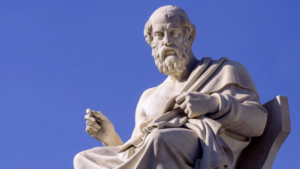
It was January 6, 2026, when the head of the Philosophy Department at Texas A&M University, a public institution, informed Professor Martin Peterson by email that he would have to remove passages from Plato’s Symposium from the syllabus. According to the university’s new regulations—which stipulate that no academic course is permitted to promote ideology related to race or gender, nor to cover topics of sexual orientation or gender identity—this effectively meant the exclusion of part of the work of an ancient Greek philosopher.
As DW writes:
“Who would have expected that two and a half thousand years later Plato’s fantasy would fall victim to censorship? And yet this is exactly what happened at the state-run American university A&M, with its eighty thousand students, in Texas. Philosophy professor Martin Peterson wanted to teach topics of race and gender this semester and included in the course material the relevant passages from Plato’s Symposium. The ever-watchful university administration intervened out of excessive zeal and asked him to ‘defuse’ the topic and eliminate the Platonic passages from the syllabus. Which Professor Peterson did, in order not to share the fate of his colleague in English literature, who was dismissed because she supported in class the existence of more than the two classical genders.”
By presidential decree, as is well known, only two genders are currently recognized in the United States: male and female. The naivety of the censors in this case, of course, lies in the fact that they either did not read, or did not understand, the Platonic text. Because the mythological anecdote told by Aristophanes presents the primordial existence of a third, androgynous gender as a prerequisite for the continuation and consolidation of male and female—the very categories the current American government claims to defend. Is it possible to censor an intellectual relic from the prehistory of one’s own beliefs?
Censoring Plato’s Symposium in the United States
“Long ago,” he says, “there were not only two genders, male and female, but also a third, the androgynous. And humans were not upright as they are today, but stuck together in pairs, like balls—man with man, woman with woman, and man with woman. Each person therefore had four arms, four legs, four ears, and two sets of genitals, with which they reproduced in the earth like cicadas.
Naturally, with so many limbs they were terrifying runners when they ran—they became missiles—and they loved running. But these early champions of acrobatics grew arrogant and began to climb toward the heavens, so the gods became enraged because they could no longer get any sleep from the constant crashing and clattering of the godless creatures. A council was convened, and the hardliners demanded that the insolent mobs be struck down by lightning so that the gods could finally have some peace and quiet.
Wise Zeus, however—always a proponent of realpolitik—considered that if the human race were exterminated, no one would worship the gods anymore, no one would burn incense for them, no one would sacrifice calves. He therefore rejected the extremists’ proposals and decided to operate on humans instead: to weaken them, to split them in two so they would not attempt it again. And so it happened.
This operation also created love, because the now-miserable human beings longed to find their other half again. The miserable men seek their other half and are today’s homosexuals; the miserable women likewise desire their other half and are today’s lesbians. Ultimately, then, the human species survived to this day because of the third gender, the androgynous one, since in that case—which was probably the majority—the miserable men pursued their female half, and the miserable women their male half. In short, order and continuity were ensured through the third gender.
And who claims all this? Certainly not some postmodern inventors of theories about a third gender. It is Aristophanes who claims it, when he takes the floor toward the end of Plato’s Symposium. The great philosopher puts this mythological anecdote into the mouth of the great comic poet, safely so, since Aristophanes had passed away shortly beforehand. With the story of the rolling human balls, Plato wanted to support his own fixation: that, unlike philosophy, art is not capable of convincingly interpreting the world.”
Ask me anything
Explore related questions