

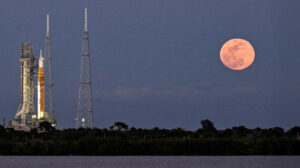
The launch of Artemis II, the mission that will carry astronauts toward the Moon, may be delayed by about a month until the next launch window opens. Even so, it sends a clear message: after decades, NASA is returning to deep-space travel beyond Earth.
Such missions require astronaut-explorers with exceptional physical and mental resilience, capable of enduring dangerous environments and extreme isolation hundreds of thousands of miles from Earth—a distance that will grow to tens of millions of miles when permanent bases are eventually built on Mars.
NASA astronaut Victor Glover, who will serve as the pilot of Artemis II, and his three crewmates will spend 10 days in space on a mission that will take them farther from Earth than any humans have ever traveled. It is a high-risk journey, as Glover explained to the BBC:
“We have a tank of water, and when we drink it, it will run out. We have food, and when we eat it, it will run out. No one will send us supplies.”
Inside the spacecraft—described by Glover as a “tin can”—even simple daily activities become difficult.
“There’s no privacy,” he says. “You go to the bathroom and close the door, but the moment you turn the system on, you wake everyone up. It’s the loudest thing on board, apart from the engine.”
Life for astronauts living at future lunar bases will be even more demanding. They will inhabit a world where nights last two weeks, temperatures are extreme, and radiation levels may be dangerously high.
Who makes a good astronaut?
The role of an astronaut is far from easy, and both NASA and the European Space Agency (ESA) are well aware of that.
“We’re not looking for superhumans in one area,” Sergio Araujo, head of ESA’s space medicine team, told the BBC. “We’re looking for someone who is good in all areas—which is much harder to find.”
In the 1950s, when spaceflight was first being planned, NASA recruited test pilots—exclusively male and in peak physical condition. They underwent weeks of testing, from lung capacity to even sperm quality. They were, essentially, highly competitive alpha males. NASA was searching for the “right stuff”—astronauts with the right mental and physical toughness.
Today, the requirements have evolved. Astronauts no longer need to be in perfect physical condition, but they must meet strict medical standards. Chronic conditions such as asthma or cardiac arrhythmias are disqualifying, as is color blindness, although nearsightedness may be acceptable. An asthma attack in space, for example, could be extremely difficult to treat.
Equally important are psychological resilience and mental skills. Modern astronaut selection has shifted away from individual competitiveness toward people who prioritize team success over personal achievement.
Two people who experienced extreme isolation without being astronauts are Danish architects Sebastian Aristotelis and Carl-Johan Sørensen. In September 2020, they spent 60 days in Greenland, living inside a carbon-fiber prototype of a lunar habitat.
The durable structure, equipped with solar panels and a lighting system that simulated day and night cycles, proved relatively easy for them to adapt to.
As preparations continue for long-term lunar habitation, simulations are increasingly conducted in remote, harsh environments such as Antarctica. From February to November, stations there must be entirely self-sufficient in food, fuel, and medical care.
Crew members must be able to handle constant pressure and stress while continuing to perform effectively. They must also cope with long periods of monotony—months at a base in Antarctica or on the Moon can be intensely boring. For this reason, medical teams recommend activities such as yoga, painting, and even playing with Lego to keep the mind engaged.
Above all, astronauts must be pleasant people—individuals others can live with comfortably for long periods in extreme isolation.
Ask me anything
Explore related questions