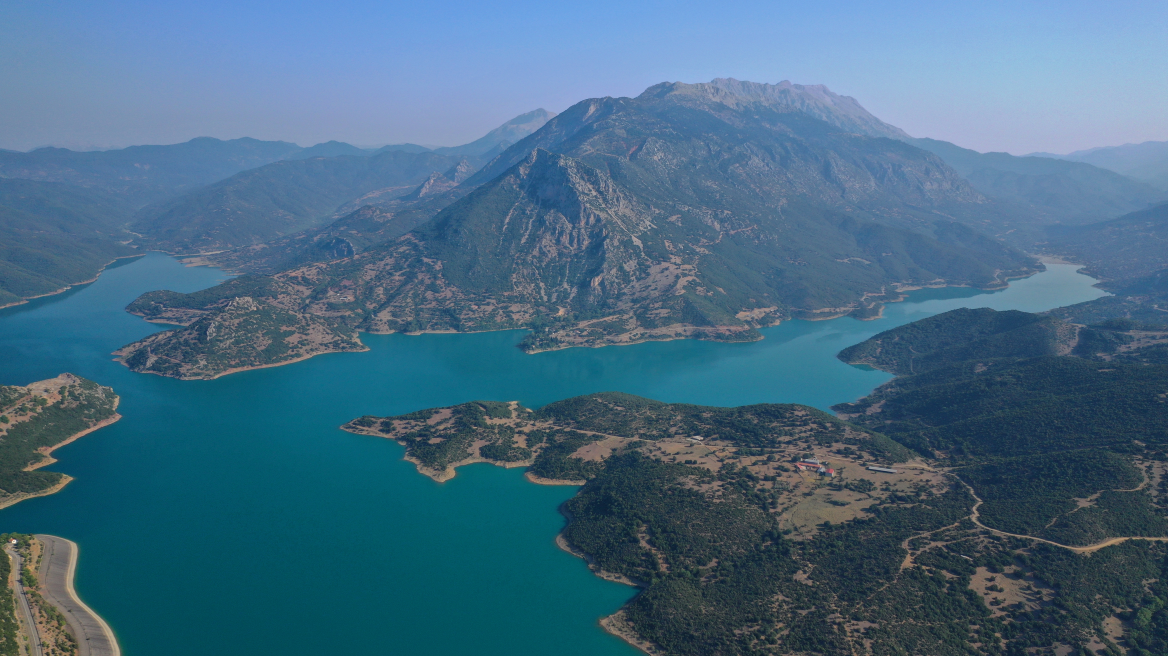
Monitoring the situation at the artificial Lake Mornos, using satellite measurements, meteorological station data and snow cover estimates, is a priority for the METEO unit of the National Observatory of Athens, which for this purpose also operates the Mornos Observatory webpage (www.meteo.gr/mornos).
According to high-resolution satellite data (Sentinel-2) processed by the METEO unit of the National Observatory of Athens, the surface area of Lake Mornos on February 21, 2026 amounts to 13 km², while the February average for the period 2006–2024 is 17.6 km² — meaning it is approximately 26% below the average value.
Despite the recovery due to abundant rainfall recorded in Greece and in the Mornos region, the lake’s surface remains at lower levels.
“We must not become complacent because of the rains”
At the same time, hydrologist Elisavet Feloni stresses that the “wet” year should not lead authorities and society to complacency. As she notes in an interview with the Athens-Macedonian News Agency (ANA-MPA), the particularly increased rainfall in Western Central Greece since autumn has provided significant relief, contributing to a faster replenishment rate of reserves.
“However, this must in no case lead us to complacency. Let me explain: Hydrologically, what we call the ‘persistence phenomenon’ or ‘Hurst phenomenon’ describes the fact that extreme values — such as droughts — tend to cluster over time. During the prolonged drought of 1988–1994, we had in between a ‘good’ hydrological year (1990–91), which nevertheless did not prevent the return of the phenomenon for two more years,” she said.
Below is the interview of the NTUA hydrologist and lecturer at the University of West Attica to ANA-MPA and journalist Giorgos Psyllias.
Q: What do current data show about water reserves in the EYDAP reservoirs? In your view, has the risk of water scarcity for this summer been overcome?
A: As of Friday, February 20, reserves in the four main Attica reservoirs (Mornos, Evinos, Yliki, Marathon) amount to approximately 683.5 million cubic meters. The picture is slightly improved compared to the same period last year, due to this year’s rainfall. The particularly increased rainfall in Western Central Greece since autumn has provided significant relief, contributing to a faster replenishment rate.
Indicatively, in the areas feeding the Mornos–Evinos reservoirs, rainfall in January was locally more than triple that of January 2025, while February records already show levels up to five times higher than last year. This means that for the upcoming summer, no immediate risk to water sufficiency is expected.
However, this should in no case lead to complacency. Hydrologically, the “persistence” or “Hurst” phenomenon describes how extreme events — such as droughts — tend to cluster over time. During the prolonged drought of 1988–1994, there was an intermediate ‘good’ hydrological year, which did not prevent drought conditions from returning for two more years. Integrated management requires continuous monitoring and scenario-based simulations over long-term horizons, such as a decade. Today we are not in a critical situation, but satisfactory rainfall should not lead to apathy or overconsumption. A public awareness strategy to limit consumption should already be in place by mid-spring, regardless of current reservoir levels.
Q: How do you assess rainfall results in the rest of Greece? What about the islands, where the most serious water scarcity problems were recorded?
A: The spatial distribution of rainfall in Greece is traditionally uneven. Western Greece receives significantly higher rainfall due to the Pindus mountain range, which acts as a natural barrier to rain-bearing systems moving eastward. This year, overall, we are experiencing a good hydrological year in mainland Greece. In some cases, there have even been overflow phenomena due to increased reservoir storage and river levels.
However, on most islands, the situation is entirely different. While intense weather events and heavy rainfall may occur occasionally, on a monthly basis total rainfall remains less than a quarter — or even lower — compared to mainland Greece. There, hydrological drought manifests much more intensely. This is due to small drainage basins and limited groundwater storage capacity, which often suffers from over-extraction, intensifying salinization. The islands’ geomorphology, with small basins and proximity to the coastline, makes rainwater only a supplementary resource.
As a result, we observe a growing trend toward reliance on desalination plants. However, these must be integrated into a rational plan that considers energy costs and environmental impact, and not function as fragmented emergency solutions.
Q: What immediate steps should the state take to avoid future concern? Is there a risk that measures will weaken because this winter was relatively good?
A: The state must move definitively from “crisis management” to “risk management.” In Greece, drought periods are often used as communication windows of opportunity to accelerate project assignments that lack long-term planning. Key actions must begin with institutional strengthening and the development of decision-support systems. One such system is currently being developed within a research project coordinated by the Democritus University of Thrace in collaboration with four other partners.
At the same time, strict demand control, reduction of network losses, and — especially in the regions — protection of groundwater are required. Mild winters combined with over-pumping lead to permanent degradation.
As for the risk of measures losing momentum due to this year’s good rainfall, that risk always exists. However, this year’s “breathing space” should be seen as a rare opportunity for structured resilience-building, not complacency.
Water is a social good. The state must implement a comprehensive plan with exemplary transparency and scientific documentation. Resources must not be wasted on spectacular interventions of questionable effectiveness, but on solutions that gradually increase the country’s real resilience.
Q: We have not seen much snow this year either. What has changed? How much does climate change threaten the Mediterranean, and what can governments do?
A: Limited snow cover is indeed a worrying factor often underestimated in public debate. Snow acts as a “natural reservoir,” gradually releasing water in spring. This slow release is critical for maintaining river flows during summer, when evaporation and consumption are high. The absence of snow, combined with projections for a warmer March, affects non-linearly the conversion of rainfall into runoff. In simple terms, even if it rains, less water ultimately reaches reservoirs than expected.
The Mediterranean is internationally recognized as a climate change “hotspot.” Rising temperatures intensify evapotranspiration, meaning that even if rainfall remained stable, available freshwater would decline. The climate crisis increases both the intensity and frequency of prolonged droughts.
What can governments do? They must avoid rushed, showy measures — even if time has been lost in the past. Infrastructure projects must be based on real hydrological data and updated climate scenarios. Above all, water literacy in society must be strengthened so that we all understand that water abundance is no longer guaranteed.
Ask me anything
Explore related questions