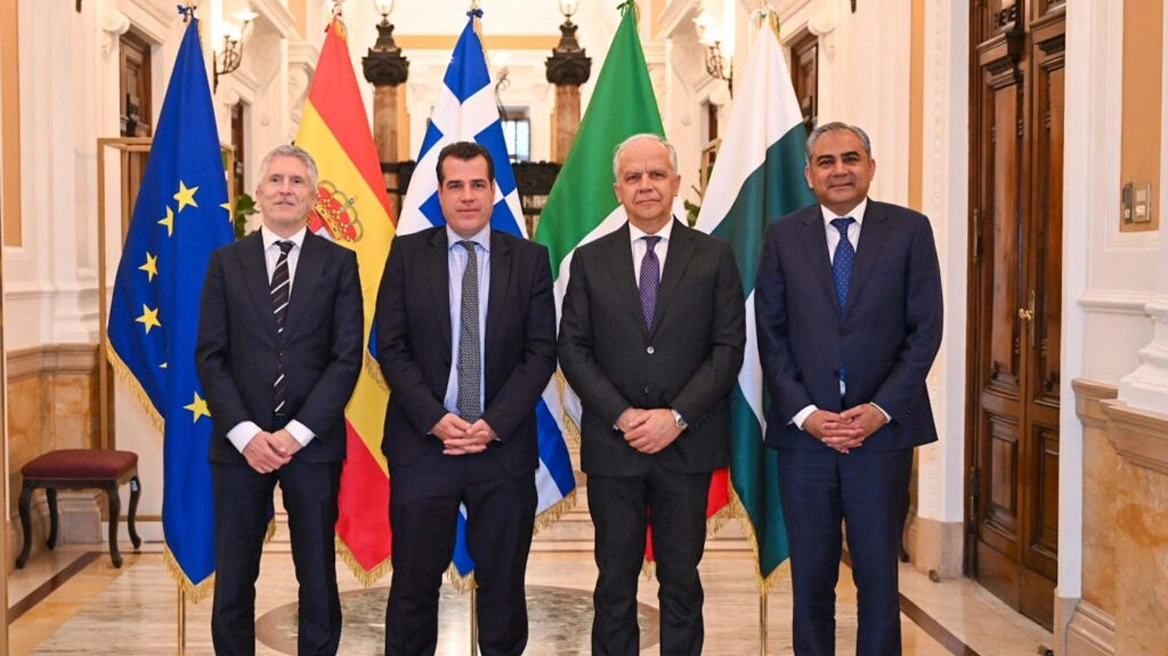
The Minister of Migration and Asylum, Thanos Plevris, participated in a four-party meeting in Rome focused on tackling illegal migration and enhancing cooperation on returns.
In addition to Greece, the meeting included Italy, Spain and Pakistan, and confirmed that the Mediterranean frontline countries will no longer serve as an “easy gateway” to Europe.
“Greece has turned a page”
Mr. Plevris made it clear that Greece has turned a page. “Illegal entry does not lead to legalization. It leads to detention, rejection and return,” he stressed, underlining that tolerance policies now definitively belong to the past.
At the same time, he emphasized that Greece is not opposed to legal migration. As he noted, many Pakistani citizens legally reside and work in the country, covering real needs of the economy. However, the message is clear: those who choose the illegal route will not be rewarded. Under the new, stricter framework, illegal entry entails administrative detention, while the final rejection of an asylum application carries prison sentences and heavy financial fines.
“Smuggling networks must be dealt with ruthlessly”
Mr. Plevris also highlighted the need for an uncompromising crackdown on smuggling networks. “Smugglers are criminals who profit from human desperation. Greece has declared war on them,” he said, recalling that the current legal framework even provides for life imprisonment.
The recent deadly shipwreck off Chios, where a smuggler allegedly endangered lives in order to escape, demonstrates the true face of these networks, the minister noted.
Cooperation with countries of origin is of key importance for the effective implementation of migration policy. In this context, the minister thanked his Pakistani counterpart for the cooperation developed in terms of identification and the issuance of travel documents, stressing that the return of those not entitled to international protection must be carried out immediately and without bureaucratic delays.
Mr. Plevris also emphasized that deterrence begins with information. “It must become clear in the societies of countries of origin that the narrative of easy legalization has collapsed. Anyone who pays smugglers to enter Greece illegally risks their life and will ultimately be returned,” he stated.
Strengthening information exchange
The participating countries agreed to strengthen information exchange on smuggling networks, enhance operational cooperation and promote legal and controlled mobility channels that respond to the real needs of their economies.
The distinction between legal and illegal migration, it was stressed, is a non-negotiable prerequisite for a credible and functional system.
In closing, the Minister underlined that Greece defends its borders, enforces its laws and does not allow the instrumentalization of human suffering. “Europe cannot function as an open field without rules. It is a union of rules – and the rules apply to everyone,” he declared.
The Deputy Minister of Migration and Asylum, Sevi Voloudaki, stated that Greece implements a strict migration policy in full respect of international law. She emphasized that effective border protection and fast asylum procedures strengthen the credibility of both the country and Europe. “We support legal mobility that meets real needs, but we do not allow the illegal exploitation of people by smuggling networks,” she said, highlighting that cooperation with countries of origin is crucial for sustainable solutions.
Bilateral meeting with the Pakistani minister
On the sidelines of the four-party meeting, a bilateral meeting was also held with the Pakistani minister. During it, the Greek minister informed his counterpart that procedures have already begun to reassess recognized refugees of Pakistani origin residing in Greece, as well as to revoke asylum statuses granted in the past where the legal conditions for doing so are met. It was stressed that strict implementation of the existing legal framework is a prerequisite for safeguarding the credibility of the system.
Greece is already recording reduced migration flows, as in 2025 there were fewer than 1,000 illegal arrivals from Pakistan and increased returns of Pakistani nationals (more than 600), reflecting the effectiveness of the new strategy of the Ministry of Migration and Asylum.
It is noted that today’s four-party meeting forms part of a broader series of contacts with ministers from countries of origin of migration flows toward the European Union’s frontline reception states, with the aim of strengthening cooperation at all levels and more effectively addressing illegal migration while increasing returns.
Ask me anything
Explore related questions