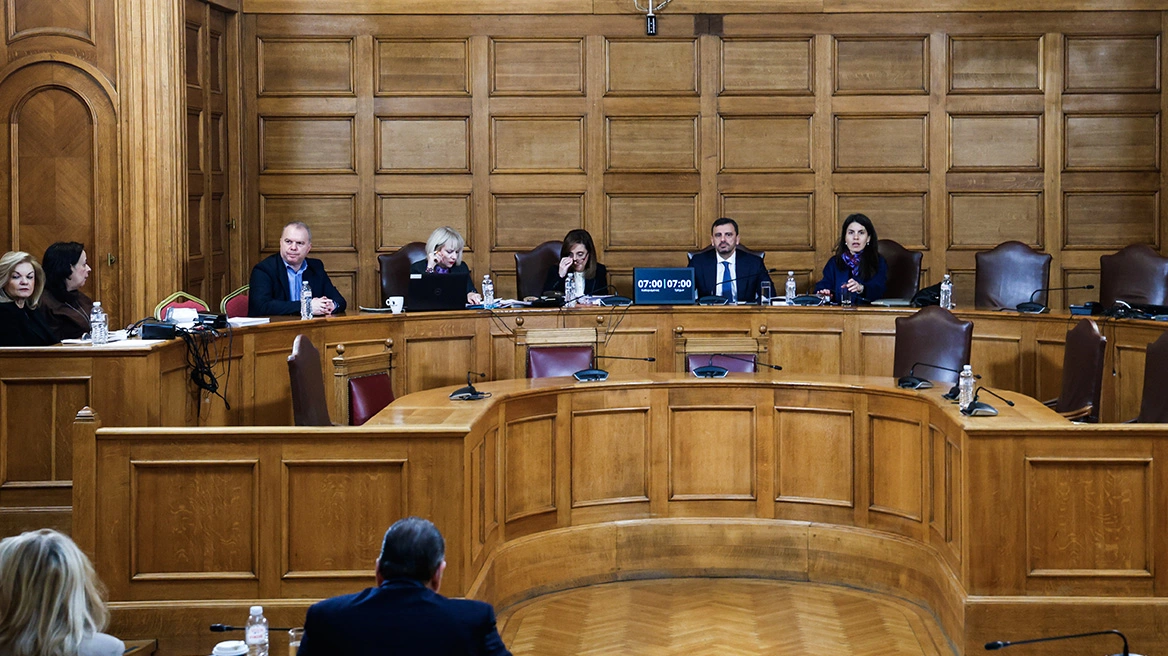
The majority and opposition conclusions submitted to the chair of the investigative committee on OPEKEPE are moving in opposite directions.
It is recalled that the investigative committee was established last September and, over five months, held 50 sessions totaling 350 hours, during which 76 witnesses were examined, 55 of whom had served during the New Democracy administration.
ND: Long-standing political responsibilities
According to information, the majority reiterates in its report that choosing an investigative committee instead of a preliminary criminal inquiry proved “institutionally” more appropriate, arguing that “From the testimony of key witnesses, such as former Minister of Rural Development and Food, Mr. St. Arachovitis, as well as Ms. P. Tycheropoulou, no criminal liabilities emerged for former Ministers Makis Voridis and Lefteris Avgenakis.”
In conclusion, ND MPs note that:
- The problems identified within the Organization are not circumstantial, but long-standing and cross-party.
- The period of SYRIZA’s governance is linked to serious responsibilities regarding the proper implementation of the so-called “technical solution.”
- Phenomena suggestive of clientelist practices were highlighted, including individuals connected to PASOK – Movement for Change and its president, Mr. Nikos Androulakis, such as his close associates from Crete.
More specifically, they argue that investigations did not identify criminal liabilities for ministers:
“It was proven that Mr. Voridis never intervened in the conduct of audits, nor did he seek to become involved in audits or the unblocking of specific tax identification numbers (AFM). Furthermore, the implementation of the technical solution, given the situation that had developed up to 2019, was a one-way path for any subsequent government. This was because grazing management plans and a series of other administrative acts that would have led to the implementation of any other solution had not progressed.
Similarly, in the case of Mr. Avgenakis, the combination of evidence shows that the specific legal elements of aiding or instigating breach of trust cannot be established. The acts attributed to him are based solely on telephone communications of third parties and not on any action or other evidence of his own. His urging the competent authorities to complete audits, unblock and pay only those AFMs meeting legal requirements, maintain the blocking of those that did not, and refer the latter to the judiciary does not constitute a criminally prosecutable act but an action fully aligned with his duty of administrative supervision.”
Finally, the authors of the majority report stress the government’s commitment to reforming the primary sector “so that support is directed exclusively to honest and genuine beneficiaries — farmers, livestock breeders, fishers and beekeepers — protecting both producers and the public interest.”
On the other hand, PASOK as well as SYRIZA and New Left speak of a “blue scandal” and reiterate the need for a preliminary criminal investigation into possible liabilities of former ministers M. Voridis and L. Avgenakis.
PASOK: An organized scheme by ND
PASOK assigns responsibility to ND, arguing that it turned the committee’s proceedings into an “organized scheme” to cover up the case. At the same time, however, the report drafted by its MPs states that “From the totality of the factual circumstances arising both from the criminal case file transmitted to Parliament by the European Public Prosecutor’s Office and from the evidence presented to the Investigative Committee, serious and converging indications emerge that during the period 2019–2024 an organized mechanism for the illegal appropriation of EU funds was formed and operated, funds paid within the framework of the Common Agricultural Policy to Greek farmers and livestock breeders.”
According to the report’s authors, “The facts do not constitute a simple administrative malfunction or a ‘long-standing pathology.’ They form a coherent and recurring pattern of actions and omissions: allocations and payments without real productive activity, weakening of controls, interventions for unblocking payments, and targeting those who attempted to enforce legality. In this light, the findings of the case file and evidentiary process require evaluation of responsibilities, especially regarding persons who had institutional authority to supervise and direct the Organization.” They reiterate the need for a preliminary investigation into possible criminal liability of former Ministers of Rural Development M. Voridis and L. Avgenakis.
SYRIZA – New Left: Political responsibility for the government, criminal for Voridis – Avgenakis
In a joint report, SYRIZA and New Left MPs who participated in the committee assign political responsibility to the government and criminal responsibility to former Ministers of Rural Development Makis Voridis and Lefteris Avgenakis.
Among other conclusions, the report states: “The OPEKEPE scandal is entirely ‘blue’ and orchestrated by the Prime Minister’s Office. Political responsibility for the OPEKEPE scandal exists and clearly bears the stamp of Mr. Mitsotakis himself. Beyond political responsibility, there are indications of possible criminal liability for persons who served as members of the Government. For this reason, SYRIZA-PS and New Left insist on the need for a preliminary examination.”
According to the authors, “The OPEKEPE scandal is not a simple administrative error. It is a deeply political matter, with a clear imprint of power and responsibility extending beyond individual persons and concerning the entire governing period of New Democracy. What is revealed is a system of artificially creating ‘eligibility,’ bypassing controls, and distributing EU subsidies to fictitious or ineligible recipients, with potential damages of hundreds of millions of euros to the financial interests of the European Union and genuine farmers. The testimonies, lawful wiretaps and the transmission by the European Public Prosecutor’s Office do not describe an isolated deviation. They describe a systematic practice with administrative continuity and political tolerance. Public land appears to have been used as a mechanism for allocating subsidies, control mechanisms were weakened, and warnings did not lead to institutional safeguards.”
At the same time, SYRIZA and New Left also attribute political responsibility to Voridis and Avgenakis, stating:
“Makis Voridis, during his tenure, did not ensure substantive supervision, did not impose effective controls and — according to the evidence — did not halt a system that created artificial conditions for receiving subsidies.
Lefteris Avgenakis, instead of proceeding with reform, is alleged to have maintained a framework of administrative instability, with pressure to unblock frozen AFMs and make payments while audits were pending.
However, in a governance model that describes itself as a ‘Centralized Executive State,’ responsibility does not stop with the ministers. The concentration of powers and central control by the Prime Minister’s Office also mean concentrated political responsibility. Kyriakos Mitsotakis himself has politically invested in the narrative of absolute central supervision and close coordination.”
Beyond political responsibilities, they reiterate the request for the establishment of a Preliminary Investigation Committee for the two former ministers for:
(i) complicity in abuse against the financial interests of the European Union, and
(ii) moral instigation of abuse against the financial interests of the European Union,
which under national law are classified and punished as:
(a) Complicity in felony breach of trust against the financial interests of the EU, committed jointly and repeatedly, with damage exceeding €120,000 (Article 390 paragraphs 1 and 2 in conjunction with Article 47 of the Penal Code).
(b) Moral instigation of felony breach of trust against the financial interests of the EU, committed jointly and repeatedly, with damage exceeding €120,000 (Article 390 paragraphs 1 and 2 in conjunction with Article 46 paragraph 1 of the Penal Code), as well as any other offense that may arise during the preliminary examination.
It should be noted that the investigative committee will hold its final session next Thursday, February 26, 2026, in order to discuss the reports and formally confirm the inability to submit a joint text to the Presidium of Parliament.
Ask me anything
Explore related questions