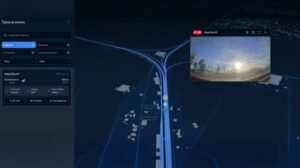
Railway.gov.gr, the new unified digital platform for overseeing the national railway network, goes live today. Greece becomes the first country to combine high-precision satellite technologies for the continuous tracking and monitoring of trains on a nationwide scale, introducing a new model of digital railway supervision.
For the first time, there is a live, public, and continuous real-time view of train traffic, initially applied on the central Athens–Thessaloniki axis.
As announced today, Wednesday, by the Deputy Minister of Infrastructure and Transport, Konstantinos Kyranakis, during a briefing with journalists, citizens can now access live monitoring of passenger trains operating on the Athens–Thessaloniki route, with gradual expansion over the next two months to cover the entire network.
By the end of March 2026, all trains operating on the axis from Piraeus to the country’s northern borders will be equipped with the satellite tracking system. By the end of April 2026, the system will be installed on all trains running across the Greek railway network.
Greek pioneering role in satellite-based railway supervision
Railway.gov.gr is a Greek technological innovation in the transport sector.
Each trainset is equipped with a high-precision satellite positioning system, leveraging the HEPOS and the European Galileo system.
This technology enables:
- position determination with centimeter-level accuracy,
- operational distinction between parallel tracks,
- continuous data transmission with latency of less than 1.2 seconds.
Unlike conventional GPS, which can deviate by up to 15 meters, Railway.gov.gr provides track-level accuracy measured in centimeters.
The system does not rely solely on satellite positioning. It combines:
- a digitally mapped model of the railway network,
- track-matching algorithms (map matching),
ensuring precise identification of which track each train is running on—even in tunnels or areas with limited signal.
Adoption of safety recommendations following the Tempi disaster
According to the Ministry’s announcement, the operation of Railway.gov.gr also marks the substantial adoption of seven out of the seventeen total safety recommendations issued in the report of the National Aviation and Railway Safety Investigation Authority following the Tempi rail disaster, concerning the operation and supervision of the Greek railway system.
Through Railway.gov.gr:
- availability of recorded operational data is maximized,
- continuous monitoring of safety-related performance becomes possible,
- real-time risk understanding and management are enhanced,
- a documented basis for incident analysis and operational conclusions is created,
- supervisory capacity of the infrastructure manager and competent authorities is upgraded.
The platform embeds key recommendations of the report into the operational oversight mechanism, establishing a model of continuous digital monitoring and evidence-based safety grounded in real data.
Transparency for citizens – train routes and live video streaming
Through Railway.gov.gr, every citizen can view:
- the live position of trains on a map,
- their speed and direction,
- estimated arrival times,
- delay notifications,
- an overall picture of traffic.
Additionally, via live video streaming from an onboard camera, citizens can watch the train’s journey in real time.
An additional safety layer
Railway.gov.gr is not only an information tool. It integrates capabilities for:
- automatic collision-risk detection,
- immediate alerts,
- monitoring of critical points and incidents.
In the event of deviation or emergency, alert protocols are activated toward control centers.
“New Infrastructure – New Trains – New Stations”: restarting the Greek railway
Railway.gov.gr is one of the key pillars of the overall restart of the Greek railway system.
On infrastructure, full restoration and upgrade of the Athens–Thessaloniki axis is underway, so that by summer 2026 the line will feature 100% signaling, 100% remote control, and 100% ETCS. At the same time, ETCS onboard installation has been completed on 100 trains.
Regarding rolling stock, after 20 years without procurement of new trainsets, a €308 million investment is being implemented through a revised agreement with the Italian group Ferrovie dello Stato, with 23 brand-new trains to be delivered gradually by 2027 under strict clauses in favor of the Greek State. A test train is already in the country and conducting trial runs.
At the institutional and organizational level, a new unified Hellenic Railways Organisation was created, fragmentation of responsibilities was abolished, the organization’s budget increased, and a new operational framework was established under Law 5220/2025, including stricter penalties for serious errors, strengthened regulatory and investigative authorities, new staffing and training models with modern simulators, psychometric testing in cooperation with the Hellenic Armed Forces General Staff, and international partnerships.
Railway.gov.gr complements this reform as the central digital oversight tool. Together with the full activation of safety systems, institutional restructuring, and fleet renewal, the railway moves definitively from fragmented management to a unified, technologically substantiated, and measurable operational model.
Statements
Deputy Minister of Infrastructure and Transport Konstantinos Kyranakis stated:
“From today, the Greek railway enters a new era of digital recording and supervision. As we committed from the first moment we assumed our duties at the Ministry of Transport, we created Railway.gov.gr and, for the first time, provide a live, public, and accurate picture of train traffic.
For the first time, citizens gain real visibility into network operations. A parent can watch in real time the train their child is traveling on and know exactly where it is at every moment.
The system is based on high-precision technology with centimeter-level positioning and continuous data transmission. It does not replace existing safety systems—it strengthens them. It is an additional safety layer, a digital safety net operating continuously in real time.
Railway.gov.gr is not merely an information application. At the Hellenic Railways Organisation Control Center, a dedicated team now continuously monitors automated system alerts, intervening immediately when traffic rule violations are detected.
Our goal is clear: trains must never collide again on the Greek railway. With Railway.gov.gr, the era of ‘blank spots’ ends, and we move decisively from uncertainty to transparency, accountability, and evidence-based safety.”
From his side, the Secretary General for Transport, Stelios Sakaretsios, stated:
“With Railway.gov.gr, Greece becomes the first country to deploy high-precision satellite technologies on a national scale for operational railway supervision. This is not a simple digital application; it is a new operational infrastructure, where every train is monitored in real time, with centimeter-level accuracy and certainty as to the track it is running on.
Today we activate the first version of the system, covering all passenger services on the Athens–Thessaloniki axis. At the same time, installation of the necessary equipment is progressing across all 140 locomotives operating on the national network, ensuring full visibility over 2,000 kilometers of railway line.
Railway.gov.gr is the core of the new digital Hellenic Railways Organisation—an integrated information system where safety-critical processes are digitally recorded and operational performance is captured in real time with measurable criteria.
The railway is definitively entering the era of documented oversight and continuous digital monitoring.”
Ask me anything
Explore related questions