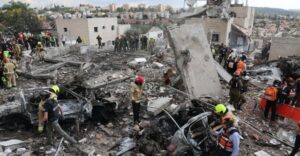
An Iranian missile struck Beit Shemesh in Israel, destroying a synagogue and causing deaths inside a bomb shelter. At least nine people were killed and 40 injured in the attack, which bypassed Israel’s multilayered air defense system. Residents and officials said the area was purely residential, with no military installations, and expressed bewilderment at the reason for the attack.
Israel’s Minister of Culture, Amichai Eliyahu, visited the site and emphasized the need to continue the fight against Iran. The incident serves as a reminder that no air defense system is foolproof, despite Israel’s significant investments. One image, which many in Israel say will remain etched in memory: a corner of Beit Shemesh flattened by an Iranian missile, a destroyed synagogue, people dead while seeking refuge in a bomb shelter.
At the site of the attack, residents repeatedly emphasized that this is a purely residential area, with no military facilities, weapon systems, or government buildings. “Why was this place a target? There is no justification,” one onlooker stated.
When rescue teams and journalists arrived, they witnessed scenes of chaos. Dozens of residents had rushed to the shelter following mobile alerts and the activation of the air-raid siren.
For many Israelis, such a response is now almost automatic, a result of previous conflicts, including the 12-day war eight months ago.
The shelter, considered the safest point, turned into a death trap within seconds. At least nine people were killed and 40 injured. The missile successfully penetrated Israel’s multilayered air defense system.
“Nothing is 100% effective,” said an Israeli military official. “We can’t stop every missile. We try, but we know that eventually one will get through.”
That is exactly what happened in Beit Shemesh. Heavy machinery arrived to clear debris while search and rescue teams looked for survivors. Soldiers, rescuers, police, residents, and politicians were present at the scene.
Among them was Israel’s Minister of Culture, Amichai Eliyahu, who, seeing the destruction, said the strike demonstrated the need to continue the fight against Iran. “What did these people do to make them a target? What did these children do to deserve harm?” he asked, adding that, in his view, there was no reason for the attack.
From the rescue teams’ perspective, Lieutenant Colonel Yochay Manoff, commander of a battalion of Israel’s National Rescue Unit, emphasized the severity of the strike: “This is a single missile that hit and affected so many buildings and lives. Imagine the number of missiles launched from Iran toward Israel in the past two days. The potential damage could be enormous.”
Despite the high number of missiles, most attacks have been intercepted by Israel’s air defense systems, in which the country invests heavily. Citizens’ trust in this technology is high; however, the strike in Beit Shemesh serves as a reminder that no system is completely infallible.
Every so often, a missile manages to penetrate the defensive grid protecting Israeli airspace.
When that happens, the consequences can be devastating. The destruction in this Beit Shemesh neighborhood is, according to those present, a stark reminder of this reality.
Ask me anything
Explore related questions