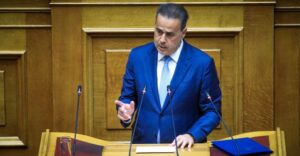
Stavros Papastavrou outlined in Parliament the government’s plan to transform Greece from a key energy hub into a producer of natural gas, while presenting hydrocarbon contracts with Chevron.
The Minister of Energy and Environment said that “Greece is making a leap: from being an energy hub it is laying the foundations, through agreements with Chevron and ExxonMobil, for natural gas production.” He noted that this prospect cannot be taken for granted, as it depends on whether the deposits prove to be commercially exploitable.
“At the same time, it cannot be underestimated. Becoming a reliable energy hub was not an obvious development. The government invested in this through infrastructure. That infrastructure allowed us to turn our geographic position into a geopolitical advantage. Our country became a major entry gateway for American liquefied natural gas, and now we aim to become a producer of natural gas,” he said.
First exploratory drilling within 12 months
Papastavrou also committed to accelerating procedures so that the first exploratory drilling in the Ionian Sea can take place within 12 months, in early 2027 — the first such drilling in the area in about 50 years.
He described this as a national success built on efforts that began with former energy minister Giannis Maniatis and continued under previous governments, including that of George Papandreou and later the administration led by Antonis Samaras and Evangelos Venizelos, which launched relevant tenders in 2014.
“This process could lead to production if the deposits prove commercially viable. No one says we will become Norway or Qatar, but it is the wealth of our country and we must explore whether it can be utilized,” he added.
Response to criticism over the Chevron clause
The minister also addressed criticism from former prime minister Antonis Samaras regarding a clause added to the agreement with Chevron that, according to critics, could question Greece’s sovereign rights.
Papastavrou responded that a private agreement cannot transfer sovereignty, stressing that the contractual provision merely reflects standard legal practice for managing potential liabilities in extreme scenarios. He clarified that it does not constitute recognition or acceptance of any such scenarios.
The issue had earlier been raised in Parliament by Fragkiskos Parasyris of PASOK, who questioned why previous contracts approved by Parliament did not contain such a clause and asked whether its inclusion was a government decision or a requirement from the company.
Ask me anything
Explore related questions