





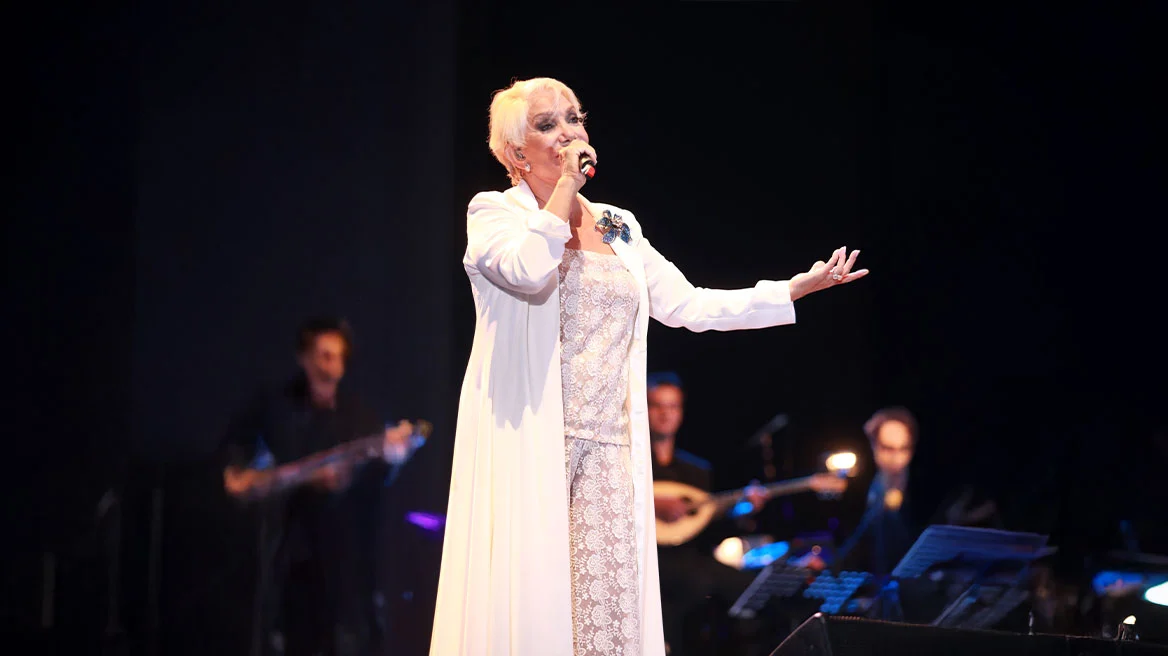
The mythical leading figure of traveling theater troupes who loved the stage as much as it loved her, the crystal-clear voice that even enchanted Frank Sinatra, the untamed companion of Kazantzidis and Voskopoulos, the muse of countless Greeks who even tattooed her image, the great name that wrote golden history in post-dictatorship Greece, was a woman who never forgot that she started from nothing—from the poor neighborhoods of Thessaloniki—and managed to conquer the world with one powerful weapon: her voice.
She was also the only one who, until her death, remained consistently at the forefront and never left the stage, because people loved her more than anyone, calling her by her name: Marinella. After all, she was their Marinella—the performer of everyone, beyond origins and identities, from the prime minister to the simplest citizen.
Her name inspired countless novels, as well as the concise biography written by Giannis Xanthoulis titled “Marinella, The Nights That Became Afternoons” published by Dioptra.
The beloved author and the famous performer shared countless moments as friends—especially afternoons, which inspired the book’s title—discussing over home-cooked dishes like vegetables or lentils prepared by the author, accompanied by glasses of fine wine, exchanging memories and mutual confessions.
There could therefore be no better confidant for the famous singer to narrate her life than Giannis Xanthoulis, a true connoisseur of past eras, who knew her closely through collaborations such as “Then Came the Bees”, meeting her in various corners of their favorite venues in Athens or Thessaloniki, in incomparable snapshots of Greek history. “It is truly a strange feeling to enclose your life in a book.”
The protagonist of endless successes and historic appearances, Marinella’s untamed figure—always armed with inexhaustible energy and drive—is directly linked to major events and the reverse history of Greece. From legendary figures—Theodorakis, Koundouros, Elli Pappa, Aliki Vougiouklaki—with whom she developed friendships, to top leaders like Konstantinos Karamanlis, who honored her with his presence, and powerful figures like Onassis, to whom she had refused to sing at Skorpios at his wedding to Jackie Kennedy, boldly telling him: “that day was her day off.”
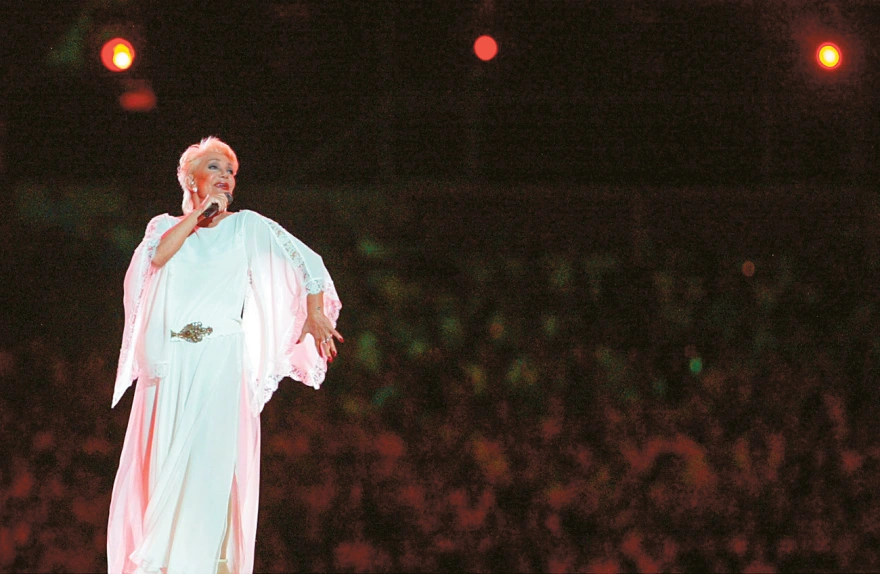
She did not refuse the invitation of the Shah of Persia—known for his unmatched extravagance—to host her in Iran and let her live her own fairy tale, like something out of One Thousand and One Nights, just a few years before the country fell under the rule of the mujahideen and Khomeini.
Among the personalities who honored her in every way was the great actress Ingrid Bergman, who sent her a thank-you letter and photographs, referring to that unforgettable evening.
Having moved beyond the first phase of her career as a second voice alongside Kazantzidis, Marinella quickly evolved into an uncompromising performer and a personality who lived everything “My Way,” as the song of another admirer of hers said. She never gave up—even when she found herself touring without money and ill with pneumonia in Soviet Russia, shortly after separating from Kazantzidis and falling out of favor, or during the early post-war years when she had to improvise to survive with her family, whom she always took care of.
In general, she never forgot the people who helped her: in her conversations with Xanthoulis, she constantly mentions Katsaros, who supported her in difficult times, as well as her former partners, such as the aristocratic equestrian champion Freddy Serpieri, with whom she had her daughter Georgina, and the man who taught her to be the aristocratic diva of the stage—who stylistically and emotionally liberated her, taking care of her every move and desire—and whom she wished to remain anonymous.
The early years: from poor Thessaloniki to traveling troupes
Like lightning. She was born in Thessaloniki in 1938, on the eve of great bloodshed. A childhood amid wounds she did not fully understand, amid poverty—sometimes festive, sometimes unbearably bitter—and yet… so many “and yets.” Her whole life was an “and yet.” And yet she survived on those dirt roads that turned to mud at the first drizzle. Roads of a postwar city, with Saint Demetrius as a comforting shadow over survivors, haunted by the absence of the Jews that still weighed on the “bride of Thermaikos,” as the city proudly called itself. And, of course, a poor mother-city.
A long-lasting poor mother, as she later sang: “My Thessaloniki, great poor mother, you who raise the best children,” writes Xanthoulis poetically in the introduction, setting the scene where Kiki Papadopoulou grew up—the youngest of a large family—with her honest fisherman father Giorgos Papadopoulos doing everything to provide for them during those difficult years.
He accepted food from a German SS officer during the occupation in exchange for fresh fish, but refused a valuable “gift” of medicine, throwing it into the sea.
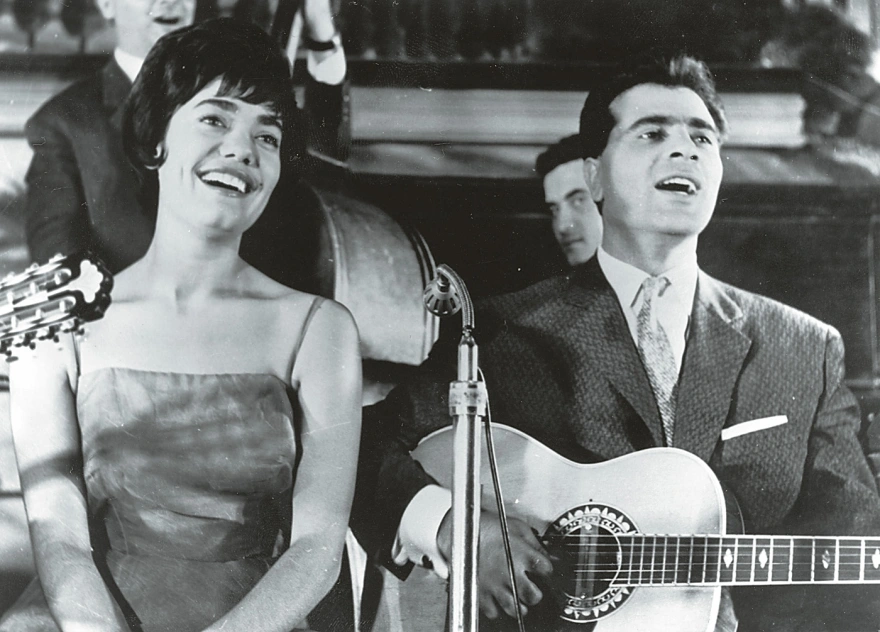
He was also the one who did not object to his daughter pursuing her childhood dreams, granting her a rare freedom for girls at the time—and perhaps it is no coincidence that she never got over his death.
It was also her father who hid Jewish girls in the basement from Nazi persecution. He encouraged the talented young girl to pursue her dreams when she began in children’s theater—like a little Thessalonian Shirley Temple—passing one audition after another, even with Alkis Steas himself.
As she grew older, she followed the path of artists of the time, touring the Greek countryside with traveling troupes. Xanthoulis vividly describes these groups, who performed under harsh conditions, fainting on stage from hunger, bathing outdoors, and sleeping wherever they could.
As for the name “Marinella,” she said it came from a gypsy song when she was searching for a stage name to replace the very common “Kiki Papadopoulou,” while singing at a countryside venue in Panorama, Thessaloniki.
Soon, however, the singer with the imposing name “Marinella” would play a crucial role both professionally and personally alongside Kazantzidis, who courted her by asking her to go out to sea in her father’s boat.
The fateful marriage to Kazantzidis
Her relationship with Kazantzidis was never easy, as she herself admitted in conversations with Xanthoulis, while trying to protect the reputation of the unforgettable composer and downplaying difficult moments stemming from his intense jealousy and difficult character.
Even her conflicts with her mother-in-law, Gesthimani—who only accepted her shortly before her death—are not described in full detail, as much is left unsaid.
Despite not being a strong supporter of marriage, circumstances led her to marry. The early years with Kazantzidis were extremely difficult, living with her mother-in-law and later in a questionable hotel near Larissa Station. Arguments and separations were frequent, as were reconciliations.
Meanwhile, their songs were hugely successful, with magazines like Domino publishing emotional reports on their “historic” reunions.
Though Kazantzidis dominated the spotlight, Marinella saw her name appear on her first record, the popular song “I am your first love.”
Performing conditions were often chaotic, resembling a “Western,” with violent incidents involving knives and injuries from broken plates.
After a near-fatal incident, Kazantzidis decided to retire early. They married on May 7, 1964.
Friendships with major figures of the era
Marinella recounts their friendships with major cultural figures such as Manolis Hiotis, Mary Linda, Mikis Theodorakis, Irene Papas, and others. Gatherings at Papas’ home included poets and filmmakers like Yiannis Ritsos, Tassos Livaditis, and Michael Cacoyannis.
“These were unforgettable nights,” she said, describing them as a true education compared to the nightlife scene.
The Marinella era
Her separation from Kazantzidis ultimately transformed her into a leading solo artist and dominant figure in nightlife. After a difficult period, she rose to fame in cinema and music, notably with the song “Petra”.
She revolutionized stage presence, introducing a more dynamic, confident style inspired by international performances.
She brought a cosmopolitan flair to Greek nightlife, replacing older, rougher traditions with professionalism and elegance.
A great love helped transform her image, leading her to adopt high fashion and refined style. Even Frank Sinatra reportedly said that if she pursued an international career, she would become globally famous within two weeks.
This independence allowed her to demand better pay and conditions, becoming a pioneer for performers. She had a child out of wedlock—unthinkable at the time—and continued performing late into her pregnancy.
She collaborated with top artists like Giorgos Dalaras and established large entertainment venues such as Neraida and Stork.
Her successes continued, including her high-profile marriage to Tolis Voskopoulos in 1973, shortly before the Polytechnic uprising. A year later, she represented Greece at Eurovision with “Wine, Sea and My Boy,” finishing 11th.
She married Voskopoulos wearing jeans!
She described the chaotic wedding, surrounded by crowds and media, eventually taking place at home in jeans due to the overwhelming turnout.
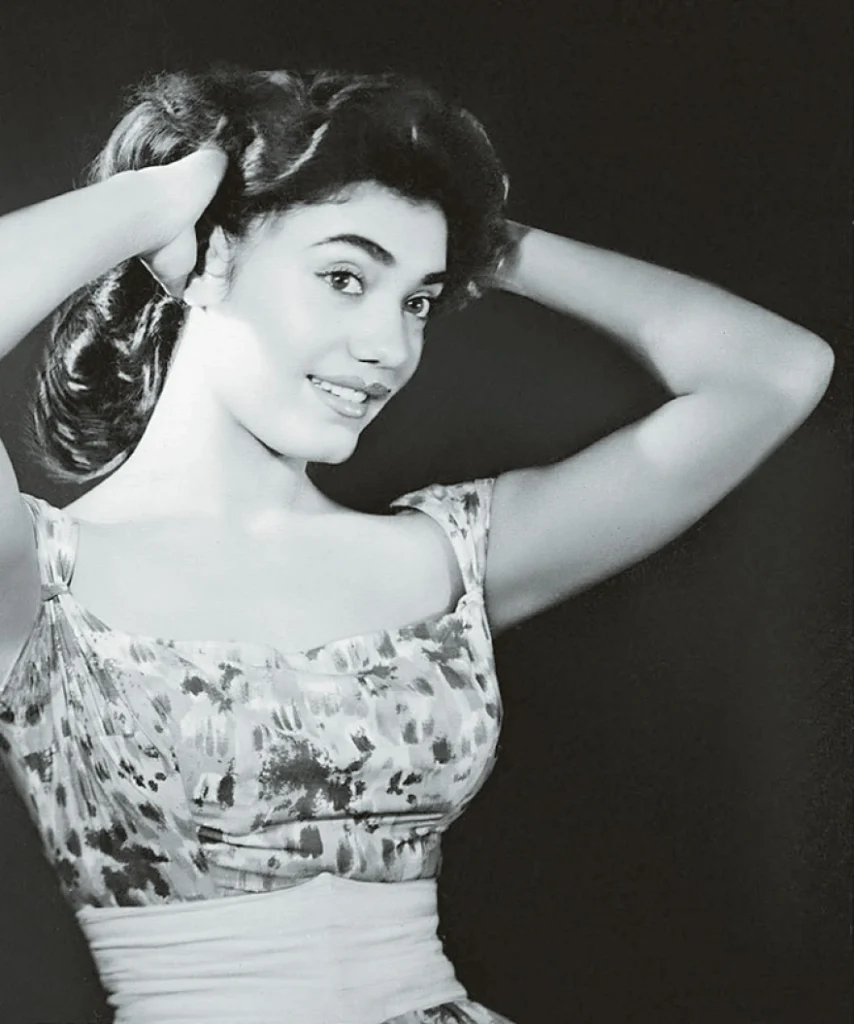
The continuation
Her divorce from Voskopoulos did not diminish her career but freed her from a restrictive institution.
She never left the spotlight, continuing to dominate every stage she appeared on—essentially setting a Greek record for longevity.
As she said:
“I have been singing for over sixty years, but I never felt that I completed my cycle or said ‘enough.’ When I decide, it will be the quietest departure possible.”
Otherwise, she wouldn’t be Marinella.
Ask me anything
Explore related questions




