





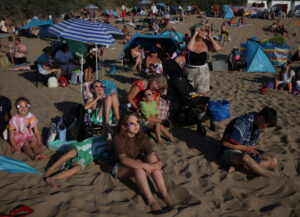
Despite warnings not to look directly at the sun without special glasses, searches for the phrase “my eyes hurt” spiked sharply after the phenomenon of the total solar eclipse yesterday, August 12.
Experts have voiced concern over a sudden surge in Google searches for eye pain following the solar eclipse, as thousands of people appear to have looked at the sun without the necessary protection.
According to the Mirror, despite warnings against observing the sun directly without special glasses, searches for the phrase “my eyes hurt” rose sharply after the event, with doctors warning that even a few seconds of exposure can damage the retina.
In Britain, related searches rose by 1,500% on Thursday evening compared with the previous day, while in Spain, where the solar eclipse was total and the sky darkened for several minutes, searches for the equivalent Spanish phrase, “me duelen los ojos”, jumped by 5,000%.
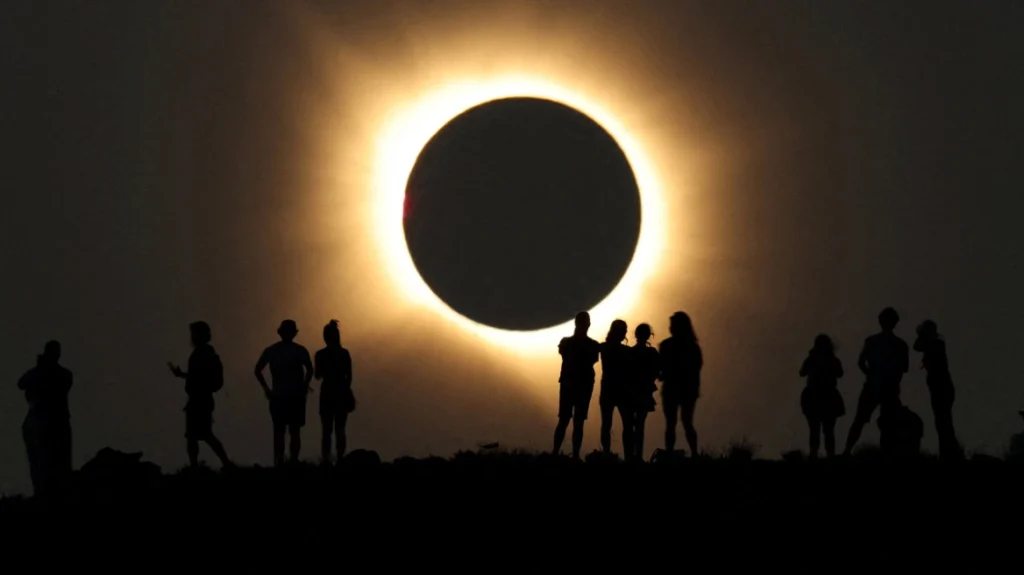
Panicked posts on social media
Following the eclipse, several social media users reported eyesight problems like eye pain, headaches and blurred vision, admitting they had looked directly at the sun.
One user wrote that they had looked at it for what felt like just a second, and that their eyes were now hurting.
Another said they had developed a headache after watching the eclipse, while a third wrote that they had looked straight at the solar eclipse and genuinely felt they had damaged their eyes, adding that their head was aching badly and their vision was blurred.
In a similar post on TikTok, one user said they had looked at it, that their eyes were killing them, that it was a feeling they had never experienced before, and that they thought they might go blind.
What is solar retinopathy
Experts warn that looking directly at the sun can cause what is known as solar retinopathy.
Alex Ionides, an ophthalmologist at Moorfields Eye Hospital in London, explained that it is a serious misconception to think it is safe to look at the sun during a partial eclipse.
As he noted, even during an eclipse the sun remains bright enough to damage the eye’s sensitive tissue.
The retina is the light-sensitive layer at the back of the eye that makes vision possible. Intense sunlight and ultraviolet radiation can damage its cells, causing solar retinopathy.
What makes this particularly dangerous is that the damage can occur even after brief exposure and is not necessarily accompanied by immediate pain. As a result, someone may not realise there is a problem until several hours later.
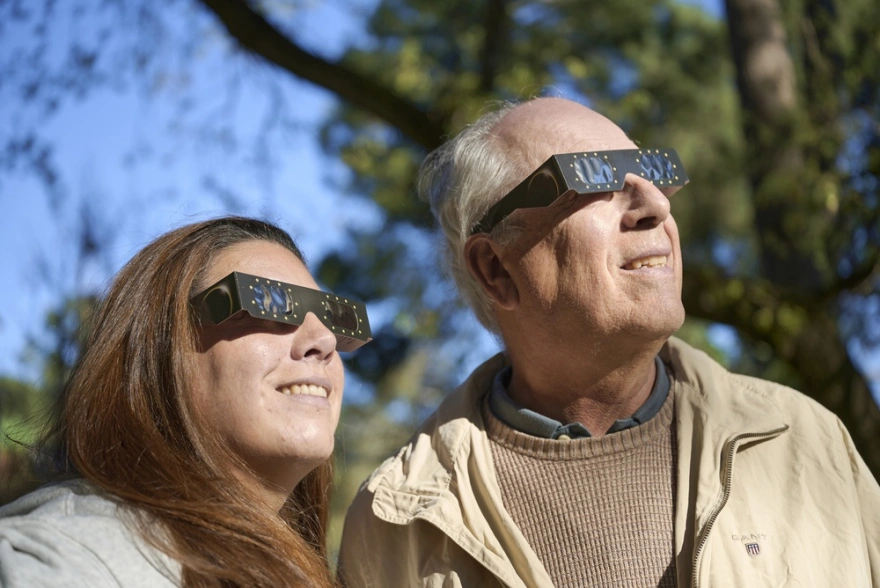
Symptoms that should raise concern
Doctors recommend seeking immediate medical attention if, after looking directly at the sun, any of the following symptoms appear:
- eye pain
- redness
- a gritty sensation or intense irritation
- blurred vision
- distorted vision
- new dark spots in the field of vision
- sudden changes in vision
Solar retinopathy can also cause reduced colour perception, difficulty reading, or a dark spot in the centre of one’s vision.
In some cases symptoms gradually subside, though there is also a risk of permanent vision loss.
What happened in Britain in 1999
Experts’ concerns are reinforced by the experience of the last major eclipse in Britain, in 1999.
At the time, Moorfields Eye Hospital received around 1,600 calls to a dedicated helpline set up for the event.
More than 100 people called within the first hour alone reporting eye problems, and the phone lines remained under heavy strain for the following 24 hours.
In addition, 220 people were examined at the hospital’s A&E department with suspected symptoms linked to the eclipse.
Pain even with special glasses
That said, not every instance of discomfort after the eclipse indicates retinal damage.
Some people reported eye strain or headaches despite having used properly certified glasses to observe the phenomenon.
According to experts, mild eye strain in these cases can be normal, similar to the discomfort caused by many hours spent in front of a screen.
Ask me anything
Explore related questions




