

The transfer of U.S. Air Force B-1 strategic bombers to the United Kingdom is increasing expectations of an imminent escalation of military operations against Iran, something Donald Trump also mentioned today when he said that the most powerful strike against Tehran is yet to come.
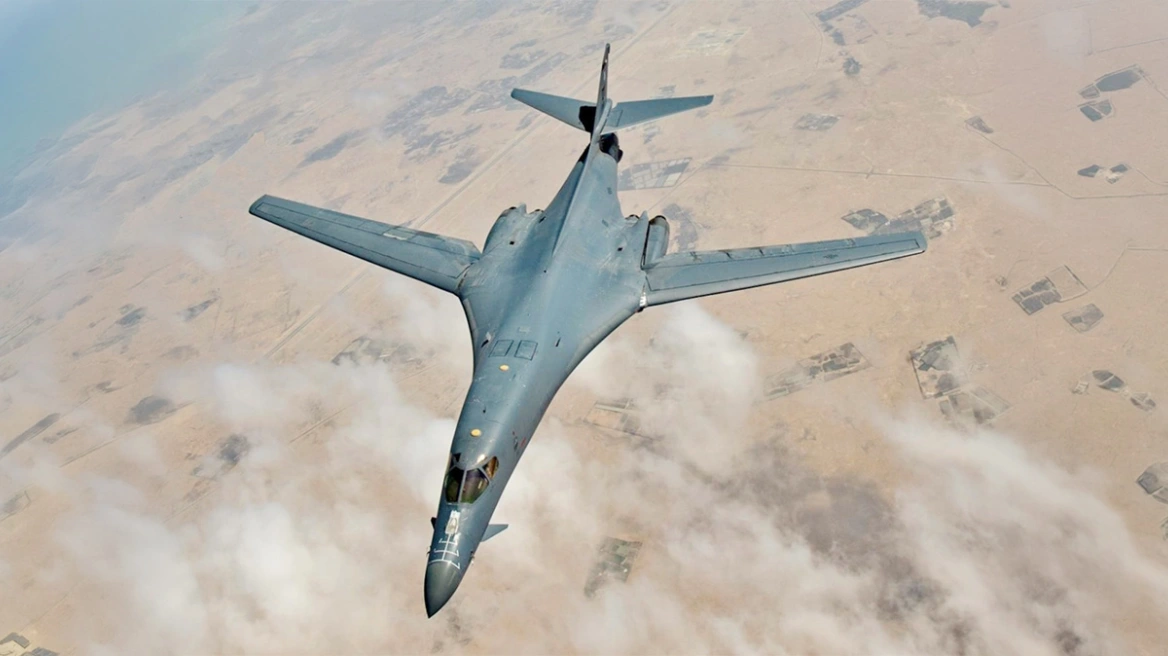
These aircraft, capable of carrying up to 34 tons of explosives, were directed to the British base RAF Fairford in Gloucestershire, in a move interpreted as preparation for possible new attacks.
Online flight observers spotted a fleet of B-1 bombers departing from Dyess Air Force Base in Texas heading for RAF Fairford. One B-1 bomber was photographed Friday night arriving at the airbase in Gloucestershire, confirming reports from Western officials earlier in the week that American bombers would be stationed in the United Kingdom in the coming days. Additional aircraft are also expected to gather at the same base, including B-2 and B-52 bombers, strengthening the U.S. presence in the region.
The strategic B-1 bombers cost up to $2 billion each, are designed for long-range missions, and can carry some of the most powerful missiles in the U.S. arsenal, performing high-intensity operations.
According to the Daily Mail, sources estimate that Saturday could be “D-Day” for a new massive bombardment, one week after the first U.S. and Israeli attack on Iran as part of Operation “Epic Fury.” U.S. President Donald Trump has warned that “the big strike” has not yet come, suggesting that attacks may intensify in the coming period.
Characteristics of the B-1
The Rockwell (now part of Boeing) B-1 Lancer is a four-engine American strategic bomber with variable-sweep wings used by the United States Air Force (USAF).
The program began in the 1960s and envisioned a Mach 2 supersonic bomber with sufficient range and payload to replace the Boeing B-52 Stratofortress. It evolved into the B-1B, a bomber mainly designed for low-level penetration, with long range and the ability to reach Mach 1.25 at high altitude.
The original B-1A version was developed in the early 1970s, but production was canceled and only four prototypes were built. The need for a new platform resurfaced in the early 1980s, and the aircraft returned with the B-1B version, focused on low-level penetration and bombing missions. However, at that time the development of stealth technology promised aircraft with dramatically improved capabilities. Production continued, and the B version entered service before the “Advanced Technology Bomber” (B-2 Spirit) during a period when the B-52 was becoming increasingly vulnerable.
The B-1B entered service in 1986 with the USAF Strategic Air Command as a nuclear bomber. In the 1990s it was converted to a conventional bomber. It was first used in combat during Operation Desert Fox in 1998, and again during NATO operations in Kosovo the following year. The B-1B has supported U.S. and NATO forces in Afghanistan and Iraq.
The B-1 also took part in Operation Inherent Resolve against Islamist terrorists in Syria. From August 2014 to January 2015, the B-1 was responsible for 8% of the ground targets destroyed by the U.S. Air Force.
The Lancer is the supersonic long-range bomber in the USAF bomber force, alongside the subsonic B-52 and the Northrop Grumman B-2 Spirit. The bomber is commonly known as “Bone” (from the pronunciation of “B-One”). With the retirement of the EF-111A Raven in 1998 and the F-14 Tomcat in 2006, the B-1B became the only active U.S. military aircraft with variable-sweep wings.
The B-1B is expected to remain in service until the 2030s, when it will be replaced by the Next-Generation Bomber.
B-1B Specifications
Crew: 4 (aircraft commander, co-pilot, offensive systems officer, defensive systems officer)
Dimensions
- Length: 44.5 m
- Wingspan:
- Extended: 41.8 m
- Swept: 24.1 m
- Height: 10.4 m
- Wing area: 182.2 m²
Weights
- Empty weight: 87,100 kg
- Gross weight: 148,000 kg
- Maximum takeoff weight: 216,400 kg
Engines
- 4 × General Electric F101-GE-102 augmented turbofans
- Thrust: 14,600 lbf (64.9 kN) each
- Maximum thrust with afterburner: 30,780 lbf (136.92 kN) each
- Optional fuel capacity: 38,000 L
Performance
- Maximum speed:
- High altitude: Mach 1.25 (1,340 km/h at 50,000 ft / 15,000 m)
- Low altitude: Mach 0.92 (1,130 km/h at 200–500 ft / 60–150 m)
- Range: 6,478 nautical miles (11,998 km)
- Combat radius: 2,993 nautical miles (5,543 km)
- Maximum altitude: 18,000 m
- Wing loading: 816 kg/m²
- Thrust-to-weight ratio: 0.38
Armament
- 6 external hardpoints for 50,000 lb (22,700 kg) of munitions (currently restricted by the START I treaty)
- 3 internal bomb bays for 75,000 lb (34,000 kg) of munitions
Ask me anything
Explore related questions