





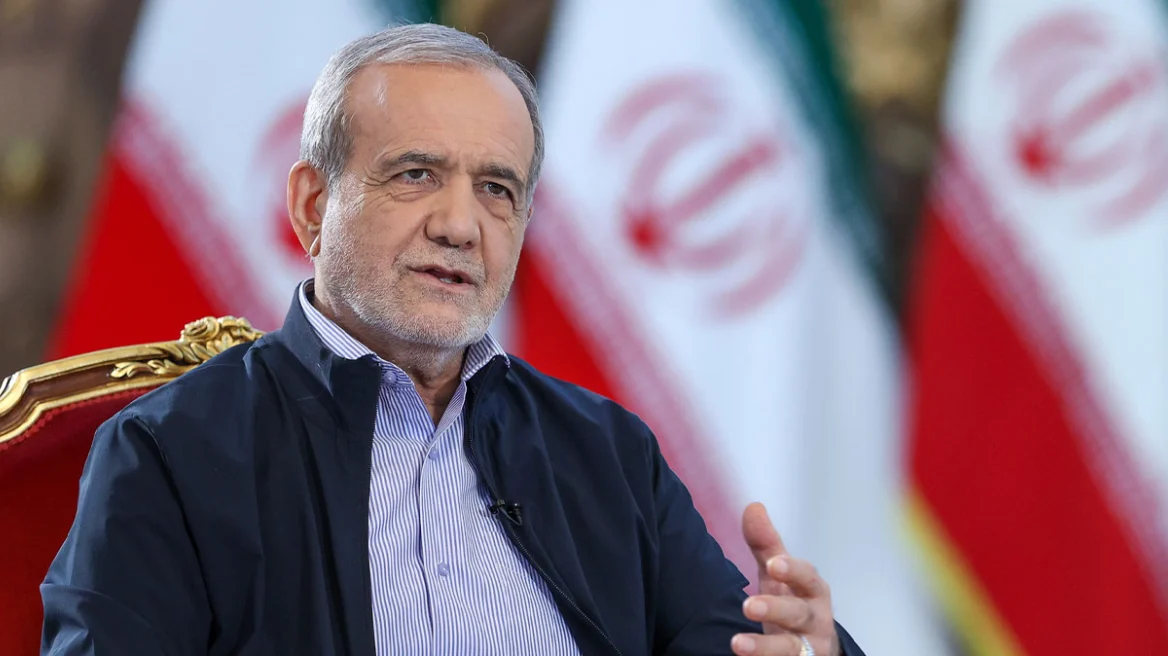
Masoud Pezeshkian appeared on Iranian state television on Saturday morning asking for forgiveness for the missile attacks his country launched against states of the Persian Gulf since last week, when air-raid sirens sounded in Qatar and Bahrain warning of new strikes.
A few hours later, however, and after criticism from hardline circles of the Iranian establishment—who described his statements as “shameful and humiliating” and even called for a change of president—Pezeshkian issued a new statement claiming that Iran had not attacked “friendly and neighboring countries” in the context of the conflict. This second statement contained no apology.
Attacks continued despite the statements
The alternating statements occurred while attacks on Gulf countries continued during the day, highlighting internal disagreements within the leadership of the Islamic Republic regarding how to respond to the American-Israeli attacks, which have now entered their second week.
Since the start of the war last Saturday, Iran has launched hundreds of missiles and drones toward Arab countries of the Persian Gulf, claiming that the targets were American military bases located in the region.
However, some of the strikes also caused damage to civilian infrastructure in several countries in the Middle East, including airports and hotels.
In an apparent attempt to calm the strong dissatisfaction of the Gulf states, Pezeshkian said on Saturday morning that he was asking “on behalf of Iran for forgiveness from the neighboring countries that were affected” and pledged that the attacks would stop.
This commitment, however, was accompanied by one condition: that the attacks against Iran—which, according to Tehran, originate from the territory of those same countries where American military bases continue to operate—must end.
He spoke of autonomous action by the army and the Revolutionary Guards
The Iranian president also argued that during the crisis the Iranian army and the Islamic Revolutionary Guard Corps acted autonomously. The crisis, he said, began with Israeli attacks that led to the assassination of the country’s supreme leader, Ayatollah Ali Khamenei, as well as other senior Iranian officials.
“Because our commanders and our leader lost their lives due to the violent attack, our armed forces, when no commanders were present, acted on their own initiative,” Pezeshkian said.
These statements raised questions about who is ultimately supervising Iran’s military response. Before his death, Ayatollah Khamenei had begun transferring increasing responsibilities to Ali Larijani, one of the country’s top security officials.
What has followed in terms of leadership after Khamenei’s death
As president of Iran, Pezeshkian holds certain powers, although the supreme political and religious authority belonged to Ayatollah Khamenei according to the constitution of the Islamic Republic. A successor to Khamenei has not yet been selected, although his son, Mojtaba Khamenei, is considered by many to be a leading candidate.
Pezeshkian is now part of a three-member council that has assumed the administration of the country until a new supreme leader is selected. Analysts, however, estimate that Iran’s powerful security services have greater influence than he does.
“Pezeshkian’s comments, which were followed by new attacks in the Gulf, will reinforce the perception that he has limited power within a system dominated by the military,” said Sanam Vakil, director of the Middle East and North Africa program at the research institute Chatham House in London.
Another member of the transitional three-member council, Gholam-Hossein Mohseni-Ejei, criticized the president’s statements without naming him. He argued that “the geography of certain countries in the region lies openly and secretly in the hands of the enemy.”
“Intense attacks against these targets will continue,” said Mohseni-Ejei, head of the judiciary and a representative of the hardline faction within the regime, according to the Iranian news agency Tasnim.
Trump tried to exploit the apology
Donald Trump quickly attempted to politically exploit Pezeshkian’s apology, arguing that it is evidence that the air campaign of the United States and Israel is forcing the Iranian leadership to accept their terms. He also warned that Iran would receive “very heavy blows.”
“Iran, which is taking heavy hits, has apologized and backed down toward its neighbors in the Middle East, promising that it will not attack them again,” Trump wrote in a post on social media.
It remains unclear, however, whether Pezeshkian actually has the authority to make such a commitment on behalf of his country. He nevertheless appeared to reject Trump’s demand for unconditional surrender, describing it as “a dream that our enemies will take with them to the grave.”
Iran’s claims regarding the attacks and what International Law says
For years, the states of the Persian Gulf had tried to mediate to de-escalate tensions between Iran and the West. Qatar played a role in facilitating talks on Tehran’s nuclear program, Oman provided back-channel diplomatic channels, while Saudi Arabia maintained direct dialogue with Iran until 2024 and early 2025.
Despite these efforts, Iran launched—and continues to launch—attacks against these countries, choosing to repay good neighborly relations… with ballistic missiles.
Iran’s argumentation is based on three main claims: that the country acted within the framework of legitimate self-defense according to Article 51 of the United Nations Charter; that the countries hosting American military bases have effectively limited their sovereignty by allowing the presence of those forces; and that the definition of aggression in Resolution 3314 of the UN General Assembly allows attacks against those bases as legitimate military targets.
However, as Al Jazeera points out, these three claims present serious problems both legally and realistically. If accepted, they would lead to a permanently destabilized Gulf region, undermine fundamental principles of International Law, and ultimately strengthen the very security threats that Iran claims it is reacting to.
The argument of self-defense and Article 51
The United Nations Charter allows the use of military force only in the framework of self-defense against an “armed attack,” as provided for in Article 51. However, the concept of an armed attack is not determined unilaterally by the state invoking self-defense.
The International Court of Justice in The Hague has interpreted the term narrowly in significant cases, such as the case “Military and Paramilitary Activities in and against Nicaragua” (Nicaragua v. United States, 1986) and the case “Oil Platforms” (Iran v. United States, 2003).
In those decisions the Court distinguished between the most serious forms of the use of force—which constitute an armed attack—and other less serious actions that do not trigger the right of self-defense.
Based on this jurisprudence, the mere presence of foreign military bases in Gulf states—which have operated for decades within the framework of defense agreements with the governments of those countries—cannot by itself be considered an armed attack against Iran.
Moreover, International Law requires that self-defense meet two basic conditions: necessity and proportionality. Iran, according to this criticism, has demonstrated neither.
An attack on the territory of sovereign Arab states in response to political decisions of the United States cannot be considered necessary, since diplomatic avenues and procedures through the United Nations still exist.
At the same time, it cannot be considered proportional, since it imposes military consequences on states that are not part of any armed conflict with Tehran.
The obligation to inform the Security Council
Article 51 also includes a mandatory procedural requirement: every state exercising the right of self-defense must immediately inform the UN Security Council.
However, Iran has systematically avoided this obligation in its previous escalating actions. Although this may seem like a secondary element, it is in fact a key mechanism through which the international community can evaluate and monitor claims of self-defense.
A state that bypasses this procedure is not applying Article 51—it is simply using its language to justify unilateral actions.
The interpretation of UN Resolution 3314
Tehran also invokes Article 3 of the Annex to UN General Assembly Resolution 3314 (1974), which states that an act of aggression may also include the case in which a state allows its territory to be used by another state to carry out an attack against a third country.
Based on this provision, Iran could attempt to consider the Gulf countries that host American military bases responsible for any attack carried out from their territory against it.
However, the mere presence of military bases is not enough for them to be characterized as legitimate military targets. This depends on whether they actually contribute to military operations against Iran, according to the rules of international humanitarian law.
Ask me anything
Explore related questions




