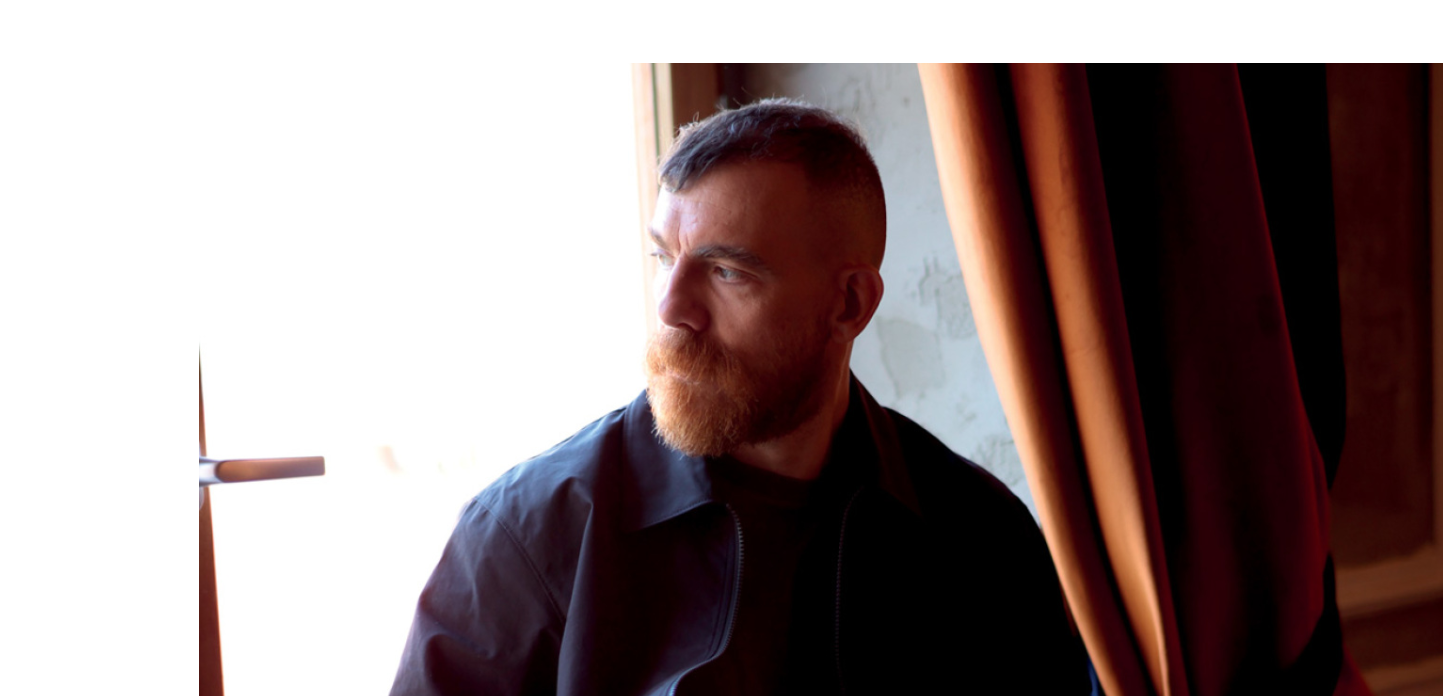
His daily life is like one large project spanning geographical coordinates without borders. One week he might be in Paris, the next in Berlin. Now, Athanasios Kanakis makes a stop in Athens to unfold his imagination.
GALA: From studying Computer Engineering in Patras to Fine Arts in Bremen and Berlin, what drove you to follow this path?

ATHANASIOS KANAKIS: Studying Computer Engineering was the result of a somewhat unconscious decision, mainly influenced by the fact that I had “very high grades.” On the other hand, continuing to Fine Arts was a very conscious choice. I went to the Bremen Academy of Fine Arts in the digital and new media program, which emphasized experimentation with different materials, theory, and generally offered me a sense of freedom. Later, my postgraduate studies at the Berlin Academy of Fine Arts significantly shaped my path, influencing the themes and media I chose to incorporate into my installations.
Shirt by Dickies, Color Skates. Trousers by Jacquemus, attica, The Department Store. Boots by Raf Simons.
G.: In your work, you speak of “place” and “memory.” Which personal memory always accompanies you, even when working internationally?
A.K.: As a child, I loved spending afternoons in my mother’s workshop—she worked with clothing—waiting for her to finish. At the end, we would organize the tools and fabrics, putting everything in its place so she could start fresh the next day. I learned this very early and continue to apply it in my own studio or any space I occupy, temporarily or permanently. Perhaps it’s a pattern or a way I learned to make a space my own, create a routine, and cultivate a sense of control. This memory also influences how I approach my work, no matter where I am.
“In set design and art direction, whether commercial or personal, I always tell a story about or through the space.”
G.: As an art director and set designer, you move between art and applied creation. How do you balance these two aspects?
A.K.: Both in art and in set design or art direction—whether personal or commercial—I tell a story about or through the space. They are closely connected yet distinct. Both involve working with materials, creating spaces, constructing objects or props, experimenting with different media, and so on. Sometimes one allows me to experiment in ways I wouldn’t in the other, or I learn new techniques that I later integrate into both. Paris was invaluable in this regard, helping me find a balance so that one doesn’t negatively affect the other but rather complements and enriches my overall practice. Let’s not forget how many major fashion houses collaborate with artists from other fields.

G.: Your artistic journeys across different parts of the world—what do they leave in you beyond artistic experience?
A.K.: I’ve spent time in Germany, France, the Netherlands, Belgium, Austria, Portugal, and Canada, both short- and long-term, often with generous scholarships. I am grateful for all these unique opportunities, which inevitably influence my work, always in dialogue with the place I’m in. Each location is different and requires continuous observation and adaptation, because the environment doesn’t always adapt to your needs. In this sense, it’s important to feel aligned with the place you are. Beyond the work and experience, what has stayed with me are the relationships I’ve built, the encounters with wonderful people, some of whom I consider friends.
Shirt and trousers by Marant, attica, The Department Store. Boots by Raf Simons.
G.: You use very diverse materials and media—from sculpture to sound to digital tools. What determines your choice each time, and which expresses you most?
A.K.: We live in environments that stimulate multiple senses simultaneously, which often makes choosing a medium complex. Sometimes one is more suitable than others depending on what I want to communicate at the moment; other times, I enjoy the challenge each offers because of its possibilities and limitations. Ultimately, all these different elements I produce become part of the same work. This diversity is strongly reflected in my sets.
G.: Your work shows research as well as strong personal expression. Do you consider yourself more a researcher or a storyteller?
A.K.: Both. My work evolves constantly and can be seen as a broader, ongoing research, which simultaneously serves as another tool to approach a subject. Sometimes, however, immersing myself in research and theory can make me hesitate, because the deeper I go, the more I realize there’s still so much to learn—then I pause and focus on the material.
G.: Which moment moves you the most: the initial idea, the execution process, or the audience’s encounter with the work?
A.K.: The moment I decide a work is ready and let it follow its own course, observing how the audience perceives it—even if their interpretations differ from my original intentions.
G.: Do you plan or work spontaneously? How do you see yourself in the coming years, with what projects?
A.K.: I’m very organized and usually have a clear idea of what I want to do and where I see myself in the next few years. In the coming year, my goal is to complete a series of works and, if all goes well, organize a solo exhibition. I also hope to highlight the importance of artistic direction and set design in fashion/beauty/luxury shoots, still a relatively early-stage area here. Additionally, I would love to work on window displays, permanent installations, or new collaborations with other fields, such as theater.
Ask me anything
Explore related questions