





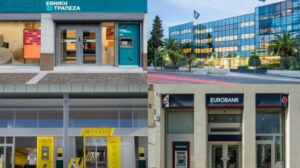
Deutsche Bank has upgraded its target prices for all Greek and Cypriot banks, maintaining a “buy” recommendation across the sector, at a time when global volatility has brought valuations back to attractive levels.
Specifically, the bank raises its target prices to:
- Alpha Bank: €4.45 (from €4.10)
- Eurobank: €4.35 (from €4.10)
- Piraeus Bank: €8.95 (from €8.75)
- National Bank of Greece: €15.95 (from €15.30)
- Bank of Cyprus: €10.40 (from €10.10)
The move reinforces the strong investment case for the sector.
Top picks and outlook
In terms of preferences, Deutsche Bank ranks Eurobank as its top pick, followed by Alpha Bank and Piraeus Bank, while National Bank of Greece is placed lower due to higher valuations.
Despite global concerns ranging from geopolitical tensions to the impact of artificial intelligence and rising risks in private credit, the bank believes Greek lenders show greater resilience than their European competitors.
This is supported by limited exposure to high-risk sectors and an improved macroeconomic outlook. Greece’s economy is expected to grow at around 2% in 2026–2027, outperforming the Eurozone and supporting demand for lending.
Valuations and growth drivers
Despite their strong performance in recent years, Greek banks still trade at a significant discount compared to European peers — around 6.5x expected 2027 earnings versus about 8x for European banks.
According to Deutsche Bank, this gap is mainly due to low market visibility, the legacy of the financial crisis, and Greece’s classification as an emerging market. However, these factors are gradually fading, increasing the likelihood of valuation convergence in the coming years.
Credit expansion and revenue boost
A key driver of profitability remains strong credit expansion. Greece is among the top performers in Europe, with loan growth of around 6% year-on-year in early 2026, mainly driven by corporate lending.
This trend is expected to continue, as the Greek economy remains relatively underleveraged after the previous decade’s crisis, leaving room for new investments and borrowing.
As a result, net interest income is expected to strengthen from 2026 onward, with pressure on margins easing and giving way to stabilization and potential improvement by 2027.
Asset quality and capital improvement
Asset quality continues to improve, with the non-performing exposure ratio near 2.6% and expected to decline further by 2027.
At the same time, the cost of risk is gradually decreasing, with no major new sources of provisions expected. Even issues such as recent developments around the Katseli law are seen as having limited impact, as relevant portfolios have already been reduced through securitizations.
Meanwhile, the accelerated reduction of deferred tax assets is improving capital quality and creating more room for shareholder distributions.
Strategy and prospects
Deutsche Bank maintains a positive stance on all banks, favoring Eurobank for its strong profitability profile and acquisition strategy, while also viewing Alpha Bank positively for its recovery momentum and improving fee income.
Piraeus Bank stands out for strong cost management and shareholder-friendly policies, while National Bank of Greece maintains a solid capital base, though it trades at higher valuation levels.
Overall, the bank expects Greek lenders to remain on a path of strong profitability and capital strengthening, with key drivers — credit growth, rising revenues, and increased shareholder distributions — supporting further outperformance versus the European banking sector.
Ask me anything
Explore related questions




