





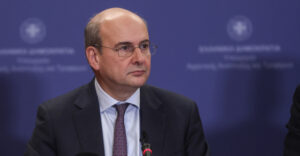
“The government has chosen direct subsidies for diesel and a fuel card system for petrol, as this ensures that the reductions are passed on directly to consumers. If we had intervened through VAT, it would be uncertain whether the price decrease would reach the pump,” said Deputy Prime Minister Kostis Hatzidakis in an interview with Alpha TV.
Hatzidakis explained that, for an average monthly consumption of 70 liters of petrol, the subsidy introduced from April 1 more than offsets the additional cost caused by rising prices due to the international crisis. Specifically, the subsidy covers the extra cost up to a petrol price of €2.11 per liter.
He also clarified that the support measures will be implemented regardless of international developments, noting that even if the war were to end immediately, its economic impact would persist.
“We have an initial margin for additional support”
Addressing the possibility of a prolonged crisis, Hatzidakis stated:
“We will first assess the fiscal space at the end of April, when the 2025 data becomes available. We have also introduced additional taxation on gambling to create a financial buffer. So yes, there is an initial possibility for further support.”
He added that if the situation worsens significantly, European countries are likely to coordinate their response:
“There will be greater flexibility, and we will act accordingly. However, we are proceeding with a sense of fiscal discipline and predictability, as much as possible in such an unpredictable situation. We are not exhausting all available options at once.”
He noted that the government has already implemented measures addressing price increases, including caps, and has introduced new support measures for fuel, fertilizers, and ferry tickets, while continuing to monitor developments in coordination with other European countries.
“Government planning will not be affected”
The Deputy Prime Minister also stated that, if the situation remains within reasonable limits, the government’s plans for new tax cuts—expected to be announced at the Thessaloniki International Fair—will not be affected, as they relate to the fiscal outlook for 2027.
“However, if conditions worsen, I believe the European Union will allow greater flexibility,” he added.
In closing, Hatzidakis emphasized that the government has acted swiftly across all sectors:
“In foreign policy, the country maintains strong alliances. In defense, you have seen our initiatives in Cyprus and Bulgaria, demonstrating a serious and robust presence. In the economy, we are moving with both speed and responsibility—qualities that are even more essential in times of crisis.”
Ask me anything
Explore related questions




