





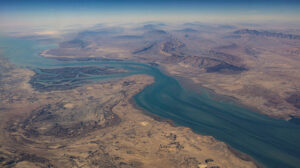
The U.S.–Iran ceasefire reopened the path for Hormuz to reopen as well—if that ultimately happens—but it has restored neither energy balance nor strategic order in the region. The real question is not what stops now, but what is being prepared for the next day—from Gulf refineries to the Lebanese front.
Yesterday’s U.S.–Iran talks in Islamabad, which ended without a final agreement after 21 hours of negotiations, confirmed that the next day remains unclear and that key issues of security and regional influence remain unresolved.
“We made clear what our red lines are,” said U.S. Vice President J. D. Vance upon departing Islamabad, while Tehran described the demands as “irrational.”
At the same time, Donald Trump left open the possibility of a naval blockade against Iran following the deadlock. Specifically, he shared an article referring to the potential imposition of such a blockade if Tehran does not accept U.S. demands.
Deep mistrust
Reopening the Strait of Hormuz—Washington’s primary objective in agreeing to a ceasefire with Iran—is certainly the first step toward restoring energy flows through the Persian Gulf. But that’s exactly what it is: a first step. Nothing more.
What Washington presents as a partial return to normality is, in reality, a fragile pause within a system already deeply damaged. And that damage cannot heal in just 15 days.
The talks in Pakistan themselves showed that mistrust between the two sides remains high and extends beyond the immediate military sphere to include Iran’s nuclear program and regional role. Refineries, storage facilities, oil and gas fields in at least nine countries—from Iran to the UAE—have been targeted.
The destruction is not only visible (fires, destroyed tanks, black smoke columns), but also invisible: broken supply chains, dispersed crews, departed technicians, immobilized ships, and markets now pricing not just war, but the risk of its return.
This is the first major problem with the ceasefire: it doesn’t stop a finished war—it freezes one that is merely on hold.
Risk remains
The agreement stipulates that Iran will allow ships to pass through Hormuz without attacks. That was the minimum needed for the U.S. to claim a strategic gain. But reopening Hormuz does not automatically restart the Gulf’s energy system.
Restoring production requires inspections, technical repairs, replacement of specialized equipment, gradual pressure restoration in fields, infrastructure recovery, and—most importantly—confidence that facilities won’t be hit again.
That confidence is currently absent.
Energy companies, insurers, and shipping firms operate based on risk forecasts, not political statements. And risk is now embedded in how the entire region is perceived.
The hidden damage
The Gulf’s energy system is not a simple on/off switch. It’s a complex network of pressure systems, temperatures, chemical balances, logistics, spare parts, and human expertise.
When oil or gas production stops, restarting is never straightforward. The longer the shutdown, the harder the recovery.
Subsurface pressure destabilizes. Water may accumulate where it shouldn’t. Corrosive elements like hydrogen sulfide damage equipment. In countries like Saudi Arabia and Iraq, where production depends on precise pressure management through gas or water injection, interruptions disrupt carefully maintained technical balances.
In practical terms, the 15-day ceasefire is not even enough to fully assess the damage—let alone repair it.
The cost of the pause
For consumers, this translates into something very simple: prices won’t easily return to pre-war levels.
Even if prices temporarily drop after a ceasefire announcement, markets know current supplies come from pre-war reserves—not a restored normal.
As the crisis drags on, high prices risk becoming semi-permanent. Oil may fall from extreme wartime highs, but it is unlikely to return to what it would have been without the conflict.
Geopolitical risk is now a permanent pricing factor.
The attempt to exit
The United States remains the world’s strongest power. But that doesn’t eliminate a recurring historical problem: difficulty exiting wars it initiates.
From Vietnam onward, military strength has enabled entry—but not guaranteed a clean exit.
A similar pattern is visible now. The ceasefire appears less like a solution and more like an attempt to freeze a conflict whose costs are beginning to outweigh its benefits.
For Donald Trump, the challenge is particularly personal. His approach resembles a high-risk business negotiation, where bold moves can shift outcomes. But here, the stakes are global stability, energy costs, and the risk of wider war.
The pause may ultimately prove insufficient if Iran, Israel, or other actors choose escalation elsewhere.
A gift to Tehran
In this context, Iran’s regime—not its people—receives an unexpected strategic gift.
Before U.S. involvement, Tehran had not fully closed the Strait of Hormuz, despite having the capability. Now it understands more clearly than ever that Hormuz is not just a waterway—it is its most powerful political and diplomatic tool.
Ironically, U.S. and Israeli actions have reinforced Iran’s importance as an unavoidable regional actor.
Geography of insecurity
The problem extends beyond Iran. Across Kuwait, Qatar, and Saudi Arabia, damage suggests a long recovery.
Even limited strikes can disrupt global LNG supply chains or oil exports. A single hit affects insurance costs, shipping routes, crew availability, spare parts, and global logistics.
The region’s reliability itself is now in question.
Lebanon as the trade-off
This leads to the second major dimension of the “next day.”
If Washington needs a ceasefire with Tehran to stabilize energy markets, Israel appears to need something in return: Lebanon.
The emerging logic suggests that while pressure on Iran may ease, Israel gains more operational freedom against Hezbollah.
This doesn’t necessarily mean a full invasion—but likely intensified and more politically tolerated military action.
If true, Lebanon becomes not a side front, but the trade-off.
That carries serious risks: the Iran conflict may pause, only to transform into a sustained, lower-intensity war in northern Israel.
Hezbollah is not a passive actor. Under existential pressure, it may escalate.
In that case, the 15-day ceasefire will not mark de-escalation—only a shift in where the war is fought.
Ask me anything
Explore related questions




