





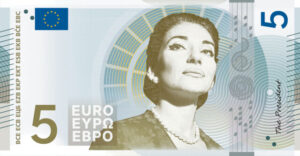
It’s 15 December 1995. In Spain, where the summit of European leaders is under way, the Greek delegation realises it is about to miss the boat: on the new banknote of the single European currency, the word “euro” will not appear in Greek. With Prime Minister Andreas Papandreou absent, receiving treatment at the Onassio Cardiac Surgery Centre in Athens, the senior minister deputising for him, Akis Tsochatzopoulos, runs into the towering German Chancellor Helmut Kohl (1.96 metres tall and weighing 136 kilograms) outside the toilets. With a wave of his hand he stops him and, in fluent German, raises the injustice.
“You promised Andreas, together with Chirac and Gonzalez,” he tells him. Kohl pauses, taken aback. He smiles and asks him to pass on his wishes for a swift recovery to the Greek prime minister. That same night, staff from the Spanish presidency distribute folders to the delegations’ rooms containing the final draft decisions, in which the word “euro” appears written in Greek characters.
Thirty one years later, and after 26 years in circulation, euro banknotes are changing again, and once more carry a Greek stamp, more prominent than ever. Besides the word “euro” itself, which will appear in Latin, Greek and Cyrillic script, one of the six historic figures chosen to represent European culture on the new notes will be Maria Callas.
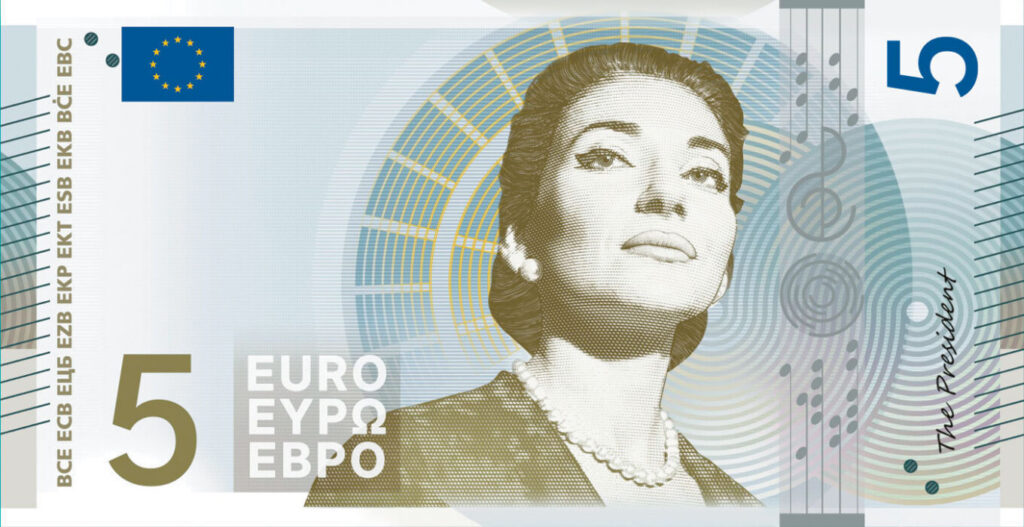
The new banknotes will feature intricate designs and unusually vivid colours rarely seen before on a banknote. For the first time they will use more sustainable materials and production processes, as the European Central Bank (ECB) looks to reduce the environmental footprint of banknotes while also making them more durable. That means they will wear out less easily, and may even survive better if left in a pocket and put through the wash.
Final deadline to vote
The train is leaving the station: a few days ago the ECB unveiled a shortlist of the 10 leading proposed designs. European citizens have until 21 September 2026 to give their opinion, with the bank’s governing council making the final decision. So what will the next euro we hold in our hands actually look like?
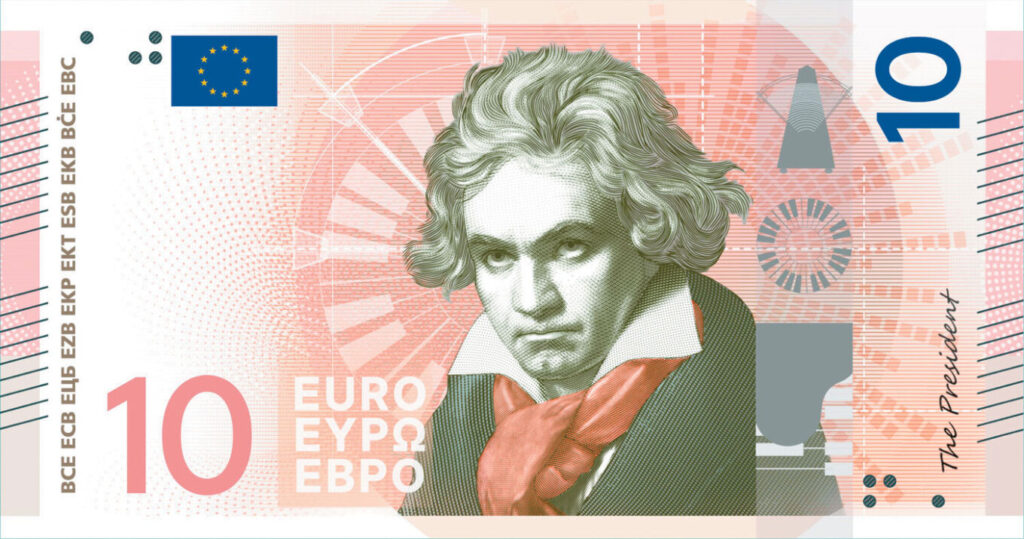
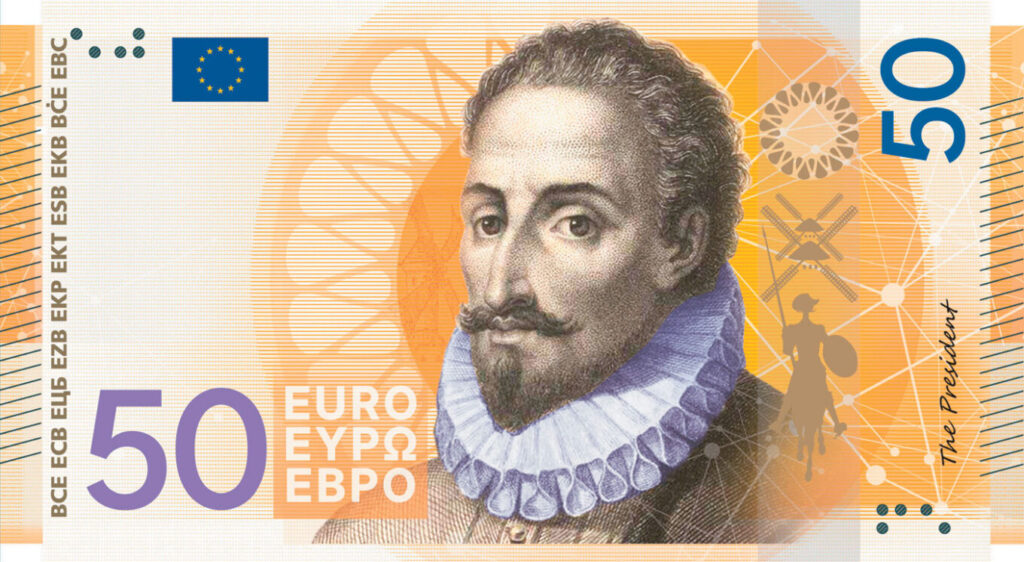
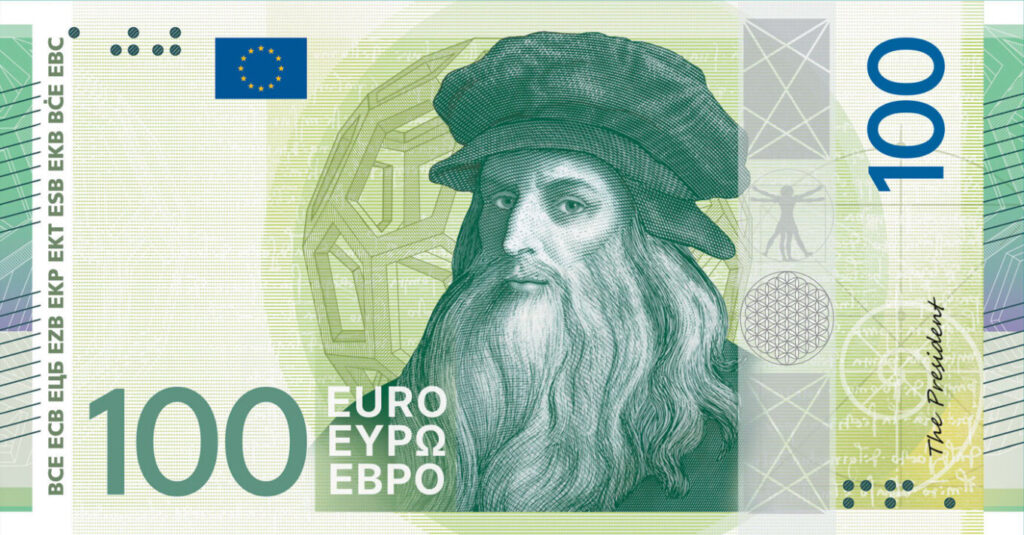
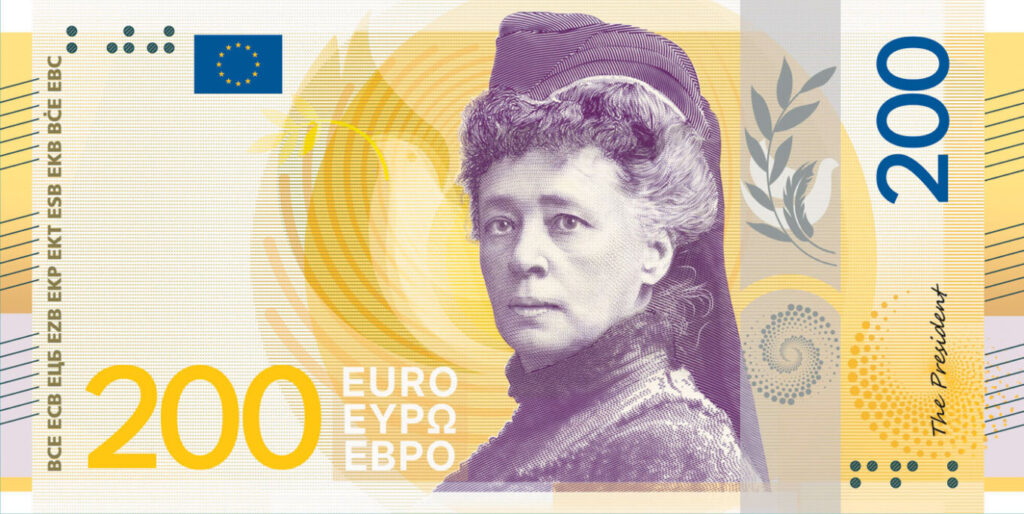
The first of the two main themes for the ey, called “European Culture,” includes six iconic figures from the arts, sciences and history, one for each denomination: 5 euros, Maria Callas; 10 euros, Ludwig van Beethoven; 20 euros, Marie Sklodowska-Curie; 50 euros, Miguel de Cervantes; 100 euros, Leonardo da Vinci; 200 euros, Bertha von Suttner.
For the first time on a European currency, there is complete gender balance, with three women and three men. This symbolises Europe’s modern commitment to gender equality, highlighting women’s contributions to science (Curie), art (Callas) and world peace (von Suttner, the first woman awarded the Nobel Peace Prize).
A complete history
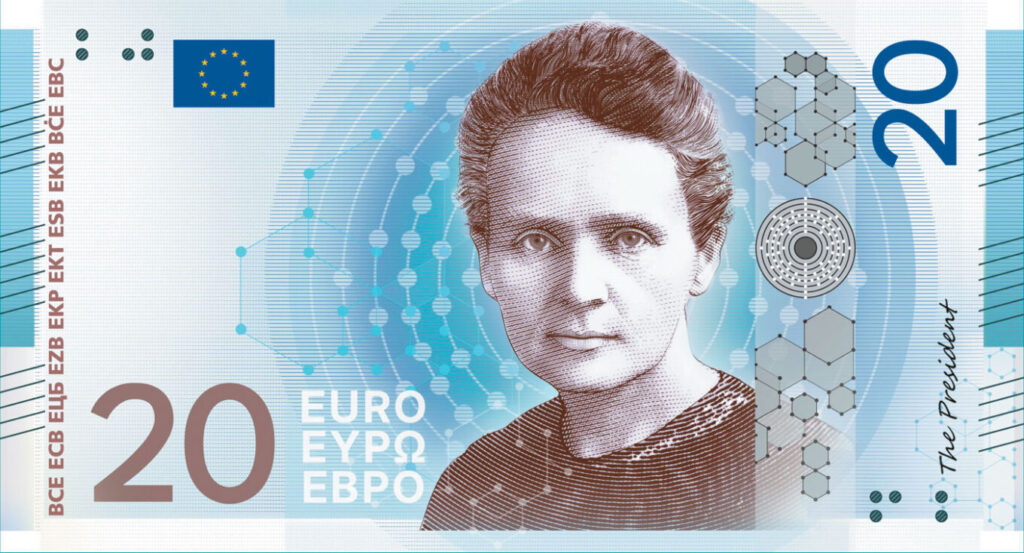
Each note does not simply depict a portrait of its subject, but also objects, manuscripts or places associated with their work. The symbolism behind these pillars of European identity is powerful.
The choice to represent Europe through artists, scientists and peace campaigners, rather than politicians, military leaders or monarchs, sends a clear message: Europe’s real strength and unifying power rests not on domination, but on intellectual and cultural contribution.
From the Renaissance (da Vinci) and the golden age of literature (Cervantes) to the Enlightenment, the scientific revolution and the 20th century, the theme illustrates that the European project is the result of a continuous cultural evolution spanning centuries.
Birds bring flight, rivers bring flow
The second theme, “Rivers and Birds,” carries symbolism that, however unusual it may sound, is just as powerful. It marks a departure from the traditional focus on famous individuals, turning instead to nature, connectivity and environmental awareness. Greece features here too, through the Evros, one of the most significant rivers and wetlands on the European continent.
Beyond the symbolism, the rivers and birds theme also serves a specific political and social purpose. Choosing historical figures always risks the perception that some countries are represented “more” than others, so choosing nature instead appears neutral. According to ECB strategists, it also conveys a contemporary message, shifting the focus from the past (history, architecture) to the future (the climate crisis, ecology), aligning the currency with the values of younger generations. There is a technical consideration too: the intricate detail of birds’ plumage and flowing water creates highly complex imagery, which strengthens the notes’ anti-counterfeiting features.
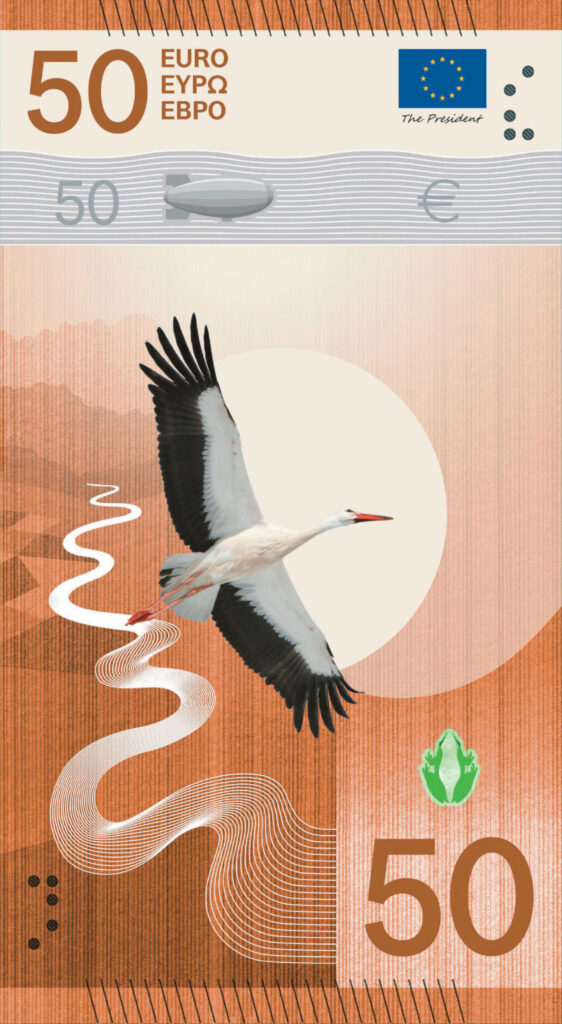
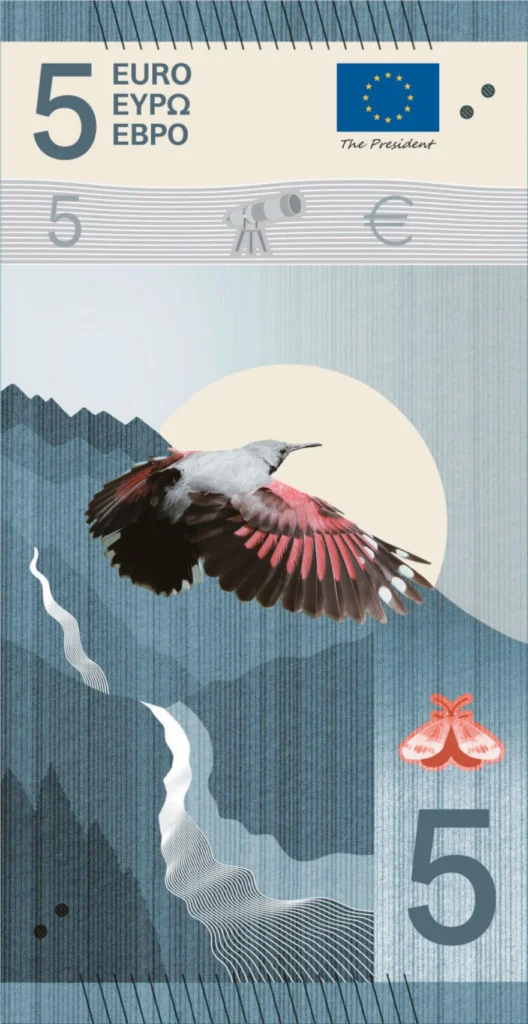
It is no coincidence that Europe’s natural ecosystems were chosen, as they symbolise freedom of movement and unity and recognise no national borders, a small irony given that the Evros forms the physical border between Greece and Turkey, and by extension between the EU and Turkey. The flowing water symbolises Europe’s evolution, adaptability and continuous movement towards the future, while birds are nature’s ultimate travellers, moving freely across borders and continents.
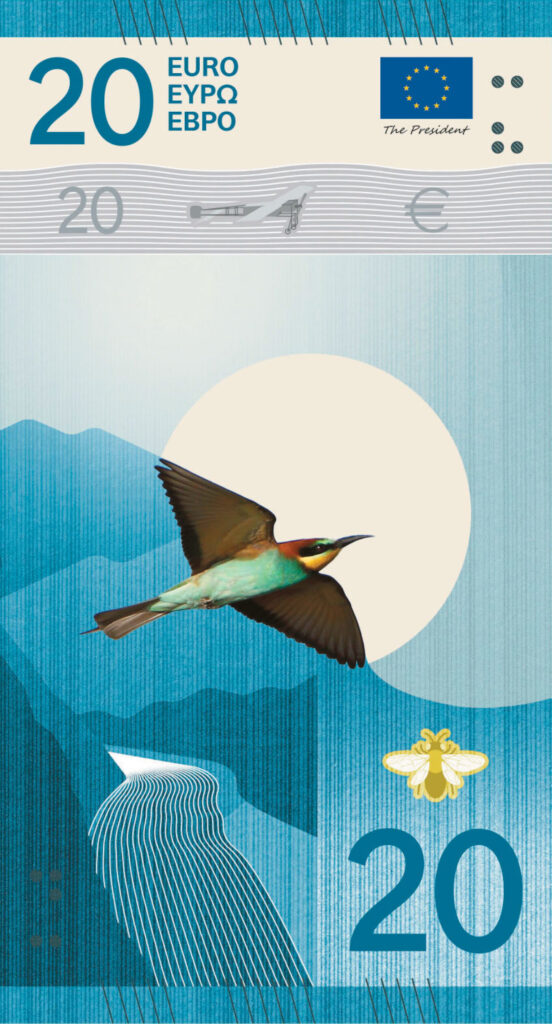
Unlike the first and second series of euro banknotes, which featured imaginary windows, gateways and bridges, the new designs place the characteristic bird of each denomination in the foreground on the front. The reverse shows a realistic yet artistically rendered natural landscape combining flowing water, riverbanks and habitat vegetation. The 5 euro note depicts the Rhine, representing Western and Central Europe, with waterbirds of its estuaries and banks, such as the kingfisher.
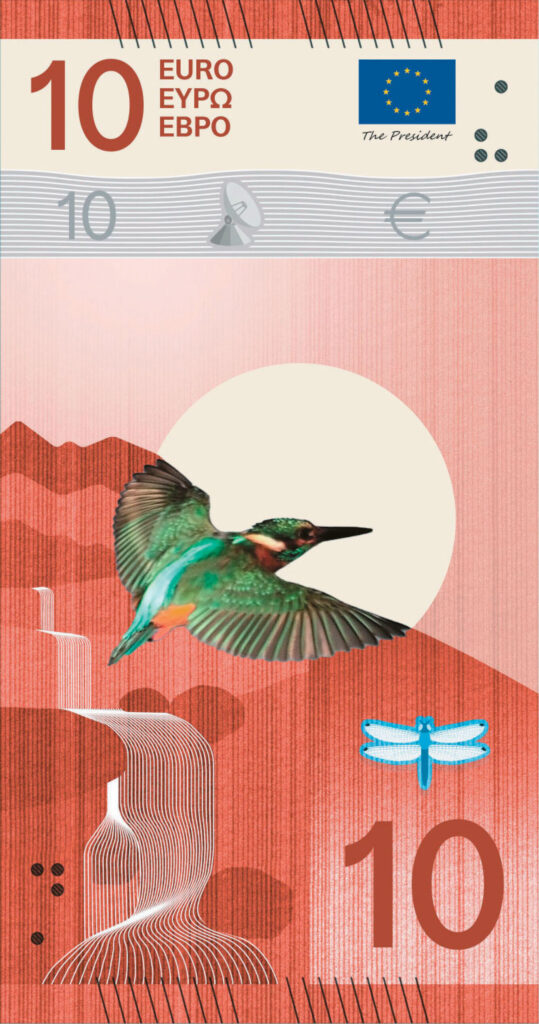
The 10 euro note features the Danube, Europe’s most “international” river, flowing through or bordering 10 countries and representing eastern and southeastern connectivity. The 20 euro note shows the Seine and the Loire, representing France’s river ecosystems and their rich riparian flora and fauna. The 50 euro note depicts the Evros and the Guadalquivir, representing Mediterranean Europe and the major wetlands of the Iberian Peninsula and southern Europe. The 100 euro note features the Po, Italy’s largest river, representing southern Europe and the Adriatic basin. The 200 euro note shows the Vistula and the Elbe, rivers of northern and central eastern Europe.
Among the birds are the wallcreeper, a striking small bird with crimson wings also found in the Pindus mountains, the kingfisher, the bee eater, the stork, the avocet and the northern gannet. The choice of wild birds serves as a reminder of the need to protect the environment and biodiversity, issues at the top of Europe’s current agenda.
Greece’s third contribution
Christine Lagarde, president of the ECB, said the euro banknotes are more than just a means of payment, describing them as one of the most tangible expressions of Europe, and said that through designs combining beauty and meaning, they would strengthen Europeans’ shared identity.
The proposals that reached the final shortlist are the result of a design competition run across the EU. More than 1,200 applications from graphic designers were submitted, with 25 reaching the final round and invited to develop design proposals for one or both themes. Among them is a Greek visual artist, Myrsini Vardopoulou.
The final decision rests with an independent jury of 21 experts in fields including graphic design, communication, neuroscience and history, who selected the 10 shortlisted designs. They do not, however, have the last word: the public will now be asked for its view, with the consultation remaining open until 21 September. Public opinion is a key part of the Eurosystem’s participatory approach, ensuring citizens’ views from across Europe are taken into account. The new series of banknotes is expected to enter circulation in the coming years.
This does not mean that euro banknotes currently in circulation will be withdrawn. On the contrary, the ECB says they will retain their value and continue to circulate alongside the new series.
The Greek engraver
Among Europe’s largest and most established design studios competing in the final round, one Greek name stands out: that of the versatile engraver and painter Myrsini Vardopoulou, whose work is among the ECB’s 25 finalists for the design of the euro.
It is not Vardopoulou’s first international success. She has been responsible for designing and overseeing the printing of stamps and all philatelic products at ELTA, Greece’s national postal service.

In 2005 she created a commemorative stamp marking 100 years of Greek Japanese relations. Her idea of combining two theatrical masks, symbols of the two cultures, with the word “friendship” written in both languages, struck a huge chord in Japan. The stamps sold out rapidly, forcing ELTA to reprint them and sell them in Japan as souvenir sheets, on envelopes depicting Mount Olympus reflected at the foot of Mount Fuji. That design also sold out.
Design E
The Greek entry, codenamed “Design E,” belongs to the European Culture theme. Vardopoulou explains her approach: “The communication approach focuses on the universal value of each individual’s work, rather than on the personality itself. The circle and the symbols function as a visual message expressing an intellectual space. This space offers viewers an immediate sense of visual familiarity. At the same time, symbolic elements provide subtle references for a deeper conceptual reading. In this way, the design conveys the message that, despite the diversity of individuals, their contribution forms a single source of inspiration and a means of reconnecting with cultural values that are both familiar and constantly evolving.”
Born in Athens in 1964, Myrsini Vardopoulou is an acclaimed painter and engraver and an honorary member of the European Academy of Philately. She is currently a PhD candidate at Panteion University, a public university in Athens specialising in social and political sciences. She graduated from the painting department of the Athens School of Fine Arts in 1993, and from its engraving department in 2001.
With a scholarship from the State Scholarships Foundation, she pursued postgraduate studies in the structure and composition of texture, under the supervision of pioneering painter Nikos Kessanlis.
Since 1995 she has been responsible for designing stamps for ELTA. Her work in philately has been honoured both in Greece and abroad.
Ask me anything
Explore related questions




