A treasured symbol of cultural heritage, craftsmanship, beauty, but also of power, wealth, and authority, Art has always held a prominent place in societies everywhere. This is why art dealers and circuits often attempt to enrich themselves by channelling into the market – galleries, online, and television auctions – fake works which they present as authentic.
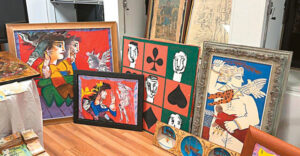
The recent attempted television auction of an 18th century Gospel allegedly authentic, which led to the seizure of hundreds of fake paintings from the warehouses of a well-known gallery owner Giorgos Tsagkarakis, who is accused of four felonies, brought back to the public the issue of trafficking in fake works of art, for which significant steps have recently been taken in our country both through legislation and intensive controls.
False sensationalism
Nevertheless, dealing effectively with the phenomenon is not a simple task, especially when there are gullible buyers who do not ask for adequate guarantees or, even worse, eager ones who knowingly buy inauthentic works motivated by the logic of fake sensationalism. After all, it is well known that a painting with a heavy signature gives the place and its owner prestige, prestige, and power.
According to data provided by National Gallery legal adviser George Economopoulos at a recent informational meeting, in the last two years alone, the National Gallery received prosecution orders for more than 2,800 fake works or documents on which it was called upon to give its opinion.
Have incidents of trafficking in fake artwork increased in recent years? “The truth is that the ‘increase’ often seems greater because of more information from the media. The phenomenon exists, but it is not substantially different from what is happening internationally. Factors influencing this reality are the globalization of the art market, the increase in online trafficking, the low experience of some buyers, and the lack of information about the authenticity and quality of the works. The phenomenon has become more widespread, and recent incidents are exceptions and not the rule,” the president of the Panhellenic Association of Art Appraisers and well-known gallery owner Achilleas Tsantilis replied to “THEMA”, to point out immediately afterwards that “the trafficking of fake works in Greece is not limited to domestic production, as they often come from international markets.”
Regarding the methods used by forgers and the role that Artificial Intelligence can now play in the copying of works of art, Chantilis explains: “Forgers use a variety of techniques: copying the artist’s styles and techniques, using worn materials to simulate aging, and creating works with the assistance of students or workshops. AI can facilitate the production of designs and patterns, but the critical distinction still requires human experience and practical knowledge of the medium and material.”
There are, of course, according to him, some artists who are more easily copied, as well as some elements that scream “fake”: “The difficulty varies depending on the work. Some works can be easily identified, but others require meticulous study. Elements that cry ‘fake’ include weak compositions, inconsistencies in medium or material, excessive or artificial aging, inaccuracies in the artist’s bibliography or biography. In some cases, a laboratory analysis is conducted, but the final judgment is always based on the careful observation of a highly experienced appraiser who has studied many similar works from the ground up over many years.”
The most likely victims of art forgery rings, however, are those who fall into the trap of opportunity: “Worldwide, and in Greece, many buyers are influenced by ‘bargains’ of high signature art at low prices – and this is one of the most common mistakes among novice and uninformed collectors. Offered works almost always do not come with certificates of authenticity, so either the buyer or the seller should seek the assistance of a qualified appraiser to provide this service,” Chantilis says.
So the basic steps an art buyer should follow are: “Checking the provenance and history of the work, studying data and literature about the artist, evaluating the technique and condition of the work (medium, material), and laboratory testing when it comes to works of great value.”
The history of counterfeiting
The origins of the phenomenon of forgery of art have their roots deep in time. “Unfortunately, the trafficking of fake art is not a current affair. Already, after the liberation from the German occupation, we have the first frequent cases. The great painters of the Munich School, Nikolaos Gyzis, Konstantinos Volanakis, Nikiforos Lytras, and George Iakovidis, were reference points for many forgers. The sad story continued with other leading Greek painters, such as the works of Konstantinos Parthenis and Fotis Kontoglou. And we have reached the distinguished contemporary painters,” says the Athens Academy award-winning exhibition curator, art critic and director of the Visual Arts Program of the V. & M. Theocharakis Foundation for Visual Arts and Music, Takis Mavrotas.
Modern forgery techniques, of course, have come a long way from the past. “If the forger is a talented painter and uses, in addition to his talent, old materials such as canvases, paints, and frames, he can mislead appraisers and buyers. So many examples, unfortunately, we have had of the works of our great popular painter Theophilos, the cholias of Greek painting. In several cases, they had used old oxidized nails to fix the canvas to the wooden crate,” explains Takis Mavrotas, to then describe a similar incident he himself had been confronted with in the recent past.
“A few years ago, two works by Konstantinos Parthenis were brought to Mr. Vassilis Theocharakis to enrich his collection. He had then asked my opinion about their authenticity, and I had replied in the negative. He came back the next day and told me that a colleague of mine, older and very experienced, claimed that I had made a mistake and insisted that Mr Theocharakis should not miss this great opportunity. I then sought the help of the late Marina Lambraki-Plaka and the experienced art conservator Michael Doulgeridis, then general director of conservation at the National Gallery and now a professor at the Athens School of Fine Arts. After months of investigation, they determined that the works were fakes. I immediately went to Mr. Theocharakis and announced our decision. He replies: “Fine. Please look at the work I have in front of me. Is it a Tsarukhis?” I told him immediately: “No.” In a loud voice, he says to me, “Are you making it up again?” I repeated to him something I’d often said to him: “Mr. Basil, if you insist, you will lose your money,” and then laughing, he says to me: “To test you, I went. I knew it was fake from the start.”
So if experts have a hard time in some cases, things are clearly more difficult for buyers who lack specialist knowledge. That is why hasty purchases should be avoided. “Philatelists should be particularly careful when wishing to acquire a work of art. They should scrupulously check its origin and not be lured by its promised very low price, since that is where the trap usually lies. The certificate of authenticity is particularly important. Not just anyone can sign a certificate of authenticity when they are not competent. For example, the most popular artist of the 20th century, Pablo Picasso: for a certificate for his work to be valid today, it must come from his institution or from one of his five eponymous museums in Spain, France, and Germany, which have their own documented catalogues,” explains Mavrotas.
New law, stricter penalties
A very important step for the suppression and prevention of offences in the field of art is the new law 5271/2026 of the Ministry of Culture, passed on January 28, 2026, which aims to protect the integrity of art itself, its creators, and those involved in it, especially today, with the rapid development of new technologies.
With this new law, for the first time, a comprehensive institutional framework has been created to prevent and combat the phenomenon of forgery and fraud on works of art and collectibles. Until recently, the criminal prosecution of forgery and fraud required that a financial transaction had taken place, which is no longer the case, as a work of art is neither a work of art nor is it equated with mere merchandise, and the offence has been extended to include fraud concerning the origin, date, or condition of the work.
At the same time, the prescribed sentences were increased to 10 years’ imprisonment and a fine of up to 300,000 euros for offences committed by an organised group or on a commercial scale, when the perpetrator has used the facilities provided by the exercise of his professional activity to commit them and when the damage caused exceeds 120,000 euros. In addition, the possibility of destroying fake works of art so that they are not put back on the market is given, and a body of sworn experts made up of experienced art historians and conservators is also recommended.
Ask me anything
Explore related questions