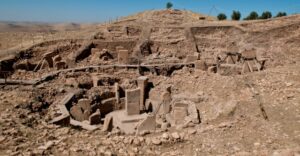
In the highlands of southeastern Turkey, near the present-day village of Örencik, lies a place that has overturned everything we thought we knew about the dawn of civilization: the Göbekli Tepe, the “Loop with a Belly,” as it means in Turkish.
The Turkish word for “Turkish-kept” means “the Turkish word for ‘wolf”, as it means in Turkish. Its story begins some 11,500 years ago, at the dawn of the Neolithic Age, and is connected to the deepest mystery of human existence: when and how man began to think, to create, to believe.
Until its discovery, archaeologists thought that people of that time were hunter-gatherers living in small groups, wandering, without permanent settlements, without complex social structures, without monumental architecture. But the Göbekli Tepe changed everything.
Göbekli Tepe challenges the dominant narrative
In 1994, German archaeologist Klaus Schmidt, from the German Archaeological Institute, found the site and, with his team, began excavations on a seemingly ordinary hill. Soon, they discovered something that would shock the scientific community: huge T-shaped stone columns up to six meters high and weighing more than 15 tons, arranged in circular formations.
Fifty-five hundred and fifty-five hundred and fifty-five hundred and fifty-five hundred.
These columns were not just stones. They were covered with artistic representations of animals -lions, foxes, snakes, boars, hawks-, carved with such precision that it is evident that their creators had already mastered a sophisticated level of artistry.
The complex also includes multiple rectangular spaces, which, it is believed, were not intended for habitation but for ritual activities.
This discovery has caused a huge revision in our understanding of Stone Age man.
Until then, researchers believed that permanent settlement and agricultural production preceded the creation of monumental structures. That is, first people learned to cultivate the land, organized themselves into communities, developed religious systems, and only then did they begin to build shrines.
The Göbekli Tepe challenges this narrative. Here we see hunter-gatherers constructing a religious centre millennia before the discovery of agriculture – a twist that forces us to rethink the order in which civilisation evolved. https://www.youtube.com/watch?v=n-phVB-EmR8
The oldest known religious complex in the world
Many scientists believe that the Göbekli Tepe is the oldest known religious complex in the world. The huge stone stelae, arranged in huge circles, appear to have served as shrines, places of worship, and possibly sacrifice. The site is located in fertile Mesopotamia, very close to Mount Karaca Dağ, which research points to as the possible cradle of the first cultivated cereals.
This leads some researchers to hypothesize that Gebekli Tepe may have been in a transitional period: a time when people began to congregate around sacred centers, which in turn led to the development of agriculture and permanent settlement. That is, it was not agriculture that brought religion and culture, but the need for rituals, for collective identity, that may have prompted people to stay in one place and experiment with farming.
The scope of the site is vast. To date, about 1.2 hectares have been excavated, but geophysical surveys indicate that the complex extends over more than 22 hectares.
This means that most of it remains buried, with unknown secrets hidden underground. The sense of mystery is heightened by the fact that around 8000 BC, Göbekli Tepe was deliberately covered with earth and abandoned. No one knows why.
Was it a ritual closing of the circle? An attempt to protect it from enemies? Or did social and religious practices change, making the monument obsolete?
Transcends the boundaries of archaeology
The significance of the Göbekli Tepe transcends the boundaries of archaeology. Some researchers compare it to the Garden of Eden, as it is located within the so-called Fertile Crescent, the region where the first great civilizations, such as the Sumerians, who developed writing, were born.
It is as if we are seeing the first stage in a long chain of cultural evolution: from the engraved stones of Ghebecli Tepe to the cuneiform tablets of Mesopotamia, and from there to the first cities and empires.
Excavations, which continue to this day, have unearthed findings that show that people of that time had far more complex knowledge than we imagined. The frescoes, the sculptures, the techniques of quarrying and transporting the huge stones prove that collective organisation and labour were required. This contrasts sharply with the image of the isolated, wandering hunter, living alone or with a few people. To build the Göbekli Tepe, dozens, perhaps hundreds of people had to work together to plan, execute, and maintain a project of extraordinary complexity.
The impact of discovery on science is enormous
The influence of discovery on science is enormous. Klaus Schmidt used to say that the Göbekli Tepe is not just a monument, but a challenge to the understanding of human history itself. Whereas until recently we thought that religion was a by-product of civilisation, the Göbekli Tepe shows that it may have been its cause. The gathering of people around a common place of worship may have created the need for new forms of social organization, for more stable food, for more durable shelter, leading ultimately to the very birth of civilization as we know it.
At the same time, the Göbekli Tepe also changes our narrative of the human imagination. The columns are full of symbols that are not just about hunting or food. Many depict mythical creatures, abstract shapes, and even elements that may relate to early attempts to understand the sky and constellations. We have no written sources, but through the sculptures, we can guess at the existence of symbolism, legends, and perhaps even early religious cosmologies.
UNESCO inscribed the Göbekli Tepe on its World Heritage List in 2018, recognizing its uniqueness. Today, it is one of the most important archaeological sites in the world and attracts scientists, historians, and travelers who want to be in the place where, as many say, “history began.” Despite dozens of years of research, each new excavation raises more questions than it answers.
The Göbekli Tepe remains a mystery, not because we don’t understand its technique, but because we don’t understand its motivation. Why was so much effort and energy invested in a work of such magnitude? What need pushed people who did not yet know how to cultivate the land to work together to build a temple? Perhaps the answer lies in man’s need to make sense of the world, to find explanations for life, death, nature, and the unknown.
Looking at its silent columns today, one feels the weight of time. It is not only an archaeological site, but a mirror of our own origins. A place where early humans gathered, not to build houses, but to find meaning.
In the Göbekli Tepe, the soil holds not only the secrets of the past, but also the first spark of our civilization.
Ask me anything
Explore related questions