





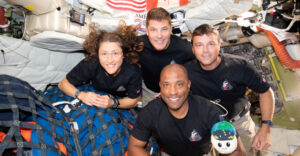
On the dawn of the (Great, for Orthodox Christians) of Saturday 11 April, humanity will be assured that it has successfully the most audacious mission to the Moon in the history of space travel. The return to Earth of the Orion spacecraft – or, more accurately, what’s left of it – is estimated to take place at 3:07 a.m. Saturday.
Orion’s return is anything but a simple process. Mainly because it is the most sensitive and the most dangerous phase of the Artemis II mission. As paradoxical as it may seem, in fact, some critical components, such as the thermal shielding of the capsule inside which the four astronauts live, have never been tested in the extreme conditions Orion will face on its trajectory to final landing, in the Pacific Ocean, about 100 km off the coast of San Diego, California, USA.
As Orion’s passenger compartment will penetrate Earth’s atmosphere traveling at about 40,000 km/h (11.2 meters/second), the friction of the penetration will cause a heat shock of about 2,760 degrees Celsius. The safe return, the survival of the four astronauts, the men who have gone further than any previous mission in lunar exploration, depends on the strength of the Avcoat, Orion’s casing. It is composed of 7.62-centimeter-thick layers of silica fibers, epoxy resins, embedded in a nest of cellular fibreglass.
The dimensions of the capsule are 4.5 metres in diameter by 2.7 metres in height – that is, something like a conical box or a relatively large wardrobe. The thermal enclosure is designed to decay in a controlled manner, so that it dissipates the terrifying heat of entry into the atmosphere, protecting the lives of the crew.
However, in 2022, when NASA conducted real-world simulations of what might happen during the spacecraft’s re-entry to Earth, the decay of the envelope did not occur as scientists predicted. Instead, pieces of the fuselage came off irregularly and were blown off in all directions. This caused great concern to the experts, forcing them to carry out a drastic revision and upgrade of the Avcoat heat shield. Again, however, the new, improved shielding was not tested in real conditions, only in experimental simulations, as there was not enough time.
NASA also modified Orion’s orbit and inclination during its return to Earth in order, precisely, to limit the stress duration of the materials used on the capsule’s exterior. There have even been harsh criticisms levelled against the Artemis II mission managers by experts on the thermal resistance of materials, who have warned that the Challenger and Columbia tragedies occurred on the basis of the same facile logic.
Of course, NASA denies any accusations of inadequacy of Orion’s thermal shielding. Elementary logic dictates that no one, ever, would put the four astronauts in mortal danger, let alone given the previous, painful experience of the space shuttles that broke apart during their reentry phase back to Earth.
In any case, and as anxiety mounts over whether everything will go smoothly for Orion, the drifting program predicts that the capsule will take about 14 minutes after it breaks through the fiery barrier of atmospheric friction to fall into the waters of the Pacific. The speed of the fall will be minimized by using the spacecraft’s propulsion mechanisms, which will substitute for braking. At the same time, a series of parachutes will be deployed that will also help to smooth the landing.
Specially trained divers will already be around the perimeter of the Orion crash site, ready to extricate the astronauts and transport them, by inflatable raft, to the US Navy’s amphibious transport ship John P. Murtha.
As usual, the quartet of astronautswill remain in quarantine, undergo medical examinations and, after about a week of readjusting their bodies to Earth’s gravitational conditions, will return to their daily lives. Which, along with infinite retellings of the tales of what they experienced in space, will certainly include an attempt to convince the suspicious that the Artemis II mission did indeed exist and that it was not a staged performance, as conspiracy theorists are expected to claim, ad nauseam.
Ask me anything
Explore related questions




