





Nearly four years after a Chinese spacecraft component struck the Moon, another impact created a fresh lunar crater on Wednesday morning—this time from the upper stage of a SpaceX Falcon 9 rocket that had been drifting through space for more than a year.
The collision had been anticipated for days by both NASA and SpaceX and provided scientists with a rare opportunity to study how a large, human-made object from Earth interacts with the Moon’s surface, which is normally shaped by meteorite impacts.
Impact Confirmed by ESO Telescope
Although NASA and SpaceX have not yet released official images or statements confirming the event, the impact was detected by the European Southern Observatory’s (ESO) Very Large Telescope (VLT).
Scientists observed spectral signatures of sodium and lithium in the dust cloud produced by the collision, which remained visible for approximately five to ten minutes.
According to an ESO social media post, the sodium likely originated from the lunar surface, while the lithium may have come from the Falcon 9 rocket stage itself.
South Korea’s Danuri Captures Before-and-After Images
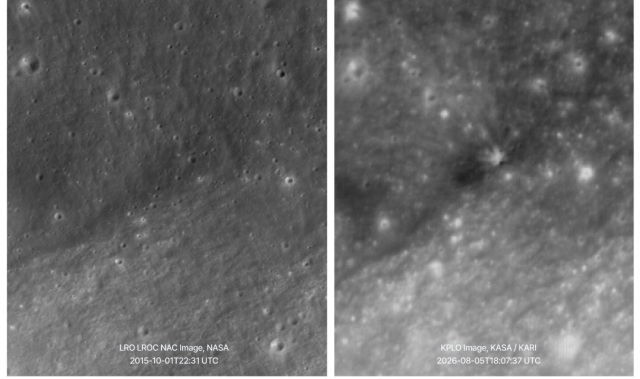
According to the Korea Aerospace Research Institute (KARI), the impact occurred at 09:34 a.m. Greek time. South Korea’s lunar orbiter Danuri captured images showing noticeable changes to the terrain surrounding the impact site, along with debris patterns created by the material ejected during the collision.
Korean scientists had begun monitoring the area about 30 minutes before the impact, allowing them to obtain images of the same location both before and after the event for direct comparison.
The new data will be combined with observations from NASA’s Lunar Reconnaissance Orbiter (LRO) as part of joint international lunar research efforts.
Struck the Moon at Nearly 8,700 km/h
At the moment of impact, the roughly four-ton Falcon 9 upper stage—about the size of a school bus—was traveling at approximately 8,690 kilometers per hour (5,400 mph).
The collision occurred near the lunar terminator, the boundary separating the Moon’s sunlit hemisphere from the side still in darkness.
According to Reuters, the impact produced a cloud of dust that briefly reflected sunlight for a few seconds. However, the flash was too faint to be visible from Earth without specialized instruments.
NASA: Similar Impacts Have Happened for Decades
Before the collision, NASA Administrator Jared Isaacman noted that comparable impacts have a long history.
He explained that during the Apollo program, NASA intentionally crashed spent rocket stages into the Moon to conduct scientific and seismic experiments.
Isaacman also pointed out that meteorites strike the lunar surface almost every hour, while impacts comparable in size to the Falcon 9 event occur roughly once every six days.
He added that future lunar bases are expected to rely on reusable spacecraft that will serve not only as transportation for astronauts and cargo but also as part of the infrastructure supporting long-term missions.
SpaceX: The Impact Was Not Planned
In a separate statement, SpaceX clarified that the Falcon 9 upper stage was not intended to crash into the Moon.
The company explained that a combination of timing, solar activity, and gravitational forces eventually altered the rocket’s trajectory, placing it on a collision course with Earth’s natural satellite.
SpaceX said such incidents are uncommon but can occur with objects in similar orbits. The company added that it is working with NASA on improved methods for managing and disposing of spacecraft components left in deep space.
The company also reiterated its commitment to more sustainable spaceflight through Starship, which is being developed as a fully reusable spacecraft.
The Falcon 9 Mission
The Falcon 9 rocket launched on January 15, 2025, on a mission to the Moon carrying two robotic spacecraft: Firefly Aerospace’s Blue Ghost-1 and ispace’s Resilience lunar lander from Japan.
After completing its mission, the rocket’s upper stage was unable to return to Earth’s atmosphere and remained in space until its orbit eventually intersected with the Moon, resulting in Wednesday’s impact.
Ask me anything
Explore related questions




