






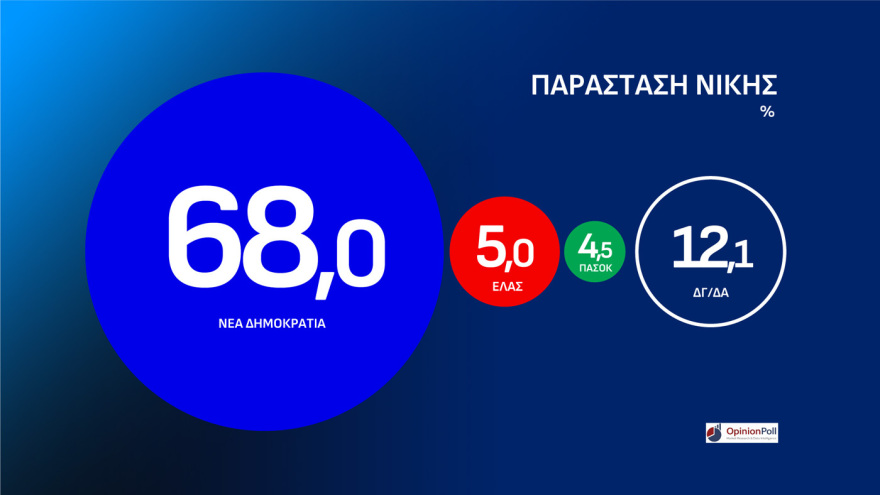
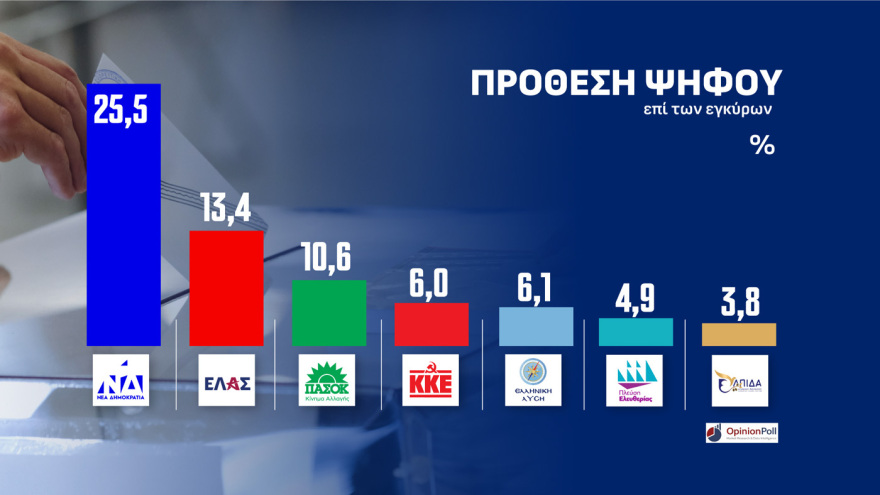
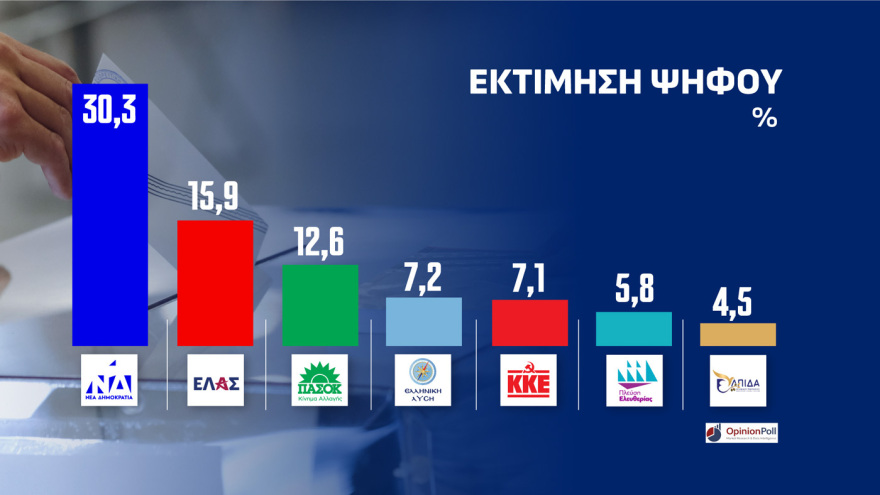
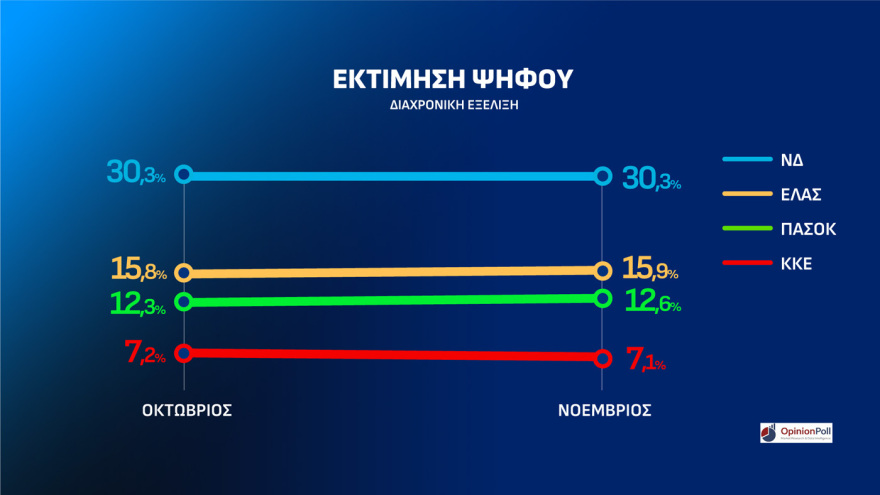
The November poll by Opinion Poll, presented on Action 24’s main evening news bulletin, shows only marginal changes compared with the previous month. In voting intention estimates, New Democracy remains at 30.3%, with a 68% chance of winning the election, while ELAS rises from 15.8% to 15.9% and PASOK from 12.3% to 12.6%.
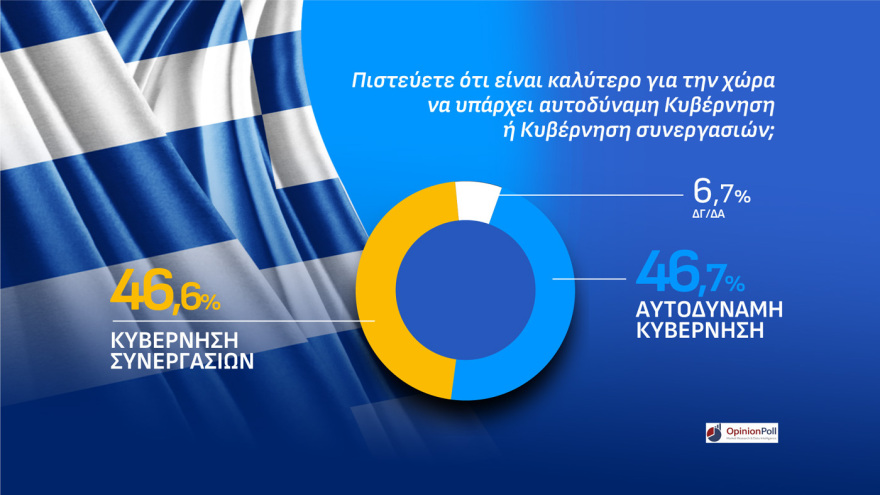
New Democracy therefore remains comfortably in first place, 14.4 percentage points ahead of the consistently second-placed ELAS, which leads PASOK by 3.3 points, compared with a 3.6-point gap in October. Notably, 46.7% say they prefer a single-party government, compared with 46.6% who favour a coalition government.
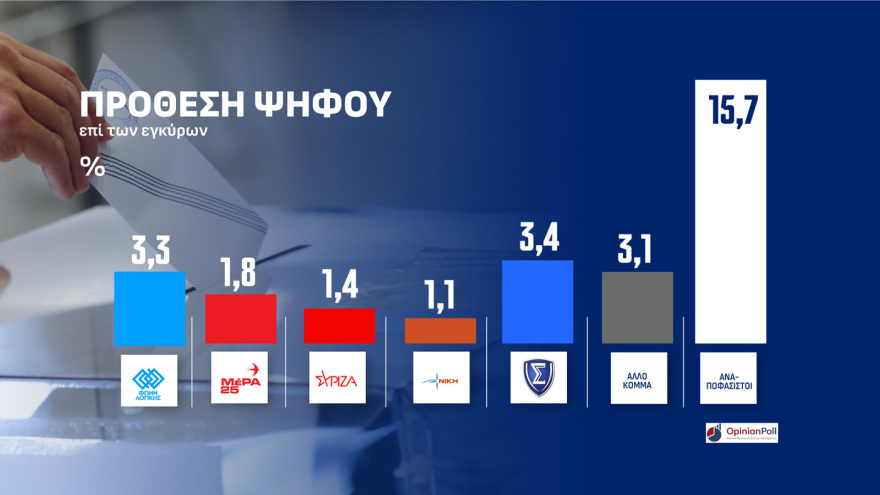
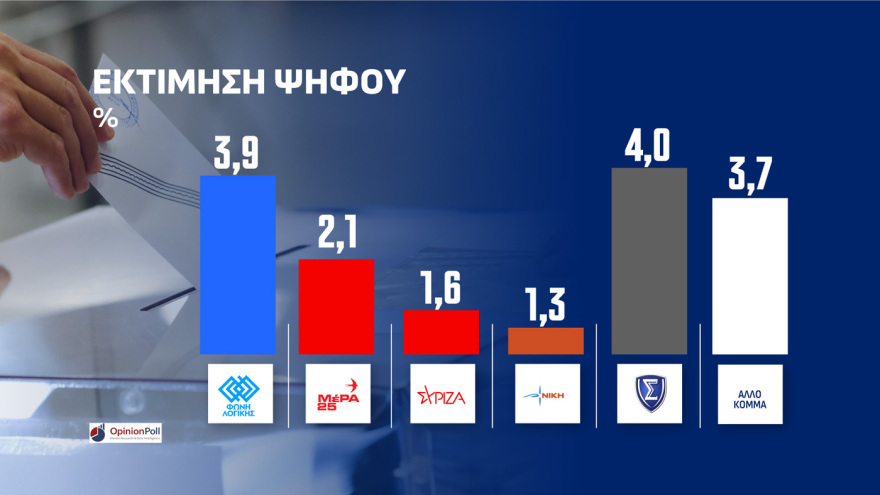
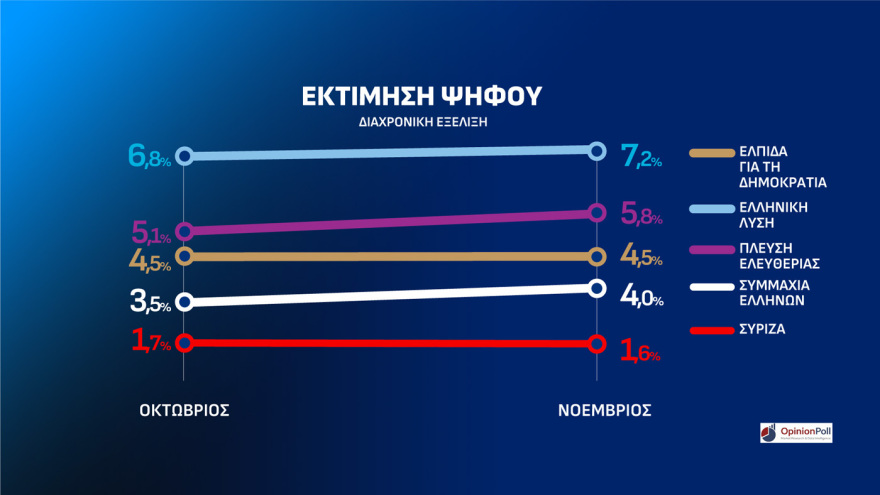
As for the other parties, Greek Solution recorded a small gain, rising to 7.2% from 6.8%; the Communist Party of Greece (KKE) remained virtually unchanged at 7.1%, compared with 7.2%; Course to Freedom rose to 5.8% from 5.1%; Maria Karystianou’s Hope for Democracy remained steady at 4.5%; SYRIZA stood at 1.6%, compared with 1.7%; and Niki at 1.3%, up from 1.1%.
Voice of Reason also gained ground, rising to 3.9% from 3.5%. MeRA25 fell to 2.1% from 2.7%, while the Alliance of Greeks recorded a small increase to 4% from 3.5%. The category of “Other party” stood at 3.7%.
The analysts at Opinion Poll noted that the “Other party” category also includes, among others, New Left, Stefanos Kasselakis’s Democrats and the Spartans, all of which are polling well below 1%.
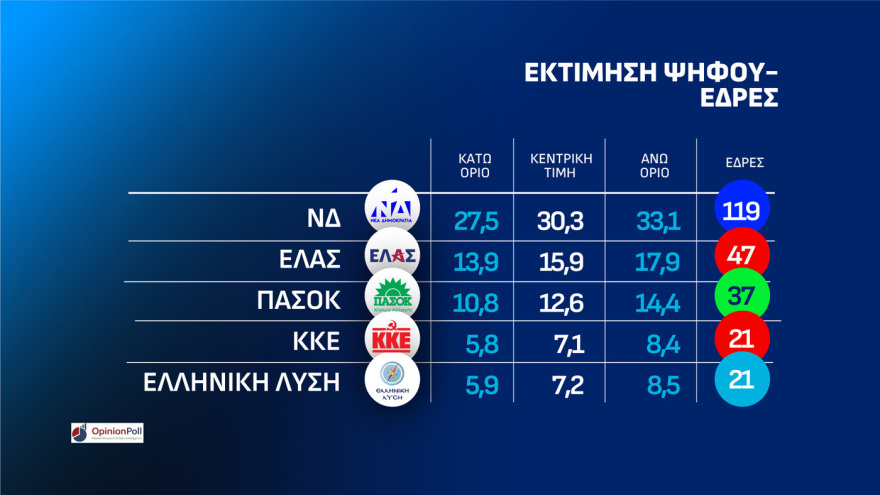
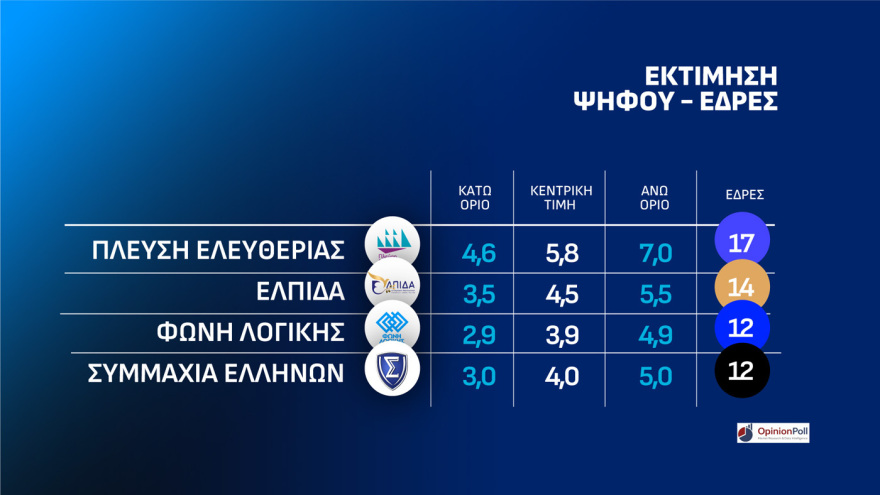
Based on these figures, Opinion Poll’s analysts forecast a nine-party parliament, with seats distributed as follows: New Democracy 119, ELAS 47, PASOK 37, Greek Solution and the KKE 21 each, Course to Freedom 17, Hope for Democracy 14, and Voice of Reason and the Alliance of Greeks 12 each.
Given that parties failing to enter parliament account for a combined 8.7%, the threshold for a single-party parliamentary majority stands at 37%. It is also noted that parties to the right of New Democracy collectively attract around 20%.
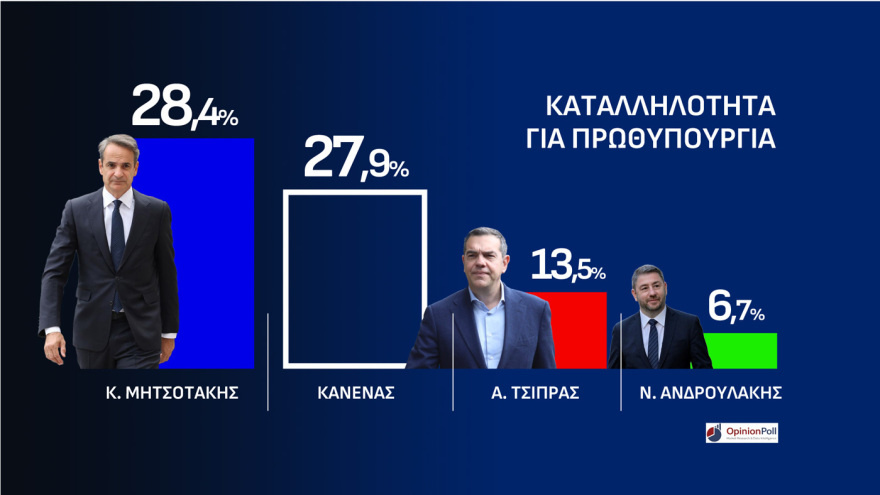
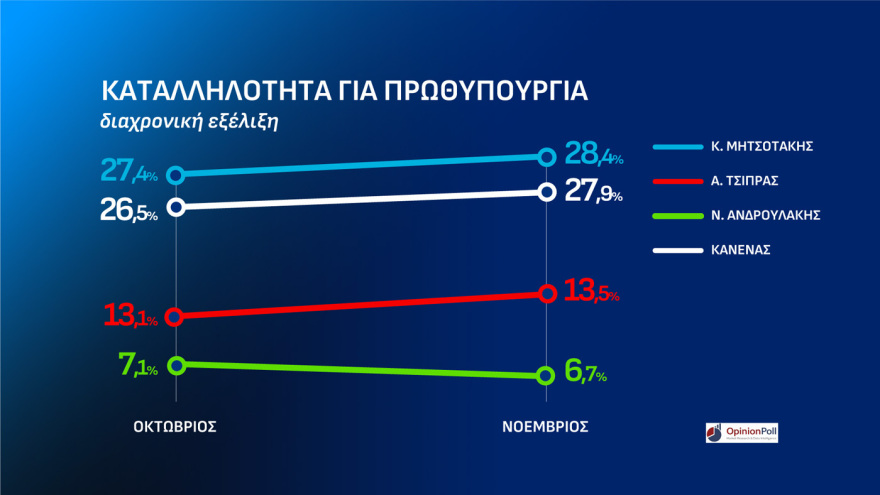
On the question of who is best suited to serve as prime minister, Kyriakos Mitsotakis receives 28.4% of preferences, up from 27.4%, compared with 13.5% for Alexis Tsipras, up from 13.1%, and 6.7% for Nikos Androulakis, down from 7.1%. The “None” option stands at 27.9%, up from 26.5%.
A positive assessment of the Mitsotakis government’s record is expressed by 31.4%, while 66.7% have a negative view. The highest share of positive opinions is recorded among New Democracy voters, at 68.9%, followed by PASOK voters at 24.8%.
The undersea cable and Greek-Turkish relations
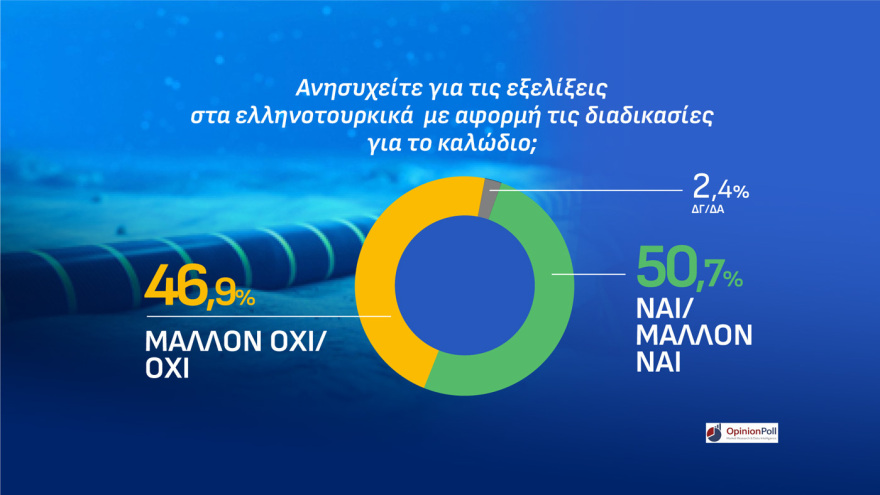
A total of 50.7% say they are concerned about developments in Greek-Turkish relations following the start of the cable-laying process, while 46.9% say they are not.
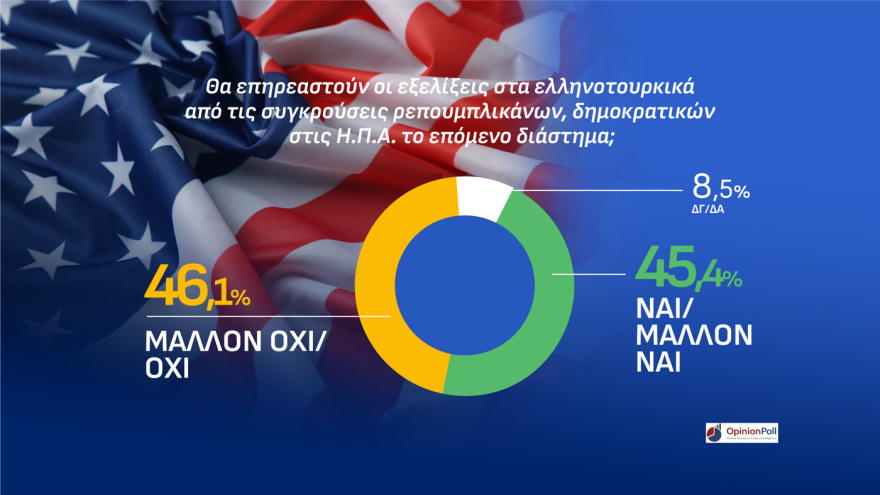
Some 45.4% believe that developments in Greek-Turkish relations will be affected by the clashes between Republicans and Democrats in the United States, while 46.1% take the opposite view.
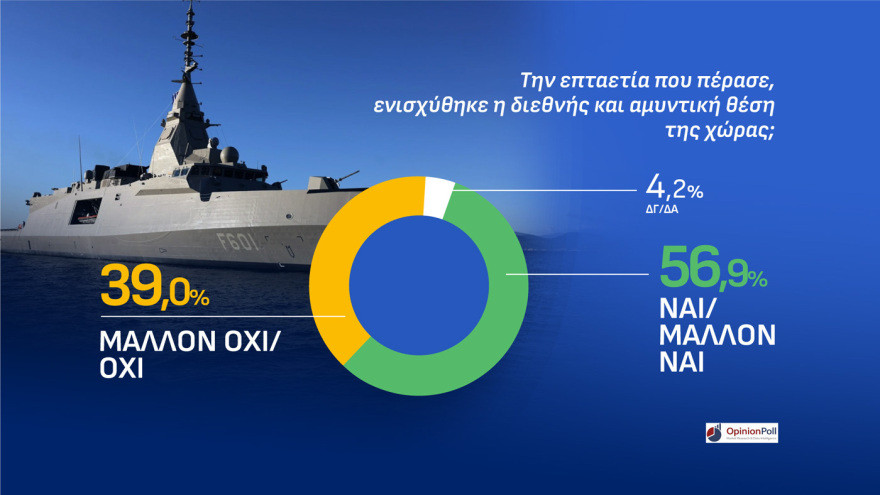
Nevertheless, 56.9% believe that the country’s international standing and defence position have been strengthened over the past seven years. A total of 39% disagree. The highest levels of positive opinion are recorded among New Democracy, PASOK and Greek Solution voters, at 82.9%, 62.4% and 51.9% respectively.
Cost of living and living standards
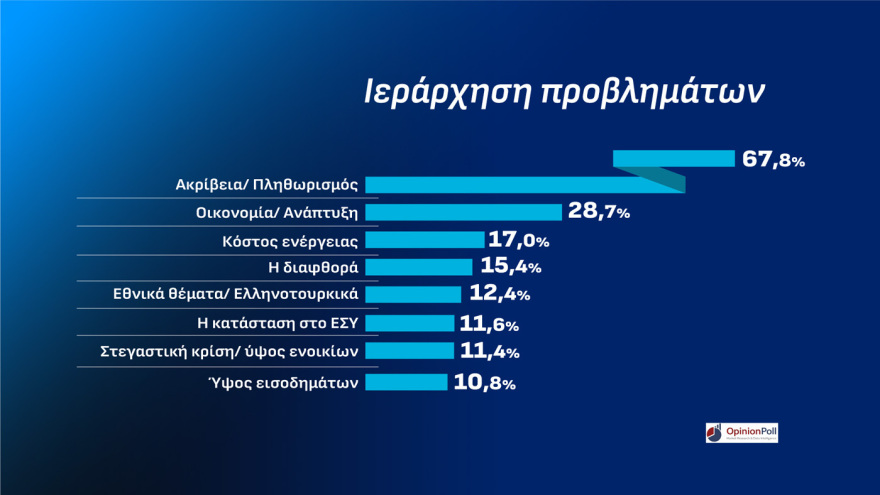
The cost of living and inflation are identified as the most serious problem by 67.8% of respondents. When the economy and growth (28.7%), the energy crisis and heating costs (17%), the housing crisis (11.4%), income levels (10.8%) and energy costs (10.4%) are also taken into account, the combined figures highlight the scale of the problem and the issues currently weighing most heavily on citizens. Respondents were allowed to give up to three answers.
Corruption also ranked highly, at 15.4%, according to the company’s analysts, while Greek-Turkish relations were cited by 12.4%.
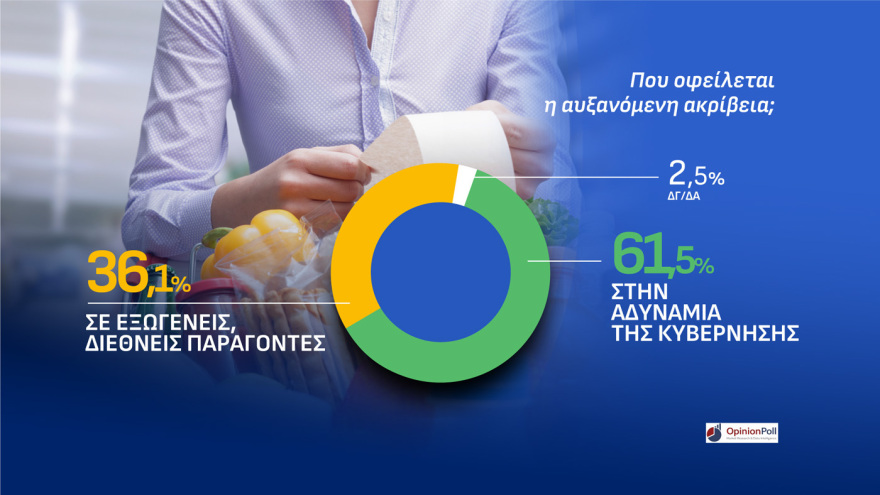
A total of 61.5% believe the government bears primary responsibility for the high cost of living because of its inability to tackle the problem. Meanwhile, 36.1% believe that rising prices are mainly attributable to external, international factors, such as wars and the global energy crisis.
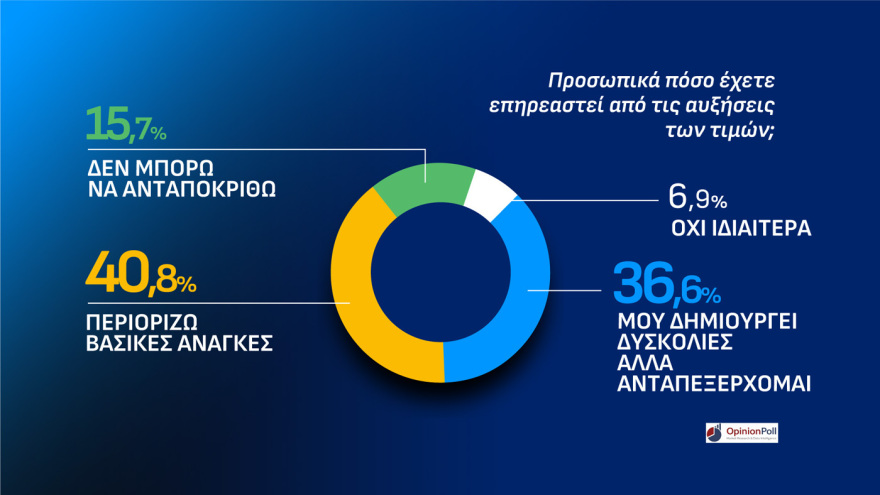
Some 6.9% say they are not particularly affected by the cost of living, while 36.6% report facing difficulties but managing to cope. At the same time, 40.8% say they are being forced to cut back on basic necessities, while 15.7% say they are unable to make ends meet. The latter two groups account for a combined 56.5%.
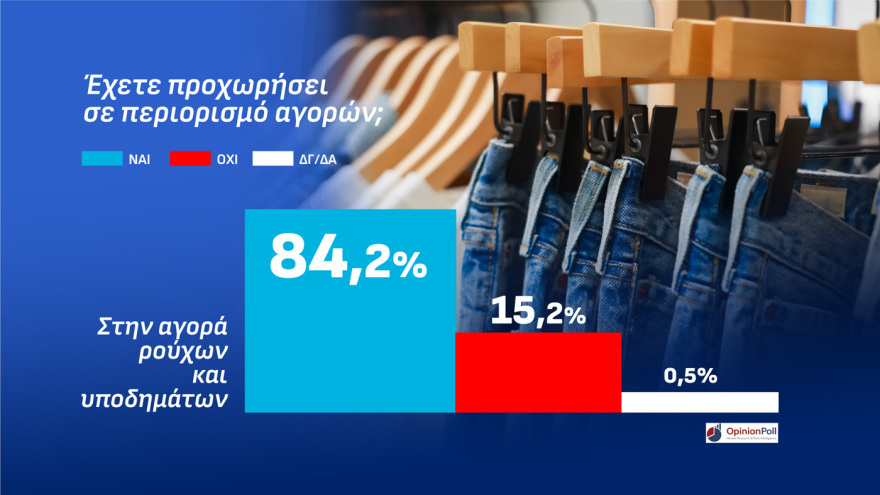
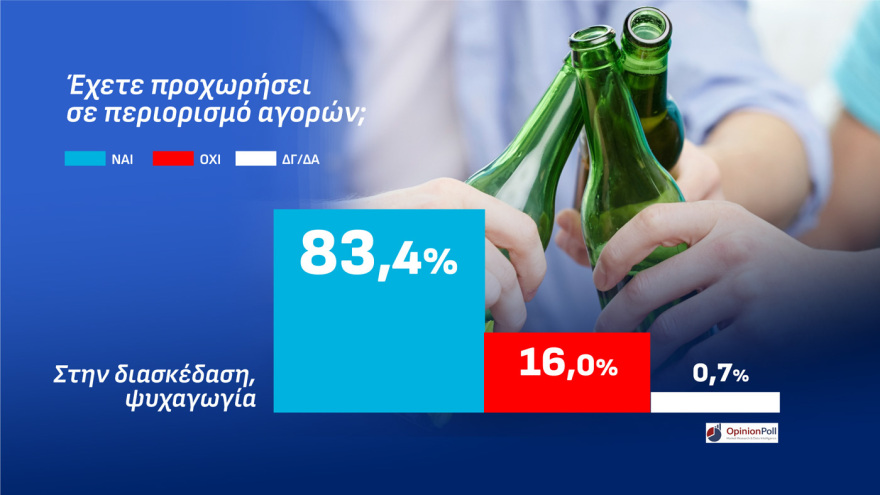
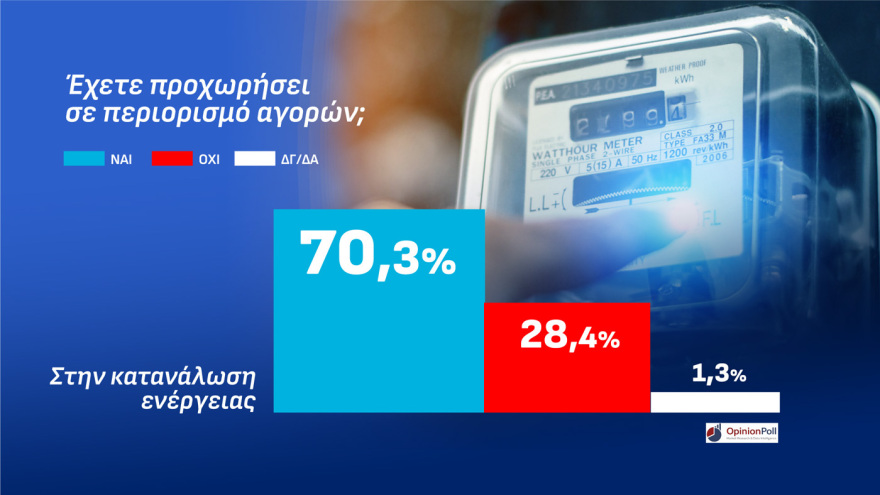
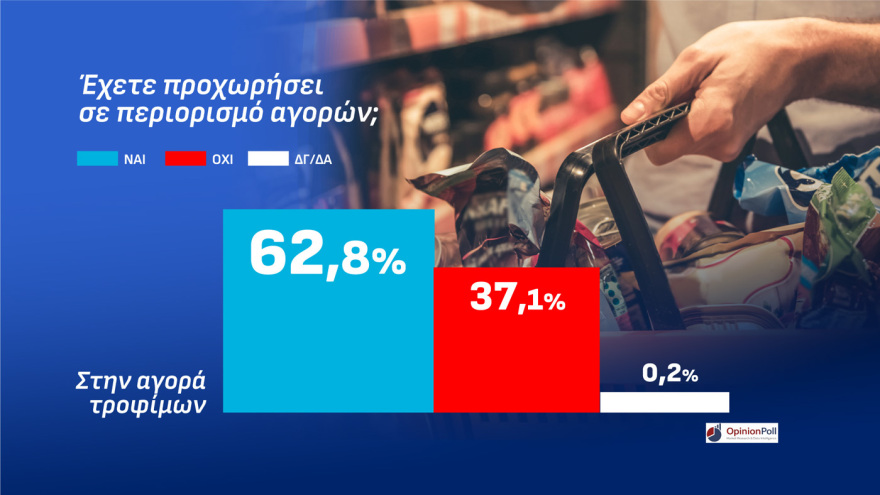
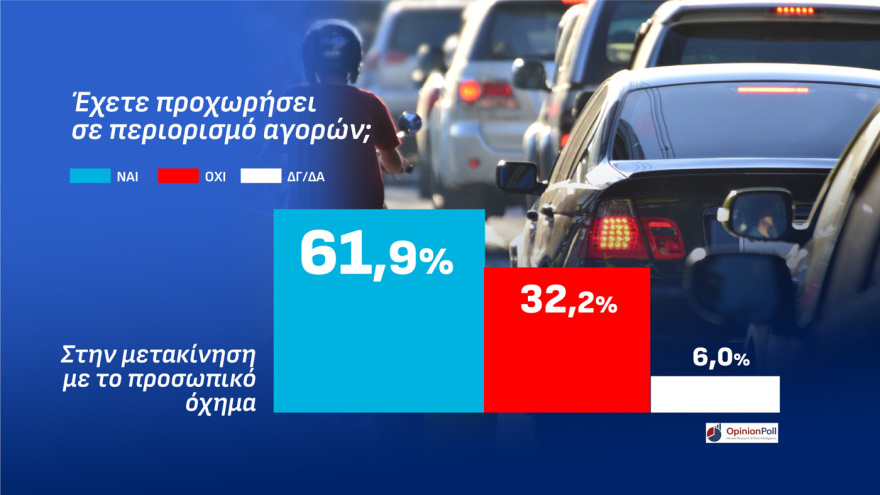
A total of 84.2% say they have cut spending on clothes and footwear, 83.4% on entertainment and leisure, 70% on energy consumption, 62.8% on food shopping and 61.9% on travel using their own vehicles.
What matters when choosing how to vote
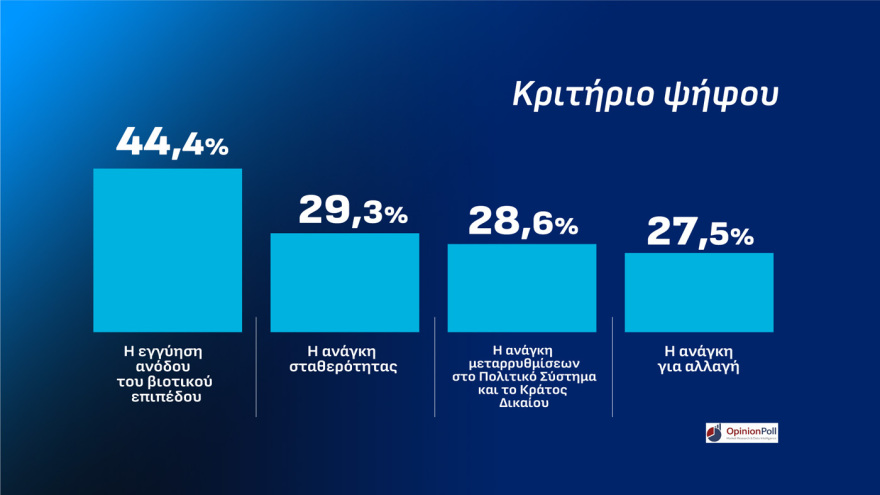
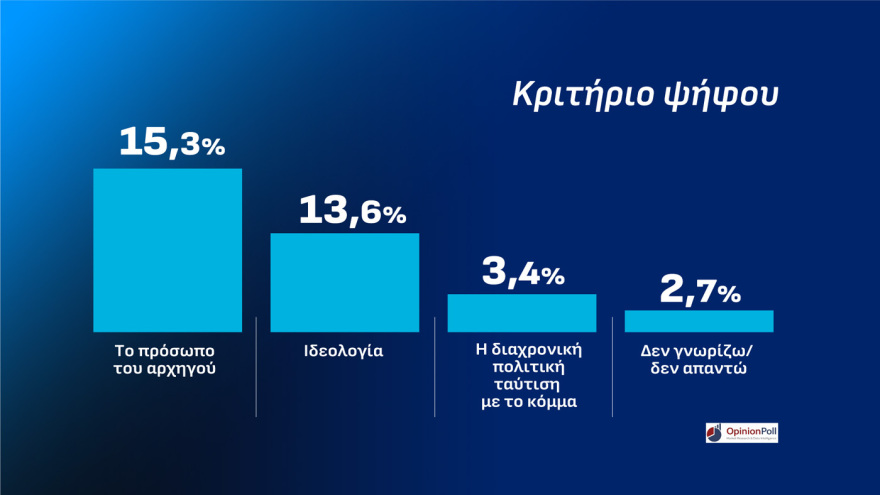
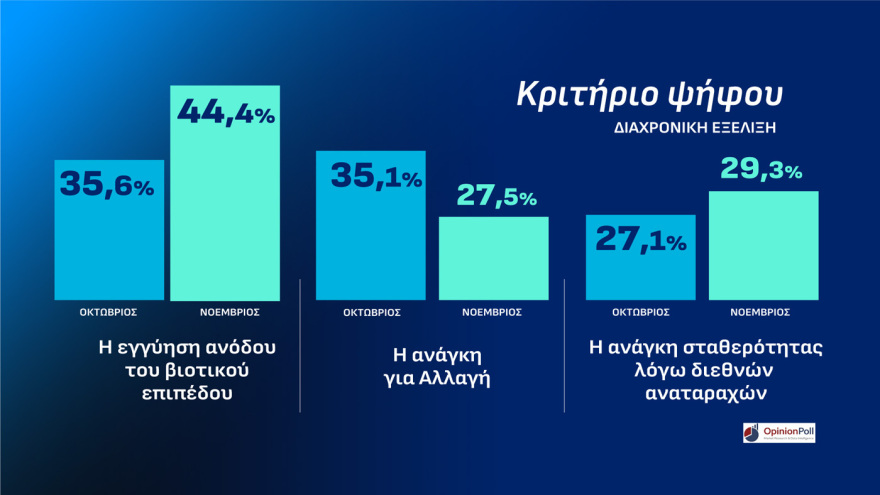
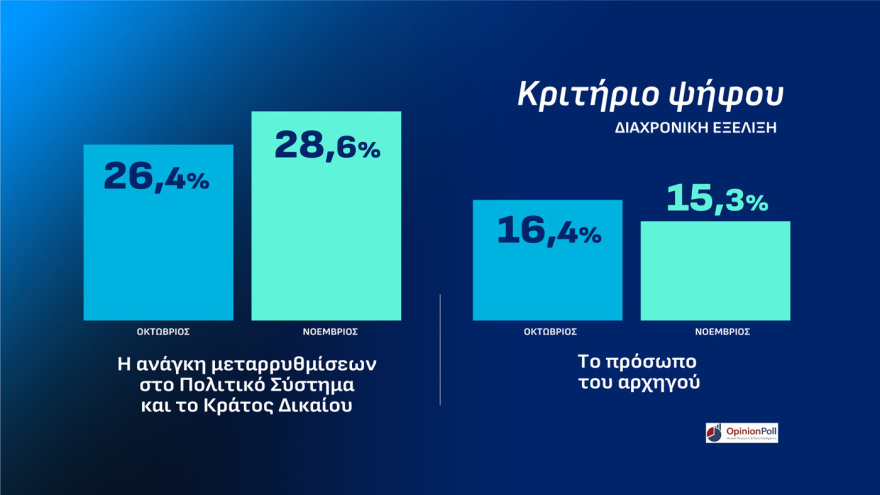
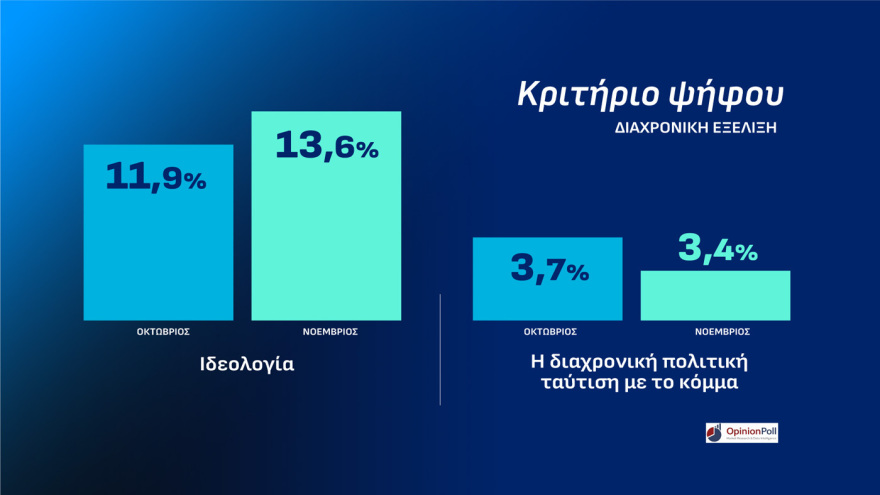
The leading factor by a considerable margin is the guarantee of maintaining living standards, cited by 44.4%. This is followed by the need for stability (29.3%), the need for reforms to the political system and the rule of law (28.6%), the desire for change (27.5%), the personality of the party leader and prospective prime minister (15.3%), ideological alignment (13.6%) and longstanding identification with a political party (3.4%).
Significant month-on-month changes can be seen in the factors influencing voting choices. For example, the importance attached to safeguarding living standards stood at 35.6% in October and has now risen to 44.4%. The need for stability increased from 27.1% to 29.3%, while the demand for reforms rose from 26.4% to 28.6%. By contrast, the desire for change fell from 35.1% to 27.5%.
See the full poll here:
Ask me anything
Explore related questions




