





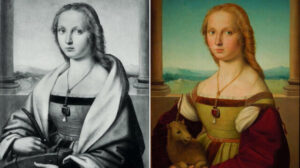
There are works in the history of art that do not easily reveal their secrets. One of these is Raphael’s Portrait of a Young Woman with a Unicorn, one of the most enigmatic works of the Renaissance.
Behind the calm figure of the young woman lies, according to the BBC, a fascinating story of transformations, ideological changes, and social expectations about the status of women.
Painted circa 1505-1506, the painting depicts a woman in a three-quarter pose, with a serene gaze and delicate features.
The composition is strongly reminiscent of Leonardo da Vinci’s Mona Lisa, but Raphael’s work is distinguished by greater clarity and composure. The young girl’s gaze is less mysterious and more steady, creating a sense of control and balance.
The unicorn and the ideal of purity
The standout element is the small unicorn that she holds gently in her arms. In the art of the Renaissance, the unicorn was a symbol of purity, as according to medieval legend, only a virgin could tame it. For this reason, many art historians believe that the painting was created as an engagement or marriage portrait, promoting the virtue and social suitability of a woman as a wife.
From virgin to saint
However, in the 17th century, the painting underwent a radical transformation. An unknown artist covered the unicorn with a new layer of paint and transformed the figure of the young woman into St Catherine of Alexandria, the Christian martyr identified by her distinctive symbol, the torture wheel.
This intervention reflects the religious and social beliefs of the time, as the ideal of the woman shifts from the future wife to the model of the pious believer who embodies devotion and self-sacrifice.
The new form remained for centuries, hiding Raphael’s original intent. The image of the woman was covered in heavier clothing, reducing the portrait’s sensual dimension and enhancing its religious significance.
The revelation of hidden layers
The truth began to be revealed in the 20th century, when experts used X-rays to examine the hidden layers of the work. During the preservation process, the later interventions were removed and the unicorn reappeared.
Analysis also showed that there was probably originally a small dog – a symbol of marital fidelity – beneath the mythical animal.
The work thus becomes a “palimpsest” of the image of woman through time. From faithful wife to pure virgin and from there to tragic martyr, the figure reflects the social perceptions shaped by male artists and patrons of the arts.
Today, the work on display at the Galleria Borghese reminds us that art is never static. Rather, it changes with society and the ideas of each era.
Ask me anything
Explore related questions




