





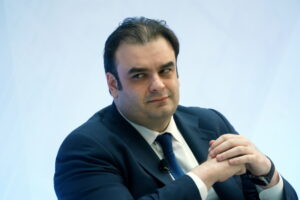
Kyriakos Pierrakakis, Minister of National Economy and president of the Eurogroup, referred to the impact of the energy crisis linked to developments in the Middle East and the challenges facing the European economy, during his participation on Tuesday morning in a discussion at Semafor’s World Economy Forum in Washington, alongside the outlet’s co-founder and editor-in-chief, Ben Smith.
The Greek minister’s participation took place in the context of his presence in the U.S. capital for the Spring Meetings of the International Monetary Fund.
The Eurogroup president described the current situation as particularly strained for the global energy market, noting that a potential prolonged disruption to shipping through the Strait of Hormuz could have wide-ranging effects on energy supply and critical raw materials, with repercussions on international prices. As he pointed out, the consequences are already being felt globally, despite the fact that Asian markets face the greatest exposure.
Referring to the European economy, he stressed that forecasts are being revised toward lower growth rates and higher inflation, clarifying that the scale of the impact will depend on the duration and intensity of the crisis. He emphasized that even under the most favorable scenario, time will be needed to restore normality in energy flows, while geopolitical risks continue to affect prices.
As for Europe’s response, he noted that emphasis is being placed on targeted and temporary support measures, aimed at protecting the most vulnerable households and strengthening business liquidity, within the framework of coordinated action among member states and drawing on the experience of the 2022 energy crisis.
At the same time, he highlighted the need to accelerate structural changes in the European economy, with a focus on strengthening the single market and removing internal barriers, as well as improving the channeling of savings into investments.
Fiscal stability, structural reforms and the digitalization of the state strengthen the credibility of the Greek economy
He made particular reference to the Greek economy, noting that fiscal stability, structural reforms and the acceleration of state digitalization have contributed to strengthening credibility and the gradual reduction of public debt. He also stressed that the experience of the crisis has highlighted the importance of maintaining a reform-oriented mindset and policy, as well as the high cost to society of delays in implementing reforms.
Finally, he noted that, despite occasional tensions, transatlantic relations retain a strategic character, expressing the view that cooperation between Europe and the United States will remain crucial in areas such as energy and technology. At the same time, he warned of the political pressures that a prolonged period of high energy prices may generate, noting that the effective and timely implementation of policies such as investments in energy infrastructure, networks and storage systems is a key factor in mitigating the impact of the crisis and maintaining social cohesion and public trust.
Ask me anything
Explore related questions




