





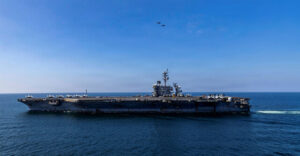
Complaints from the families of the approximately 5,000 sailors and Marines aboard the U.S. aircraft carrier “Lincoln” about conditions on the ship appear to be only one side of a much larger problem.
A new extensive report by CNN documents the crew’s exhaustion after nearly nine months on deployment, shortages of basic supplies and infrastructure problems, as well as the strain that prolonged operations are placing on the aircraft carrier itself.
The aircraft carrier “Lincoln” departed San Diego on November 21, 2025, and has remained on deployment ever since, with its mission extended because of military operations in the Middle East.
As mentioned above, its time at sea is now approaching nine months, far exceeding the U.S. Navy’s standard deployment plan, which generally calls for deployments lasting around seven months, or 210 days.
Credits: U.S. Navy/Handout via REUTERS
Even after it is replaced in the Persian Gulf, the crew will still face the long journey back to California. As a result, the “Lincoln” could approach or even break the record set by the USS Gerald R. Ford, which remained on deployment for 326 days.
“Every day we wait to find out when we’re coming home”
The picture conveyed by crew members to CNN is one of people now anxiously waiting to learn when they will finally begin their journey home.
Close
A sailor described morale aboard the aircraft carrier “Lincoln” as extremely low. “Every day we wake up and hear our captain speak. We desperately and anxiously hope to hear some update about our return,” he told the American outlet.
It is recalled that a few days ago, media outlets affiliated with the U.S. Navy, Navy Times and Stars and Stripes, reported even on attempts by sailors to jump overboard. At least two sailors attempted to jump into the sea, Newsweek reports.
Other sailors say the conditions are unlike those of their previous deployments, mainly because military operations have drastically limited stops at allied ports.
These stops are not only necessary for refueling and ship maintenance. They also give the crew an opportunity to go ashore and rest after weeks of continuously remaining at sea.
Toilets out of order, no hot water and shortages
The report also confirms the reports of problems affecting even the crew’s basic needs. At times there have been shortages of food and personal hygiene products, while malfunctions in the water supply system are ongoing.
Toilets and drinking-water stations are frequently taken out of service, while there are periods when there is no hot water.
A sailor who spoke anonymously to CNN, fearing consequences for his career, described the situation at the ship’s store. On previous deployments, he said, people could obtain whatever supplies they needed and personal hygiene products were consistently available.
Now, restrictions have been imposed on the quantities each crew member can purchase, while basic personal hygiene products are in short supply.
Reports of suicidal thoughts
Greater concern is being raised about the mental state of some crew members. A sailor aboard the “Lincoln” told CNN that he had repeatedly heard about colleagues who expressed suicidal thoughts.
The U.S. Navy, however, disputes that there has been an increase in such incidents.
“We have not observed an increase in suicidal thoughts or attempts aboard the ship,” it said in a statement to the American outlet, adding that doctors, mental health professionals and military chaplains are available to the crew.
Credits: U.S. Navy/Handout via REUTERS
“I can see my husband changing”
Families in the United States are also experiencing the pressure of the months-long deployment. The wife of a serviceman aboard the “Lincoln” told CNN that her husband describes the deployment as the worst one he has ever taken part in.
As she explained, her husband had always been someone who could leave work at work and not bring it into his personal life. Now, however, he tells her that he feels himself changing.
As she described it, he has become more angry and frustrated, behavior that, she says, is not characteristic of him. For her, the hardest part is that she is thousands of miles away and cannot do anything to help him.
It’s not only the crew that is becoming exhausted
The months-long stay at sea is also having consequences for the aircraft carrier “Lincoln” itself. Experts told CNN that the longer a deployment continues, the more critical components wear down, while repairs that can be carried out at sea are often temporary.
Smaller problems therefore begin to accumulate. Among other things, the arresting cables used to stop fighter aircraft as they land on the deck become worn, while seawater can penetrate the ship’s systems.
The more such problems accumulate, the greater the risk of an accident, experts point out.
Deployments are getting longer and longer
The problem, however, is not limited to the aircraft carrier “Lincoln.” A CNN analysis shows that the duration of U.S. aircraft carrier deployments has been steadily increasing since 2020.
The Navy normally plans three-year operational readiness cycles that include a deployment of approximately seven months. From 2018 to 2022, most deployments were completed within that timeframe or with a deviation of just a few days.
The situation began to change after the Hamas attack on Israel in October 2023 and the escalation in the Middle East.
The “Ford” aircraft carrier returned to its base in January 2024 after 260 days, while the “Eisenhower” completed 274 days before returning in July of the same year.
Three U.S. aircraft carrier deployments that began in 2024 exceeded 250 days.
In 2025, the pressure became even greater, with two deployments exceeding 270 days.
Concern over personnel resignations as well
Personnel exhaustion is now also concerning U.S. Navy leadership for another reason: there are fears that experienced personnel will choose to leave the service.
Particular concern exists over aircraft operators and specialized maintenance personnel. Earlier this year, Defense Secretary Pete Hegseth ordered an examination of personnel retention problems in the Navy’s fighter squadrons.
At the same time, annual bonuses worth tens of thousands of dollars are being offered to pilots and other naval aviation personnel in order to encourage them to remain in service.
Ask me anything
Explore related questions




