





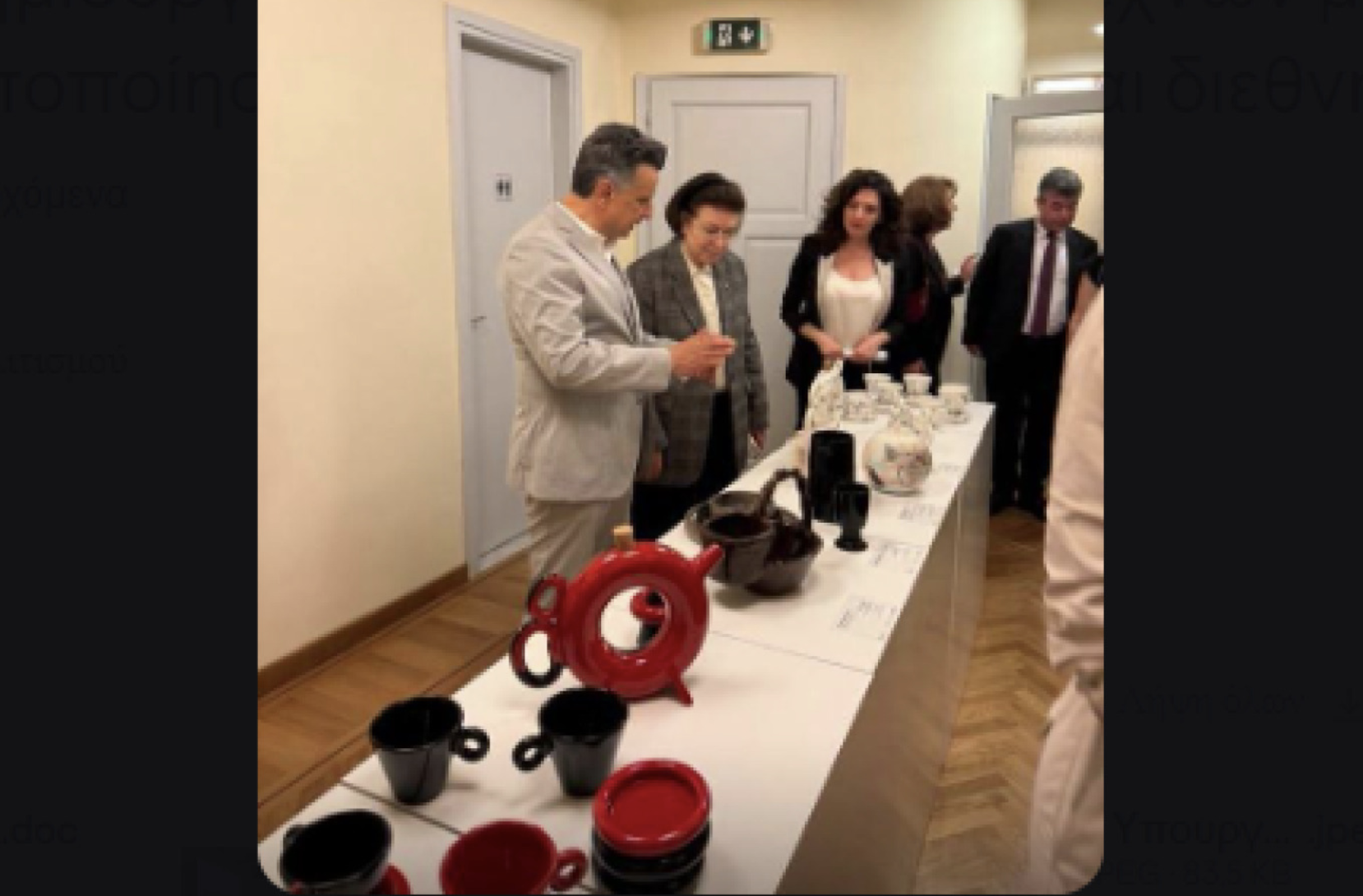
The prospects of Greek craftsmanship, the sector’s sustainable development, and its integration into modern cultural and economic life are the focus of the international conference titled “Greek Craftsmanship: Contemporary Trends and Prospects,” organized by the Ministry of Culture in collaboration with the University of West Attica, the University of Western Macedonia, and the University of Thessaly, from April 16 to 18 at Acropole Palace.
The conference is part of the Ministry of Culture’s Strategic Revival Program for Greek Craftsmanship, titled “Educational Program for the Development of Skills Related to Craftsmanship,” which created 19 craft structures nationwide using resources from the Recovery and Resilience Facility.
“The revival of Greek craftsmanship has been a strategic policy priority of the Ministry of Culture since 2019. It is not only about preserving intangible cultural heritage—an asset of invaluable worth—but also about transforming it into a modern development model, fueled by traditional practices, so that it becomes a driver of growth, employment, and the revitalization of regional Greece. The revival of Greek craftsmanship holds enormous potential, which is only now beginning to emerge. It concerns the preservation and transmission to younger generations of a vast cultural capital embedded in age-old practices that technological progress and modern techniques threaten with extinction. For centuries, craftsmanship has been both a means of survival and a form of aesthetic expression,” Minister Lina Mendoni emphasized during the opening of the conference, adding:
“Our goal today is to create a sustainable model for development and business support in the sector, a new generation of artisans with professional training, certification, business support, international networking, and the empowerment of related small enterprises. In this context, and with the funding made available through the Recovery Fund, the Ministry of Culture implemented pilot programs in weaving, ceramics, and woodworking, which are now being completed. We proceeded with programmatic agreements for cultural development with the universities of West Attica, Western Macedonia, and Thessaly, focusing on pilot educational programs lasting four semesters, under the supervision of the Lifelong Learning Centers of the collaborating universities. The programs had a total duration of 260 hours and covered the three aforementioned craft sectors, across 19 training structures established in regions with corresponding craft traditions. At the same time, we focused on studying the value chains of the three traditional raw materials—wool, wood, and clay—whose use dates back thousands of years. The educational program is now being completed, but it is already being evaluated and the next steps for its continuation are being planned. Our intention is for the program to continue, as it lies at the core of the revival of Greek craftsmanship, enabling current trainees to take the next step—either by securing employment in related fields or, ideally, by launching their own businesses.”
The first day of the conference concluded with the inauguration, by the Minister of Culture, of a group exhibition featuring graduates from the 19 Craft Training Structures. A total of 208 graduates are participating, presenting works in weaving, ceramics, and woodworking created during the educational programs (November 2024 – December 2025) implemented by the Lifelong Learning Centers of the three universities.
The conference will continue for two more days, during which topics such as mapping and analysis of raw material value chains in craftsmanship, best practices and international experiences, the multiple dimensions of craftsmanship, museums and collections, business models, and the challenges and prospects for the sector’s sustainability will be presented and discussed.
Ask me anything
Explore related questions




