





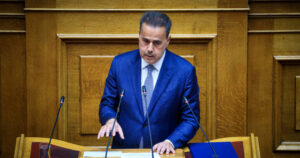
“The sun and the wind belong to everyone. We are opening the way for ‘balcony photovoltaics’ and creating the possibility for every citizen to reduce their energy costs,” said Stavros Papastavrou.
“With today’s bill, we are paving the way for ‘balcony photovoltaics,’ giving every Greek citizen the opportunity to lower their energy costs,” Papastavrou said during discussions on legislation aimed at modernizing the legal framework for the use and production of energy from Renewable Energy Sources (RES).
As he explained, “the RES Directive we are incorporating sets clear targets, establishes rules, provides definitions and criteria, and updates the existing framework.” It is “a legislative initiative through which we strengthen energy democracy by simplifying procedures and accelerating the sustainable energy transition, enhancing citizen participation in the energy market with transparency, and further increasing the share of Renewable Energy Sources in the energy mix.”
“That is why I speak of energy democracy. The sun and the wind belong to all citizens. And with today’s bill, we are opening the way for ‘balcony photovoltaics.’ The 800W systems we are enabling will allow every Greek citizen to reduce their energy costs, thus putting the concept of energy democracy into practice,” he added.
High penetration of small photovoltaics
Referring to “small photovoltaics,” the minister noted that “of the 18 GW of RES in our energy mix, about 9.2 GW come from the distribution network operator, meaning low and medium voltage. Of these, at least 80,000 installations are small photovoltaic systems.” He added that this represents one of the highest proportional penetrations in Europe, proving that in Greece energy concerns everyone—not just a few.
European directive and national targets
Papastavrou emphasized that the European directive included in the bill applies to all EU member states, which are at different stages in RES adoption. “Therefore, it does not have the same impact on all countries. Some, like Greece, have already achieved their targets and are among the leaders in the share of energy from sun and wind in the energy mix—we rank seventh globally. Other countries need these simplifications much more to boost RES penetration,” he said.
“The goal remains affordable, abundant energy for citizens, with a diversified energy mix, reduced dependence on imported fossil fuels, and energy resilience and security for both citizens and businesses,” he added.
Natura areas and urban planning
Regarding provisions related to Natura 2000 areas, he stressed that the aim is to “bring order while protecting biodiversity.” As he noted, entire cities and key infrastructure are currently located within Natura zones, including Ioannina, Kastoria, islands such as Halki and Skopelos, as well as airports and ports.
The objective, he said, is to curb uncontrolled urban sprawl and prevent illegal construction through limited, planned expansion of city plans—supported by special environmental studies within local or special spatial plans.
He also highlighted that there is always a safeguard through strategic environmental impact assessments, which include public consultation and detailed evaluation of any proposed expansion’s effects on protected areas. These plans are ultimately approved by the Council of State, ensuring legal compliance and environmental protection.
“In place of a misguided form of political correctness that does not truly protect nature, we choose to look at reality as it is today and recognize the need for balanced development—with order and rules—that meets the needs of local communities while preserving the balance between environmental protection and biodiversity,” the minister concluded.
Ask me anything
Explore related questions




