





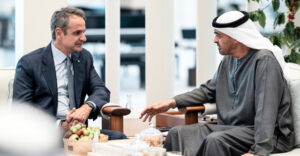
At the very moment when Emirati air defense systems, along with early warning systems on high alert, were detecting and intercepting threats from ballistic missiles and drones targeting the territory of the United Arab Emirates, Kyriakos Mitsotakis was passing through the gates of Qasr Al Watan, the imposing Presidential Palace.
Inside the vast white marble complex, beneath domes that absorb the desert heat, his fifth meeting with the President of the United Arab Emirates, Sheikh Mohammed bin Zayed Al Nahyan, was beginning.
A meeting immersed in the ceremonial brilliance of diplomacy, but also under the shadow of a region on edge.
Symbolism and messages
From the moment the Greek prime minister’s aircraft entered UAE airspace, two Emirati F-16s escorted it in precise formation, signaling the level of relations the two countries aim to maintain and deepen.
At the presidential airport, Minister of State for Foreign Affairs Lana Nusseibeh personally welcomed the Greek Prime Minister, even boarding the same car with him on the way to the palace — a gesture of high diplomatic significance underscoring the warmth of the reception. The Mitsotakis–Mohammed meeting began with a warm embrace, while in the background warning alerts continued to sound on social media and Emirati civil protection communication channels.
At the same time, the Ministry of Defense and the National Emergency Crisis Authority were providing real-time updates on new drone threats and missile interceptions, creating an almost cinematic setting for a meeting of global importance.
A central topic of discussion was the Strait of Hormuz — a fragile artery of global trade whose instability is already causing economic shocks in energy markets. Through its cooperation axis with the UAE, Athens seeks to maintain a role as a stabilizing interlocutor between the Mediterranean and the Gulf, as concerns grow over a wider spillover of the crisis.
Diplomatic momentum
At the same time, discussions covered the future of the renewal of the Greece–UAE Strategic Partnership Agreement — considered the “crown jewel” of bilateral relations. Since 2020, this agreement has built foundations of cooperation in defense, investment, technology, and diplomatic support, and is seen as the stable pillar of Greek–Emirati relations.
In parallel, the two sides signed a new memorandum of cooperation on Artificial Intelligence and innovative technologies, confirming that Athens and Abu Dhabi are investing not only in major strategic frameworks but also in the “small steps” of everyday diplomacy — where continuity and trust are built.
Throughout the Greek delegation’s stay, the Prime Minister’s office and the Foreign Ministry maintained open communication channels with key regional players. Foreign Minister George Gerapetritis held contacts with his counterpart from Bahrain, which is undertaking a diplomatic initiative at the UN Security Council regarding the Strait of Hormuz, demonstrating that Greece’s presence in the Gulf is coordinated and multi-layered.
The trilateral
The visit to Abu Dhabi, amid sirens and interceptions, served as a prelude to a broader Greek diplomatic initiative. In the coming hours, Kyriakos Mitsotakis will be in Amman for the Trilateral Meeting of Greece–Cyprus–Jordan, at a time when the Eastern Mediterranean is being tested by spillover tensions.
The trilateral meeting is expected to focus on security, energy cooperation, and humanitarian aid, particularly in light of developments in the Middle East. The Prime Minister’s participation in this critical conference confirms that Greece is attempting to position itself as a reliable mediator and stable partner between Europe, the Arab world, and the Persian Gulf.
Ask me anything
Explore related questions




