





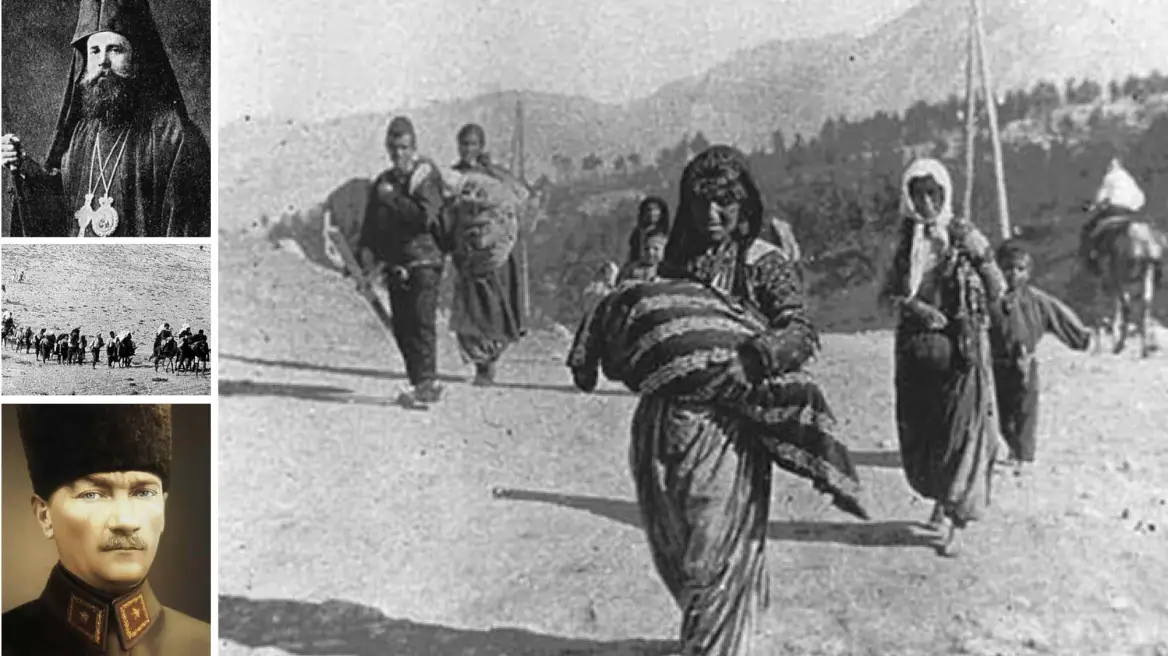
The President of the Hellenic Parliament, Nikitas Kaklamanis, called on the EU leadership to proceed immediately with the recognition of the Pontian Genocide, noting that Europe’s “strange silence” on this issue produces a “loud dissonance.”
Opening the event organized by the Pan-Pontian Federation of Greece titled “The Genocide of the Greeks of Pontus: Memory, Strategy and Internationalization of Historical Responsibility,” hosted in the Senate Hall of the Parliament, Mr. Kaklamanis stated, among other things: “In our neighborhood, the EU, although it has recognized the genocide of our Armenian brothers, maintains —until today— a strange silence on the issue of recognizing the genocide of the Pontian Greeks and, of course, avoids pressuring Turkey to recognize the genocides it has committed throughout history.” He added: “This ‘dissonance’ of the European Union is even louder when one considers that the reputable International Association of Genocide Scholars has already officially recognized the Genocide of the Pontian Greeks. Along with it, countries such as our Cyprus, Armenia, Sweden, and the Netherlands.”
The President of Parliament reminded that in 1948 the UN adopted the international application of the term “genocide,” thereby making —as he said— the official Turkish state accountable and exposed. “From this perspective and with these facts, the issue of the Genocide of our Greek-Christian populations, and specifically of Pontus, should have already been resolved for us as well, making Turkey accused of committing genocides already from the period of the late Ottoman Empire and the early years of the Turkish Republic,” he noted.
It should be noted that the Argentine ambassador was also present at the event. As Mr. Kaklamanis informed, the Argentine parliament is currently discussing a bill for the recognition of the Pontian Genocide.
The full speech by Nikitas Kaklamanis is as follows:
“The horror is not discussed
because it is alive,
because it is unspeakable and it moves forward.
It drips by day, it drips in sleep,
a remembering pain…
Ladies and gentlemen, dear colleagues,With these few verses from Giorgos Seferis’ ‘Last Station,’ I call on you today to honor united the Day of Remembrance of the Genocide of the Greeks of Pontus. Although Seferis wrote this poem much later —in 1944— I believe that his words, as always, embrace the memory, the pain, and the devastation of exile, regardless of place and time.
This year marks 107 years since the day the final act of the tragedy of the Pontian Greeks was played out.Persecutions, murders, tortures, forced labor, arsons, lootings, and deportations… These were some of the horrifying ‘methods’ applied according to a plan and with unimaginable cynicism.
Our 353,000 victims, from 1914 to 1923, were only the tip of the iceberg within a broader, systematic persecution of the Greeks that had already begun in 1911, following the decision of the Young Turks at their third congress in Thessaloniki.
It was then that they decided that ‘the wild weeds, that is, the Christians, must be uprooted’…
Based on a ‘surgical’ plan of extermination, the annihilation of the Pontian Greeks constituted only one part of the Genocide of the Greeks of the East, which was implemented in three main areas: Asia Minor, Pontus, and Eastern Thrace.
With the decisive contribution of foreign powers and the Ottoman army during the First World War, interests in the Middle East were advanced through the horrifying invention of the ‘white death’ of the labor battalions for the entire Greek-Christian populations.
On the altar of this perverse conception, 353,000 souls were sacrificed, and even more: those who suffered while still alive, far from their roots and their hearths.
Today —107 years later— the demand for the restoration of historical and humanitarian truth is more urgent than ever. From 1994, when the Genocide was officially recognized by Law 2193, to today’s successive diplomatic and political initiatives by Greece, the struggle for justice has intensified with institutional pressure on the international community, the European Union, and Turkey.
In our neighborhood, the EU, although it has recognized the genocide of our Armenian brothers, maintains —until today— a strange silence on the issue of recognizing the genocide of the Pontian Greeks and, of course, avoids pressuring Turkey to recognize the genocides it has committed throughout history.
This ‘dissonance’ of the European Union is even louder when one considers that the reputable International Association of Genocide Scholars has already officially recognized the Genocide of the Pontian Greeks. Along with it, countries such as our Cyprus, Armenia, Sweden, and the Netherlands.But even beyond the borders of Europe and our sister nations, we are joined by the United States of America with 12 states, South Australia and New South Wales, as well as individual cities and regions of Canada, which until today has not officially recognized the Genocide.
Once, in 1933 —long before the Holocaust— the Polish-Jewish lawyer Raphael Lemkin had drawn on the massacres of the Armenians to bring to light the definition of Genocide as a set of ‘systematic persecutions and mass murders under a coordinated plan of different actions aimed at destroying the basic foundations of the life of national groups, with the ultimate goal of their annihilation.’
On the basis of this concept, in 1948 the UN accepted and adopted the international application of the term as a primordial crime, thereby making the official Turkish state accountable and exposed.
From this perspective and with these facts, therefore, the issue of the Genocide of our Greek-Christian populations, and specifically of Pontus, should have already been resolved for us as well, making Turkey accused of committing genocides already from the period of the late Ottoman Empire and the early years of the Turkish Republic.
After all this, it is only natural to agree that whoever closes their eyes to History is condemned to relive it.
And it is worth remembering that today’s day is not simply a painful anniversary for a precious national asset such as the Pontian Greeks, but an opportunity for unified action.
Now is the time for yet another national effort. With prudence, understanding, and consensus. Because together we owe the truth and justice to the generations that left and to the generations that are coming.
Because we owe it to History and to memory. Because we owe it to ourselves and to our future.”
Ask me anything
Explore related questions




