





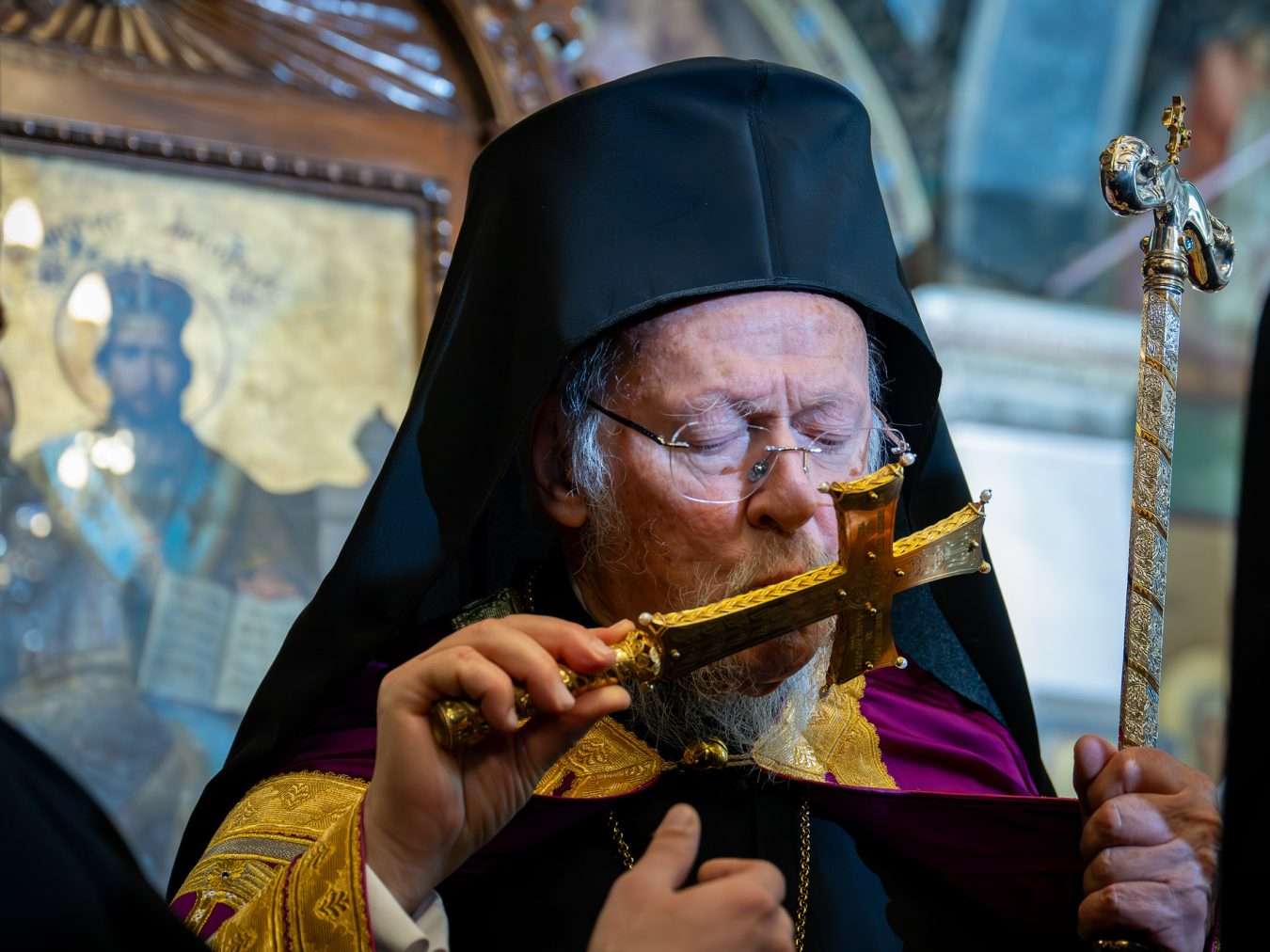
The Church of the first millennium was centered around five Patriarchs, that is, Bishops of large regions that were frequently characterized by their own particular traditions of liturgical worship and the expression of our Holy Orthodox Faith. These Patriarchs oversaw the Churches of Rome, Constantinople, Alexandria, Antioch, and Jerusalem. In the Holy Orthodox Church today, there are nine Patriarchs: those of Constantinople, Alexandria, Antioch, Jerusalem, Moscow, Georgia, Serbia, Bulgaria, and Romania.
Only one of these is known as the “Ecumenical Patriarch”: the Archbishop of Constantinople-New Rome, who since 1991 has been His All-Holiness Bartholomew, the longest-serving and one of the most consequential of all Ecumenical Patriarchs in the history of the Church. As the Archbishop of Constantinople, His All-Holiness is the 269thsuccessor of Saint Andrew the First-Called Apostle to lead the Church in what has come to be known as “the queen of cities.”
The Archbishop of Constantinople has been known as the Ecumenical Patriarch ever since the year 586, when the Roman Emperor Maurice conferred the title “Ecumenical” on the Patriarch of Constantinople, Saint John the Faster. The Emperor conferred this title in view of the fact that the Archbishop of Constantinople was Patriarch of the Church in the city that was the capital of the great empire, the superpower of its day.
This was, however, much more than just a ceremonial title or a recognition that the Patriarch of Constantinople would be honored first in prayers and at gatherings of the worldwide Church. The Ecumenical Patriarch of Constantinople had certain responsibilities that were unique in the Church.
Canon 9 of the Fourth Ecumenical Council, which was held in Chalcedon in 451, stated: “If a bishop or cleric has a disagreement with the metropolitan of the province, let him appeal to the Exarch of the Metropolis, or to the throne of the Imperial City of Constantinople, and let him be tried there.” Canon 17 added: “And if any one be wronged by his metropolitan, let the matter be decided by the exarch of the diocese or by the throne of Constantinople, as aforesaid.” Canon 28 spoke of how the Church of Constantinople had “equal privileges” to those of the Church of Rome.
Although these particular ecclesiastical responsibilities of the Church of Constantinople were known and established by the time the Patriarch of Constantinople was granted the title “Ecumenical Patriarch,” the Pope of Rome, Saint Gregory Dialogos, was alarmed. Saint Gregory understood the title to meaning that Saint John was being proclaimed the universal bishop of the entire Church, in the sense that the Church now had only one bishop, and all the others had been dethroned.
Saint Gregory wrote in strong terms to Saint John: “Whoever calls himself universal bishop, or desires this title, is, by his pride, the precursor to the Antichrist…. May all Christians reject this blasphemous title – this title which takes the sacerdotal honor from every priest the moment it is insanely usurped by one.”
That was not, however, what the title “Ecumenical Patriarch” really meant. It did not establish the Patriarch of Constantinople as a super-bishop at the expense of all the others. It did not mean that the Patriarch of Constantinople had any authority beyond the limits of his own ecclesiastical jurisdiction except that which the Council of Chalcedon and other Ecumenical Councils had granted.
Since it was at that time and remains today the responsibility of the Ecumenical Patriarch of Constantinople to adjudicate disputes between bishops, he has an authority that is truly ecumenical. This does not mean, however, that he has full, ordinary, and immediate jurisdiction over every diocese everywhere, after the manner of the Pope of Rome in the understanding of the Roman Catholic Church. It does not mean that he is personally infallible in his pronouncements on matters of faith and morals, as, once again, the Roman Catholic Church teaches about the Pope of Rome.
The title “Ecumenical” for the Patriarch of Constantinople does mean, however, that His All-Holiness Ecumenical Patriarch Bartholomew, following in the footsteps of his holy predecessors, is truly “first among equals”: a bishop like other bishops, a priest like other priests, and a Christian like other Christians, but at the same time one who has been chosen by Almighty God for a special responsibility for the preservation and defense of the Church worldwide, without infringing upon the rights or privileges of other bishops anywhere.
As such, the Ecumenical Patriarch is the foremost guardian of the Church’s unity and integrity around the world. Thanks be to God for the inexpressible gift!
Ask me anything
Explore related questions




