





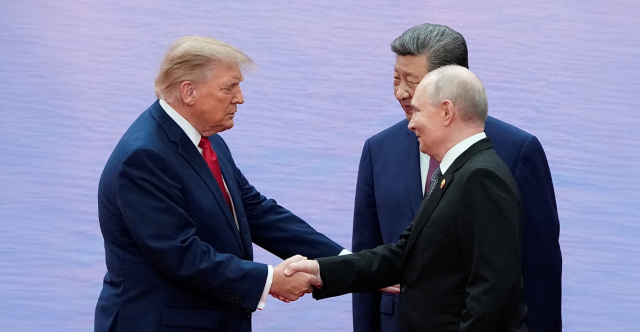
Shortly before the Asia-Pacific Economic Cooperation (APEC) leaders’ group photograph, Russian President Vladimir Putin approached US President Donald Trump. The two presidents shook hands and exchanged a few words at the official welcome dinner in Shenzhen, China. Tomorrow, Thursday 19 November, they will sit down together with Chinese President Xi Jinping for the first time. Trump and Xi will meet beforehand for their third meeting of 2026.
Xi had gone to the airport earlier to welcome the US president, returning the gesture Trump made in September when he met him at Andrews Air Force Base outside Washington. A few hours later, the Chinese president and his wife, Peng Liyuan, welcomed their guests to dinner. As Trump entered, an ensemble of string and wind players performed ‘America the Beautiful’. The US president paused to listen, applauded briefly and raised his fist before turning towards the cameras.
Washington, Moscow and Beijing have yet to announce a detailed agenda for tomorrow’s three-way meeting. Trump has already said publicly that he wants to discuss limiting nuclear weapons and ending the war in Ukraine with Xi and Putin. Beijing has made only a broad reference to peace and stability in relations between the major powers. For Putin, who held a separate meeting with Xi today, taking part in the three-way talks carries political weight in itself. More than four years after the invasion of Ukraine, the Russian president will sit across from the leaders of the world’s two largest economies, including a US president willing to discuss with him how to end the war.
Why Xi chose Shenzhen
In the late 1970s, few would have chosen the area across from Hong Kong to showcase the achievements of the Chinese economy to foreign leaders. At the start of the following decade, however, Deng Xiaoping chose Shenzhen as a testing ground for opening China to foreign investment. Four decades later, the city of about 18 million people has more skyscrapers than New York, is home to some of China’s biggest technology companies and even has networks that deliver food by drone.
For Xi, the city offers a setting in which to illustrate the case he made today to business leaders from across the Pacific. As the United States raises tariffs and restricts China’s access to advanced American technology, the Chinese president defended free trade in a city that owes much of its wealth to it. Speaking to the same audience, Putin chose to address Western sanctions. Both leaders were clearly sending a message to Washington. Xi was also speaking to Asian economies that trade with both China and the United States and are already feeling the effects of their dispute.
Tomorrow’s meeting with Trump will focus on more specific issues. In Washington in September, the two presidents agreed to extend their trade truce by two months. Washington now says Beijing is still restricting rare earth exports and is pressing China to honour its commitments to buy US agricultural products. Rare earths are of direct concern to American industry. Agricultural purchases matter just as much to Trump, two weeks after the Republicans suffered a heavy defeat in the midterm elections.
Beijing rejects the US allegations over rare earths and has its own objections to decisions taken in Washington in recent days. The new US restrictions also cover Chinese companies that remotely access advanced processors installed in data centres outside China. A Chinese artificial intelligence company can, for example, use computing power from a centre in Singapore without a single American chip crossing the Chinese border. That is precisely what the United States is seeking to restrict. This issue links the bilateral talks in Shenzhen to the Nvidia case and the US authorities’ investigation into Megaspeed’s activities in Singapore.
Trump himself put Ukraine on the agenda
Before Trump left for Asia, his aides told reporters that Ukraine was off the agenda for the three-way meeting. On Tuesday, the US president gave a different account. He said he saw scope for ending the war, citing the losses the Russian military suffers each month. By the time Trump arrived in China today, Moscow had announced no change to Putin’s terms.
The mere prospect of talks on Ukraine explains why references to a ‘new Yalta’ have resurfaced, chiefly in Russia. The circumstances are far removed from those of 1945. Kyiv and European capitals have a specific concern. If Trump asks Putin tomorrow under what conditions he would stop the war, the Russian president will have the opportunity to set out his territorial and political demands in Xi’s presence. Ukraine, whose territory is at stake, will be absent from the table, as will the Europeans who would be asked to support any agreement.
For Beijing, the comparison with Yalta is of little use. Xi wants to show that China can bring the US and Russian presidents into the same room. He also has every reason to guard against the impression that the three are claiming the right to decide for other countries. The same summit is attended by leaders and representatives of Pacific economies that Beijing is trying to persuade it can be trusted.
What could be agreed on nuclear weapons
Trump’s most ambitious aim for the visit is to persuade Russia and China to open talks with the United States on their nuclear arsenals. New START, the last treaty limiting US and Russian deployed strategic nuclear weapons, expired in February. The two countries have decades of negotiations behind them and know what it takes just to agree on how each side will verify the other’s compliance.
Talks with China would start from a different point. Its nuclear arsenal is growing, though it remains considerably smaller than those of both the United States and Russia. Beijing cites that difference when rejecting proposals that it accept limits. Rose Gottemoeller, who negotiated New START on behalf of the United States, believes that even a joint statement from the three countries in favour of opening talks would be a substantive outcome. It would allow Washington to continue negotiations separately with Moscow and Beijing. That gives a measure of what to expect on Thursday. The three countries have yet to agree even to begin such a process.
The Strait of Hormuz and concern in Taipei
On Iran, Washington and Beijing share at least one interest. Restoring normal shipping through the Strait of Hormuz matters directly to China because of energy costs and to the United States because of its ongoing war with Tehran. Beijing has channels of communication with the Iranian leadership, as does Moscow. The question for Trump is whether Xi or Putin will agree to put pressure on Tehran and what they might ask of the United States in return.
In Taipei, Taiwan’s presidential office said today that it was in close contact with Washington ahead of the meetings. The statement came in the same week that two Russian military aircraft flew along the island’s eastern coast. For Taiwan, what matters is what Trump says to Xi in private and whether he restates the US position with Putin also in the room.
In the early 1970s, when the United States sought closer ties with China, the deep distrust between Beijing and Moscow gave Washington a significant diplomatic advantage. Tomorrow, Trump will sit across from two leaders who have built a close relationship and had the opportunity to discuss their positions before meeting him. Putin has already ensured that Moscow’s voice will be heard on Ukraine. Xi will already have discussed trade and technology directly with Trump. For the US president, who spoke of ending a war and limiting nuclear weapons before he even reached Shenzhen, the hardest part of the visit begins after the handshake.
Ask me anything
Explore related questions




