





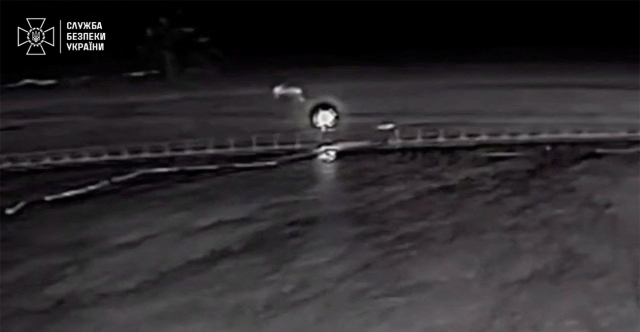
A seven-stage operation, prepared over several weeks and involving hundreds of drones, long-range missiles and a new communications system, led to the collapse of one of the most important sections of the Kerch Bridge, which connects Russia with occupied Crimea.
The Ukrainian attack, completed in the early hours of November 17, caused extensive damage to the structure that Vladimir Putin had personally inaugurated in 2018, creating serious problems for the supply of Russian forces in southern Ukraine.
In an extensive report, The Guardian reveals the background to the operation through accounts from military personnel who took part in it, while the BBC presents the seven-stage plan, the scale of the destruction and the military consequences for Moscow.
According to experts who spoke to the British broadcaster, the damage is so severe that fully restoring road traffic could take more than a year.
The seven stages of the operation
The destruction of the Kerch Bridge was the result of a seven-stage operation that Ukrainian forces had been preparing for several weeks.
According to the BBC and The Guardian, the plan involved weakening Russian air defences, inflicting initial damage on the bridge and then delivering a final strike using hundreds of drones and long-range missiles.
– First stage: For several weeks, the Ukrainians carried out targeted strikes against the air-defence systems protecting the Crimean region, with the aim of reducing Russia’s ability to intercept Ukrainian weapons.
– Second stage: At the same time, Ukrainian forces struck radars and equipment used by the Russians to detect and counter enemy drones and missiles.
– Third stage – the first attack on the bridge: On November 16, Ukrainian drones struck the bridge, causing visible damage to the large arch of the road section. The bridge remained standing and traffic was temporarily restored.
– Fourth stage: On Monday evening, hundreds of Ukrainian drones were launched from different locations towards Crimea. According to The Guardian, their purpose was to occupy Russian air defences and make it more difficult for them to counter the subsequent strikes.
– Fifth stage: A second wave of drones was used as a system for relaying images and radio signals in real time. Until then, Ukrainian forces had been using Starshield, the military version of Elon Musk’s SpaceX Starlink system, for medium-range attacks in occupied territories.
However, approximately ten days before the operation, restrictions had been imposed which, according to the Ukrainian side, prevented drones from reaching speeds greater than 161 kilometres per hour. SpaceX maintains that no such slowdown has occurred, a claim that Ukrainian President Volodymyr Zelensky has described as false.
According to The Guardian, the Ukrainians appear to have found a way to circumvent these restrictions by creating their own communications network. The drones in the second wave effectively operated as relay stations, transmitting images and signals between Ukrainian forces and the weapons heading towards the bridge, without having to rely on Starshield. This made it possible to continue the operation despite the restrictions which, according to Kyiv, had been imposed on the American satellite system.
– Sixth stage: This was followed by the launch of Ukrainian Flamingo cruise missiles, which can carry up to 1,000 kilograms of explosives. According to The Guardian, the exact number of missiles has not been confirmed, although some reports put the figure at at least four.
– Seventh stage: In the early hours of November 17, the attacks caused the collapse of the large arch of the road section, which measured 227 metres in length and weighed thousands of tonnes. Approximately 200 metres of roadway also fell into the sea along with it, while the adjacent railway structure may also have sustained damage.
Kremlin spokesperson Dmitry Peskov nevertheless assured the public that the bridge “will be rebuilt and will be even better than before”.
The consequences for the Russian military
Beyond the damage to the infrastructure, the attack creates serious problems for the supply lines of Russian forces in southern Ukraine. Moscow has transformed Crimea into an extensive military base, with airfields, ammunition depots, training grounds and troop concentrations.
Drone and missile attacks against Ukrainian cities are also launched from the peninsula, while military equipment, fuel and ammunition were systematically transported across the bridge.
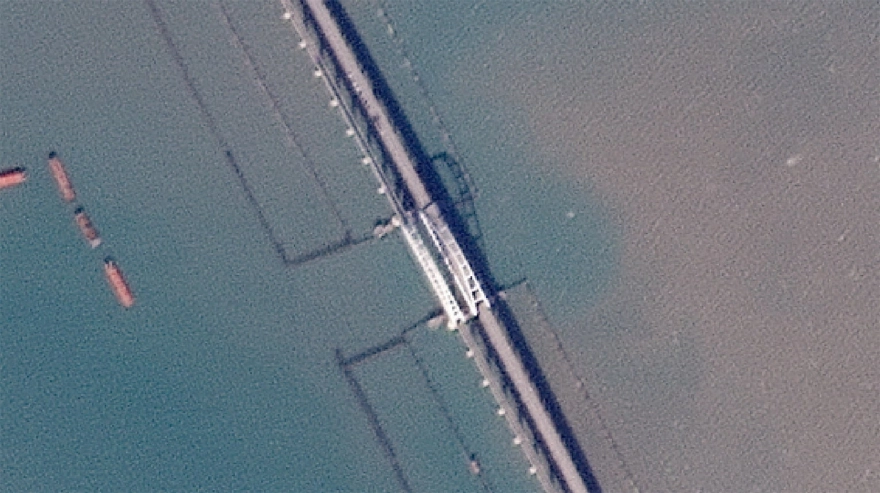
As the BBC explains, the destruction of the road section significantly increases the risk of a serious transport and supply crisis in Crimea, although it is still too early to speak of a complete blockade of the peninsula.
Russia retains an alternative land corridor through the occupied regions of Zaporizhzhia and Kherson. However, Ukraine has been systematically targeting roads, bridges and railway connections in northern Crimea, particularly in the area of Chongar.
At the same time, ferry connections across the Kerch Strait have limited transport capacity, while vessels remain vulnerable to attacks by Ukrainian naval and aerial drones.
According to the two British media outlets, the wreckage of the enormous arch may also be obstructing navigation through the passage connecting the Black Sea with the Sea of Azov, causing additional problems for the occupied ports of Mariupol and Berdiansk.
The political message to Putin
The attack appears to have been planned with a specific political objective as well.
According to a source within the Ukrainian armed forces who spoke to The Guardian, the timing was chosen ahead of Vladimir Putin’s scheduled meeting with Donald Trump and Xi Jinping on Thursday, in the Chinese city of Shenzhen, on the sidelines of the APEC summit.
“The bridge is a symbol of Putin’s power. Its destruction sends a message to the other two major leaders that Putin is not as powerful as he pretends to be,” the source said.
“What we have done shows the whole world that the king is naked. Putin is weak and vulnerable, and we have just proved it. The operation was deliberately planned for this particular historic moment,” the source added.
The Kerch Bridge was a personal prestige project for the Russian president. In 2018, he inaugurated it by driving a Kamaz truck across it himself, four years after Russia’s illegal annexation of Crimea.
The road section that he crossed at the time has now collapsed.
Ask me anything
Explore related questions




