





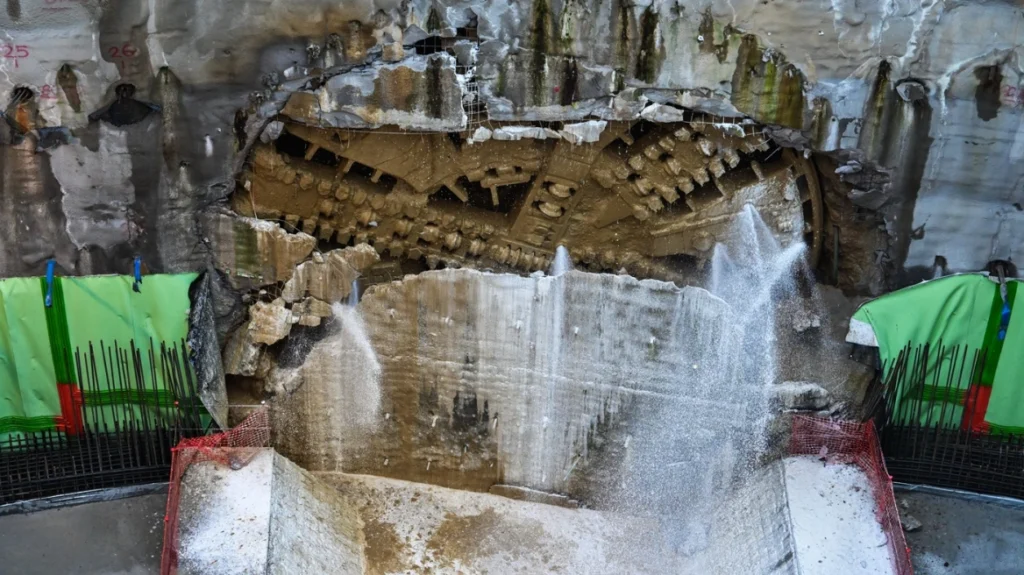
A construction solution that moves most of the work underground and drastically limits interventions in Rizari Park is being pursued in an effort to resolve one of the most difficult outstanding issues facing Metro Line 4: Evangelismos station.
The revised design, which has also been the subject of discussions with the Municipality of Athens, keeps the station in its original location but changes the construction method and the positioning of its three entrances, in order to avoid creating a large-scale surface construction site.
The solution, however, does come at a cost, as it requires new studies, amendments to the environmental permitting and additional construction work. The financial implications of these changes remain unresolved.
At the same time, the second major outstanding issue concerning Line 4, in Kypseli, continues to generate tensions between residents, the municipality and Elliniko Metro.
With the tunnel-boring machine (TBM) immobilised since last May, the British expert’s report expected on December 10, and residents’ protests escalating, Line 4 is facing two critical challenges. At Evangelismos, the objective is to turn the agreement reached into a technically feasible construction plan. In Kypseli, the priority is to address the problems affecting buildings and restore residents’ confidence before paving the way for the TBM to resume operations.
Underground construction site, starting from Vasileos Konstantinou Avenue
Of these two outstanding issues, the one concerning Evangelismos appears to be entering a new phase following the agreement to change the construction method, which aims to limit surface-level interventions and preserve Rizari Park intact.
The main change concerns the way access to the station under construction will be provided. Instead of extensive surface excavation, the work will be carried out primarily underground, making use of the existing construction site on Vasileos Konstantinou Avenue, from which the TBM emerged.
This option makes it possible to preserve most of Rizari Park, over which there has been a long-running legal dispute with shipowner Nikos Pateras, protecting the most significant trees and limiting the impact on public space. At the same time, it avoids extensive traffic interventions on Vasilissis Sofias Avenue, which had been another problematic aspect of the original construction approach.
The station itself is not being relocated. It will remain in its designated position, along the route of Metro Line 4, in the area of Rizari Street, with no change to its operational role. The revision therefore concerns exclusively the construction method and the organisation of construction-site access points, with the aim of limiting the project’s footprint at ground level.
How the three entrances will change
A key element of the new solution is the rearrangement of the station’s three entrances, which are being adapted to the revised construction approach.
The first entrance will be moved to the junction of Rizari Street and Vasileos Konstantinou Avenue, while the second will be located on the side of Evangelismos Hospital.
The third, which will also serve as the main entrance to the new station, will be situated in front of the current Metro exit leading towards Rizari Park.
At this particular location, a limited excavation pit will need to be opened. This will constitute the main surface-level intervention retained in the new design. Access to the construction site for building the entrance will be provided from the Hilton side, in order to avoid occupying a large part of the park.
These changes are intended to preserve the station’s functionality without the disruption and burdens associated with the original construction method.
The agreement with the Municipality and environmental approvals
The new solution was presented to shipowner Nikos Pateras as early as the summer, while Athens Mayor Haris Doukas also appears to support it as a means of resolving the outstanding issue concerning Evangelismos station.
According to information, the understanding reached represents a decisive step towards avoiding further legal action over this particular issue, creating the conditions for the station project to move forward.
The agreement, however, does not mean that construction work can begin immediately. The new design is currently at the stage of being developed and brought to technical maturity, as an Environmental Impact Assessment is being prepared. This will provide the basis for amending the existing Decision Approving Environmental Terms by the Ministry of Environment and Energy.
So far, no specific timetable has been established for completing the process, leaving the start date for construction under the new method uncertain. What is certain, however, is that this is not a solution that can be implemented immediately.
The cost conundrum
The biggest question mark concerns the financial implications of the change, since underground construction entails additional technical requirements and a different organisation of the work.
In the past, estimates provided by the project’s contractor indicated an additional cost of around €50 million, while more recent, unconfirmed information puts the figure at €100 million. According to sources at the Ministry of Infrastructure, the final assessment will depend on the completion of the technical studies and the additional work that will be required.
British expert’s report on Kypseli expected shortly
In Kypseli, the other major outstanding issue concerning Line 4, attention is now focused on December 10, when the report by British professor Robert Mair is expected to be submitted. The report concerns ground subsidence and damage recorded in buildings in the area during the passage of the tunnel-boring machine.
The report is considered crucial for evaluating the technical evidence and determining the interventions that will be required in order to assess whether the machine can safely resume operations. It has remained immobilised since May 8.
According to information, there is still no clear picture of the expert’s final conclusions. During his recent visit to Kypseli, however, the professor appeared reassuring about the possibility of addressing the problems through technical measures. Attention is now focused on the specific interventions he will recommend to ensure that work can safely continue, as well as their implementation costs. It is considered certain that repairing the damage will require additional expenditure, although the amount remains unknown.
The wait for the report coincides with renewed tensions in the area, as disagreements between residents, the Municipality of Athens and the contractor have intensified in recent days over the extent of the damage, the safety of buildings and the conditions under which work can continue.
In this context, the Kypseli Residents’ Initiative is calling for a large turnout at the Athens Municipal Council meeting today, Wednesday, November 18, demanding comprehensive structural adequacy assessments for all buildings within the zone of influence, full restoration of the damage, and the relocation of affected residents to suitable housing, with the associated expenses covered.
The fourth demand is also the clearest indication of the escalation in opposition, as the Initiative is calling for the TBM not to be restarted under any circumstances.
Kypseli’s growing polarisation
In a radio interview yesterday, Deputy Minister of Infrastructure Nikos Tachiaos left open the possibility of temporarily relocating residents, if this is deemed necessary either to carry out repair work inside apartments or for safety reasons.
He also referred to the reactions prompted by recent work carried out in an apartment building in the area, pointing out that the work had received the approval of the building’s management.
He attributed the tension to a local residents’ group, criticising its intervention and arguing that it was attempting to assume a role in the project’s construction process beyond the remit properly assigned to it.
Ask me anything
Explore related questions




