





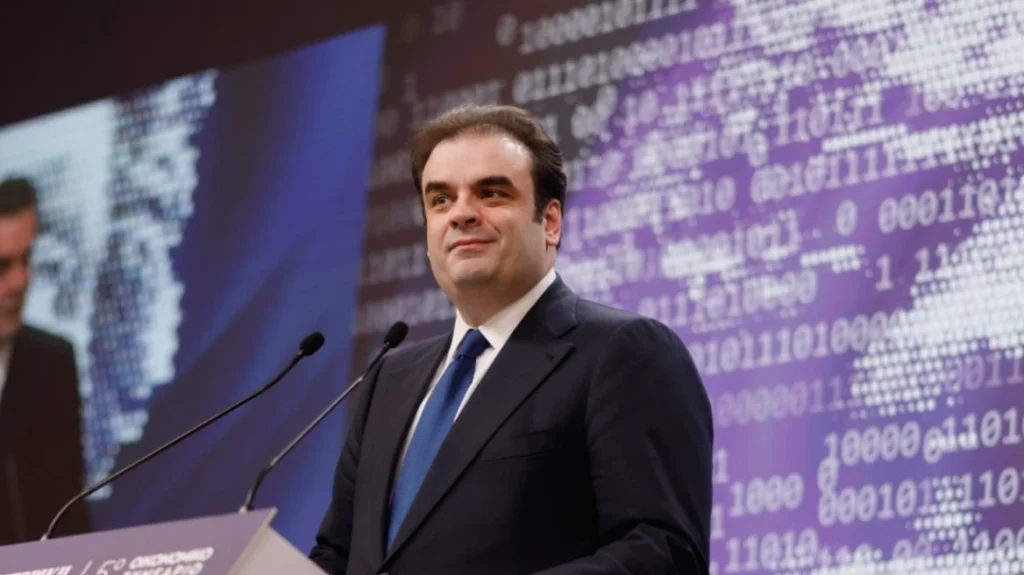
The government’s strategy for transitioning the Greek economy to a new productive model, featuring more investment, stronger businesses and greater international competitiveness, was presented by the Minister of National Economy and Finance and President of the Eurogroup, Kyriakos Pierrakakis, speaking at the 5th Naftemporiki Economic Conference.
He placed particular emphasis on the commitment to reduce electricity prices by 30% over the next three years, clarifying that this target would be achieved through investment rather than subsidies, so that the reduction would be permanent.
At the same time, he announced the creation of a new €1.5 billion lending and guarantee programme for small and medium-sized enterprises, while the Public Investment Programme will increase from €9.8 billion in 2026 to €11 billion in 2027.
Referring to the economic outlook, he forecast growth of 2% in 2026 and 2.3% in 2027, compared with 1.2% in the Eurozone, as well as an increase in investment of 7.9% in 2027. He also stressed that public debt is expected to fall to 128.8% of GDP in 2027, from 209.4% in 2020.
He made a special reference to the “savings fund for the new generation”, under which the state will provide a matching contribution to family deposits of up to €1,200 annually. He emphasised that the objective is to give young people an initial pool of capital for education, housing or business ventures.
The full speech by Kyriakos Pierrakakis follows:
Ladies and gentlemen,
First of all, allow me to express my warm thanks to Naftemporiki for the invitation. For more than a century, the newspaper has been documenting not only what is happening in the Greek economy, but also what could be done differently.
The title of today’s conference also speaks for itself, using the term “architecture”. And I believe this is a particularly appropriate choice. Because architecture resembles the economy. An economy, like a building, is not judged by its façade. It is judged by its foundations, by its design and by whether people can live a good life inside it.
As you know, as we all know, for many years Greece during the crisis – if we follow this analogy – was carrying out repairs. This was absolutely vital, because it was how the structure was saved. Today, however, we must do something different: we must design the next day as we want it to be, rather than as an emergency situation dictates, as happened in the past. This is also the thinking behind the concept of “a new architecture for the Greek economy”.
Allow me to begin here with something that usually makes us uncomfortable: rules.
For many years, rules were something imposed on us from outside. From this unpleasant situation, however, we learned a major and particularly painful lesson. A country that violates fiscal rules ends up borrowing at high costs, with others making decisions on its behalf. Conversely, a country that complies with them has the privilege of making its own decisions independently, both about the present and, above all, about its future.
The most visible proof, as was mentioned earlier, is public debt: from 209.4% of GDP – the level it had reached in 2020 – it is now projected to fall to 128.8% in 2027. This is the largest reduction in the world. And it demonstrates that discipline is not austerity. Discipline is freedom that is earned.
And allow me to say here that rules are not simply a matter of some kind of morality. They give us something far more tangible. Every euro left over precisely because the rules have been observed creates three possibilities: lower taxes, social benefits for those who need them, and strategic investments for the future.
Ladies and gentlemen,
For many years, the country was running behind developments instead of shaping them. Today, it is making its own choices.
The Greek economy is expected to grow by 2% in 2026 and by 2.3% in 2027. In the Eurozone, the forecast is 1.2%. This will be the seventh consecutive year in which Greece grows at a rate significantly higher than the Eurozone average. Seven years do not constitute a statistical coincidence. They constitute an established trend. And when a trend lasts, it changes the way the world sees a country and, above all, the way a country sees itself.
And today, we have the confidence to shape our own plan.
Where should we begin this planning? Undoubtedly, with investment. The figures here are indicative: in 2027, investment is expected to increase by 7.9%, compared with an estimated increase of 1.7% in the Eurozone.
Obviously, we still have a long way to go before reaching the European average. Let me remind you that investment stood at 11% of GDP in 2019. We are now just below 18%. The European average is 21%. Therefore, we are covering this distance as we transform our productive model, alongside doubling exports compared with the country that went bankrupt in 2009–2010.
So, as the Prime Minister also described earlier, the productive model is changing day by day. I would simply like to mention that the Financial Times, in an article published just yesterday, described Greece as an “ideal destination for foreign investors and a pillar of stability in an unstable world”. One only needs to compare the situation with that of a few years ago. This alone demonstrates and highlights just how much has changed.
As all of you know very well, the Greek economy has a very large number of small businesses and fewer medium-sized and large ones. Small businesses are part of its soul. Larger businesses, however, export more, innovate, generally pay better wages and are more resilient in times of crisis.
And for years, our system – tax-related, bureaucratic… I would say, more broadly, psychological – sent a distorted message: stay small. If you grow, we will tax you more heavily. Today, by contrast, those who grow are not punished, provided they comply with the law and fulfil their obligations. On the contrary, we are trying to establish corresponding incentives.
Our objective is to have Greek champions who will become European champions and be able to compete internationally on equal terms. Pay attention, however: the state may build the playing field, but businesses score the goals, and for that they need capital.
We obtain capital from three sources:
The first, as we have said, is foreign investment. And achieving investment-grade status was a fundamental prerequisite for enabling us to attract it.
The second is the public capital that we mobilise. With transparency, with a plan and with specific objectives. The Public Investment Programme will increase from €9.8 billion in 2026 to €11 billion in 2027, in order to maintain and contribute to the growth momentum of the Greek economy. We are also creating a new €1.5 billion lending and guarantee programme for small and medium-sized enterprises, expanding their access to financing.
Allow me to dwell for a moment on yesterday’s European Commission forecasts, particularly regarding the assessment of investment momentum following the completion of the Recovery and Resilience Facility. This is a challenge we are aware of and for which we have already designed our response. Indeed, an important source of funding is coming to an end with the Recovery Fund.
However, I would like to point out that there is already a substantial pipeline of investments that are continuing to be implemented. We are talking about contracted investment projects worth €29.3 billion, financed through loans from the Recovery Fund, bank capital and businesses’ own funds – and in 2027 alone, we estimate that €3.2 billion will be disbursed from the Fund’s loans.
To these, we must add the strengthening of the Public Investment Programme that I mentioned earlier, as well as the new financing instruments we are activating.
The third source – and perhaps the most important – is savings, Greek savings. Greeks save, but primarily they do so through bank deposits and real estate. We want to open up other avenues as well. We recently passed the legislation for the “savings fund for the new generation”, and I will return to this shortly.
Allow me also to emphasise the significant added value that our country will gain through the inclusion of the Greek stock exchange in Euronext’s pan-European network.
Our strategy is specific: we want Greek citizens to be co-owners, not merely spectators, of growth. And let us not forget that it is people who bring buildings to life.
And here lies our greatest challenge, beyond everything else: skills. Skills related to the education system, but also skills connected with our ability to bring back a large part of the country’s talent pool that is currently outside Greece.
The guiding principle here is simple: we want those who excel abroad to return to our country, and we want more and more of them to do so. They will not return out of nostalgia. They will return if they find here an opportunity worthy of the one they are leaving behind.
And it is our responsibility to make that happen. In any case, the new architecture is not limited to just one floor. Every sector must move one step higher up the value chain.
In tourism, this means not simply attracting more visitors, but extending activity throughout all 12 months of the year and providing higher-quality services that will also generate more revenue.
As for what is known as the “silver economy”, we know that an increasing number of Europeans want to spend their retirement years here, investing in second homes. We must organise this promising sector even better and more quickly.
In agriculture and rural development, moving up a level means better processing, higher-quality certification and branded products that break through the limits of the domestic market and conquer international markets.
In shipping, the Greek-owned fleet is the largest in the world. The next step is to move from ship ownership to becoming a maritime hub. Financing, insurance, legal services – the entire ecosystem should, if possible, be located here in our country.
In healthcare and pharmaceuticals, where we find some of the largest and most dynamic Greek companies operating at the technological forefront, we make no secret of the fact that our ultimate objective is for them to become European champions, within the framework I described earlier.
In defence and technology, in a world undergoing major geopolitical changes, and particularly for Europe, the era of geopolitical innocence is over. We know that security needs can and must become a driving force for innovation among Greek businesses.
And behind all of this must be stable and cheaper energy. We have committed to reducing electricity prices by 30% over the next three years, not through subsidies, but through investment, so that the reduction is stable, permanent and sustainable.
Our ambition is always to think on a larger scale, primarily European, and certainly global. The Draghi and Letta reports told us something we essentially already knew: Europe is lagging behind in competitiveness. But Greece, which was once the problem at the centre of European discussions, can today be part of the solution, with credibility and with a voice of its own.
That is why we are taking the initiative in Europe to advance discussions on banking integration, the broader Savings and Investments Union, the digital euro and the implications of artificial intelligence applications.
Our country is therefore increasingly recognising that it can and must become a regional hub at the heart of its wider area – for capital, people, energy and data – always bearing in mind that capital follows talent, not the other way around.
Wherever capable people want to live, that is where wealth goes too. And here the benefits are threefold: economic benefits, obviously, because a hub generates wealth; security, because a country that is indispensable to its neighbours can also feel safer; and influence, because in the emerging world, geography is regaining the great importance it once had.
Our country is located at a pivotal point for security and energy corridors, as well as for educational and regional hubs. This is particularly relevant to the policy we are developing to internationalise higher education in Greece and establish, for the first time, non-state universities, with the aim of attracting foreign students to our country. This is something that did not happen in previous decades; in fact, the opposite was generally the case.
And here I come to something we often forget in economic discussions.
People do not choose only a job; they choose a city. A young engineer considering returning from a Northern European city does not compare salaries alone. You know this well, including from our own family stories. They compare quality of life.
That is why housing is a central economic issue, not only in Greece but across Europe. And the response must come through public policy rather than simply leaving the matter to supply and demand.
Allow me here to emphasise the crucial role of decentralisation.
Greece is not just Athens, much as we love it – especially those of us who are Members of Parliament for Athens’ First Constituency. It is also Thessaloniki, Patras, Heraklion and Ioannina, which are increasingly becoming lifestyle choices.
All of this also presupposes a state that operates as an open system, one that is intelligent and strategic. And that means many things: removing obstacles, lower and predictable taxes, and ensuring that investors can live with a tax burden – we understand that – but they cannot live with uncertainty.
Ladies and gentlemen,
Allow me to conclude with a thought. I mentioned the savings fund earlier, and I would like to emphasise the importance of this policy.
I belong to a generation that grew up with certain images. One of them was the lump-sum retirement payment that someone would receive at the end of their working life, upon retiring. And I remember many political forces in Greece arguing that, in addition to this retirement payment, we should also have something equivalent for young people, so that they could have some money to help them get started in life.
That was the idea behind the savings fund.
We looked at what other countries in Europe and beyond were doing and decided to design an investment account, not simply a savings account, into which the state would contribute an additional euro for every euro deposited by a parent or the wider family, up to a maximum of €1,200 per year.
And I was thinking that the children benefiting from this savings fund will turn 18 in 2044. Some of them are being born in these very months. We do not even know their names yet. But we do know that in 2044 they will hold something that no previous generation has had to the same extent. Beyond the qualifications on their CVs, they will also have start-up capital in their hands, enabling them to study, establish a business, acquire a home and dare to take risks.
That, ultimately, is the new architecture. We are not building it for ourselves; we are building it for these young children.
Friends,
I will conclude by saying that our objective is certainly more growth, but also better growth: growth that relies less on consumption and more on production and exports.
To achieve this, we must remove obstacles and replace them with a Greece of opportunity and confidence – a Greece that does not complain, but knows how to take the lead, with planning and imagination.
For years, Greece did not have the luxury of looking far ahead. We lived from one assessment to the next, from one loan instalment to the next. Today, through hard work and consistency, we have earned something valuable. We have earned the right to design this new architecture, as reflected in the title of your conference, and this time we also have the plan to make it a reality.
Thank you very much, and I wish you every success with the proceedings of the conference.
Ask me anything
Explore related questions




