





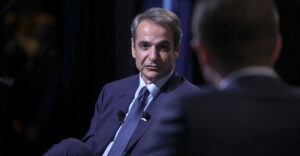
One day after the puzzle of the new political map was completed with Tsipras’ party — with the only remaining uncertainty being the possible new party of Samaras — Kyriakos Mitsotakis, speaking at the ygeiamou.gr and protothema.gr conference, clearly outlined his strategy: he described what New Democracy has done and what it will do if it remains in power and gets the chance for a third term, and contrasted this with an opposition lacking strategic direction, whose only demand is the fall of New Democracy.
He directly targeted Mr. Tsipras, something he is expected to do increasingly on the road to the elections in order to revive the two-pole dynamic of 2023, while for the first time he also targeted Maria Karystianou.
“What can I say about the name, I suppose he left EAM to Mr. Polakis,” Mr. Mitsotakis said jokingly about the name EL.AS chosen by Mr. Tsipras.
“Mr. Tsipras was Prime Minister, he was judged as Prime Minister, he was my opponent when I was leader of the opposition. He was judged as opposition leader in the 2023 elections. He will now also be judged as the leader of a party that has not yet even produced any clear footprint,” Mitsotakis said, avoiding commenting on whether it would be SYRIZA under a new legal identity.
In any case, he dismissed the content of the former prime minister’s founding declaration as a “spectacular dive” into the past, contrasting it with the strategy of himself and his government to focus on issues that concern citizens’ daily lives and the immediate future.
Mitsotakis is clearly seeking comparison with Tsipras, given that within Maximos Mansion there is a “manual” for handling the former prime minister dating back to the dual elections of 2019 and 2023, which also led to Tsipras’ resignation from the leadership of SYRIZA.
Many government officials acknowledge that New Democracy must have a counterweight, both for comparison and to present itself as an alternative in case it does not secure a third term. It is clear that as Tsipras’ new party gains momentum and presents positions and proposals, government responses will become more frequent. However, officials do not underestimate Tsipras, and there is a firm belief in government circles that the former prime minister holds a comparative advantage over Androulakis in the battle for second place.
First “shots” at Karystianou
Given that Karystianou’s party is also an unpredictable factor in the political system, Mitsotakis took a more direct position for the first time since the announcement of the founding of “Hope for Democracy”.
“Everyone will be judged. This is a special case; Ms. Karystianou is a person who emerged emotionally through a national tragedy and chose to take the step of forming a party. I always have a natural caution toward those who consider everyone else to be ‘bad, corrupt’ and more or less ‘worthy of prison’ and that ‘only we can save the country’,” Mitsotakis said pointedly.
This indicates that while there will be respect toward Karystianou as a person, the government will not leave unanswered attacks that aim to mobilize the so-called “anti-system space”. “The country has experimented with self-proclaimed saviors, and that did not go very well in the past,” he added.
More broadly, the Prime Minister is sending the message that in reality there are two poles in the political system: New Democracy, with its positives and negatives and its focus on a reform agenda, and an opposition made up of disparate forces without a coherent alternative proposal, whose only aim is political overthrow.
“I believe this is the structural problem of an opposition that is currently recycling its internal issues in a competition against a government which, despite its problems and mistakes, has a plan for the future. It is unfolding that plan. I think it was also clear from today’s discussion that we have made progress in healthcare, but we also want to do much more. We are doing it — not ‘we did it’ in the past tense. We are doing it and will do even more. I believe this comparison will be reflected in the 2027 election result, not only because citizens want stability in turbulent times, but because they primarily want a perspective,” he concluded.
Ask me anything
Explore related questions




