





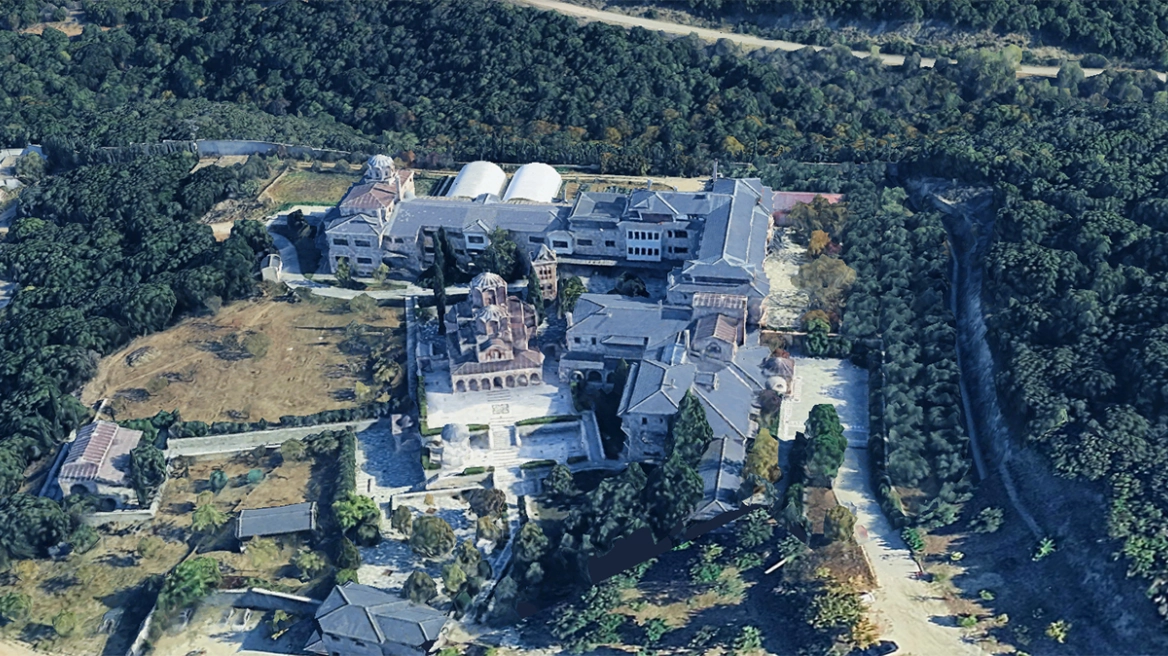
The Holy Women’s Hesychasterion “The Resurrection of Christ – Emmaus” is located on the northern slope of Mount Hortiatis with a panoramic view toward Lake Koroneia, near the village of Agios Vasileios in the Thessaloniki prefecture.
Although it is only 30 minutes from the center of Thessaloniki, the monastery truly lives up to its title if one sees where it is situated: within an enormous green landscape, constituting almost the only sign of life amid the complete silence of the natural surroundings. It thus appears ideally isolated, fitting the sacred purpose of austere monastic life.
A few years ago, however, difficult as it may be to believe, certain individuals connected to it proved excessively… restless and exploited the monastery in order to orchestrate a colpo grosso centered on the acquisition and transfer of dozens of properties.
This women’s monastery is relatively recent, having been founded in 1997, after which construction of both the main church and the rest of the monastic complex advanced rapidly. The founder and spiritual father of the monastery was Archimandrite Maximos Psilopoulos.
The central church (the Katholikon) was inaugurated in 2010, while in 2020 the chapel of Saint Luke the Apostle was completed and inaugurated. The complex was designed by Minas and Eleni Trembelas, architects specializing in the architecture of Mount Athos monasteries and Byzantine monuments.
The Holy Hesychasterion, dedicated to the Resurrection of Christ and also bearing the special title Emmaus, has fulfilled its spiritual mission since its creation under the jurisdiction of the Holy Metropolis of Lagadas.
In the past, however, there were actions by certain individuals that in no way aligned with the spiritual and charitable mission of a monastery.
The 2008 scandal
The involvement of prosecuting authorities began at the end of 2008 following complaints about suspicious land transactions. The complaints alleged that the monastery appeared to purchase various properties at normal prices, while the corresponding contracts listed values much higher than both their objective and market values. In this way, it sought and obtained loans of much greater amounts.
Subsequently, media reports citing a related report from the Financial Crimes Unit (SDOE) described a major scam that was set up mainly during the 2006–2008 period. However, the foundations had reportedly been laid much earlier.
According to the voluminous case file handled by a special investigator, authorities discovered purchases of plots with low objective values financed through inflated loans, suspicious transactions worth millions of euros through an offshore company in Liberia, money transfers through a construction company, and even investments in speculative “bubble” stocks.
All of this, according to SDOE investigations, was carried out using the monastery as a vehicle and led to serious charges initially against 35 individuals alleged to have committed a range of major offenses, from fraud and money laundering to felony-level embezzlement.
More than 30 properties, an €11.5 million blow
According to the case file, specific representatives of the monastery were accused during that period of proceeding with the purchase of more than 30 properties from private individuals, whose actual values were particularly low.
They then allegedly secured much larger bank loans because, with the cooperation of bank appraisers and employees, they managed to present the properties as being worth far more. Within this framework, they reportedly obtained a €35 million loan to repay previous borrowings.
The judicial investigation concluded that the colpo grosso damaged both the monastery and the banks by €11.5 million. Some of the accused allegedly pocketed the difference between the real value of the properties and the corresponding loan amounts. At the same time, however, the monastery itself, burdened with the massive loans, was forced to repay them.
The report by Thessaloniki’s former Special Audits Service (later SDOE) was submitted in 2011, and based on it, the Thessaloniki first-instance prosecutor filed felony charges for fraud against a private legal entity — namely, the monastery itself. The case finally reached the courts in early 2015.
By then, however, several of the initially implicated individuals had been removed from the frame either as “misled parties” or because some had died. A ruling by the Thessaloniki Council of Appeals referred three monks and three laypersons to trial on charges of repeated fraud and embezzlement against the monastery, as well as money laundering from criminal activities.
The six defendants who stood trial before the Three-Member Felony Court of Appeal were alleged to have embezzled €28 million, while the court found that their actions had been carried out without the approval of the abbess, who had already been cleared by judicial ruling.
The main defendants, under the pretext of financially supporting the monastery, allegedly approached believers to persuade them to buy farmland through loans taken out in their own names.
Within this framework, according to the proposal of the deputy appeals prosecutor adopted by the Thessaloniki Council of Appeals, the defendants entered into 29 loan agreements, obtaining unlawful financial benefit and damaging the monastery’s assets by €28 million. This included substantial sums collected for charitable purposes, such as the construction of a home for the poor and elderly, support for impoverished families, and similar causes.
The defendants were also alleged to have invested the funds between 1998 and 2008 in brokerage firms and foreign currency time deposits, while in 2007 they established an offshore company in Liberia which guaranteed a €35 million loan benefiting the monastery.
Unanimously acquitted
Ultimately, in February 2019 — a decade after the investigations began — the Three-Member Thessaloniki Felony Court of Appeal acquitted all those involved.
After lengthy proceedings during which numerous witnesses testified, the court ruled that the felony charges had not been proven and unanimously cleared the defendants. It should also be noted that the prosecutor herself had recommended acquittal.
Although all those involved were acquitted, only a few years later the loans began turning “red,” and the monastery found itself facing a storm of foreclosure auctions.
From the end of 2021 until today alone, it is estimated that more than 150 auctions have taken place against the monastery involving every kind of property, from farmland and maisonettes with swimming pools to buildings leased to public services such as tax offices and EFKA social insurance branches. The people responsible for the “investments” had evidently favored commercial properties with reliable tenants as well.
It is characteristic that despite the passage of so much time, the list of properties — one that even Real Estate Investment Companies (REICs) might envy — still has no end.
Even now, electronic auctions continue to be posted, with 17 scheduled in just the next two months. Specifically, for Wednesday, May 27, an auction was scheduled for two properties leased to the EFKA branch in Polygyros, Halkidiki.
The proceedings target the private legal entity named “Holy Women’s Hesychasterion The Resurrection of Christ,” with the special title “Emmaus,” headquartered in Agios Vasileios, Lagadas, Thessaloniki. The action is being pursued by doValue, acting as manager for Amoeba Issuer DAC, with the claimed debt amounting to €2,000,200.
Going under the hammer once again — after previous unsuccessful attempts — are the full ownership rights to a ground-floor commercial property on Strati Myrivilis Street in Polygyros, Halkidiki, measuring 614.37 square meters, housing medical offices, waiting areas, administrative services for the former IKA (now EFKA), and five restrooms for the public, staff, and doctors.
Also included is the full ownership of a connected underground storage area of 480 square meters linked internally to the above property. The starting prices are €270,000 for the ground floor and €75,000 for the basement, totaling €345,000.
These properties came into the monastery’s possession in 2005 and carry multiple mortgages and seizures, including a 2007 mortgage note securing an €810,000 loan from Marfin Egnatia Bank.
The tax office and the maisonettes
Another 15 auctions were scheduled for June 17 involving farmland plots totaling 126 acres located in the “Orliak” and “Gouta” areas of Asvestochori in the municipality of Pylaia-Hortiatis, Thessaloniki regional unit.
The area lies outside the urban plan, consisting of agricultural land and dirt roads, without officially designated land uses. Due to the elevation, both the settlement of Agios Vasileios and Lake Koroneia are visible. Once again, doValue is the party pursuing the action, with starting prices ranging from €1,950 to €18,850.
From late 2021 until today, countless buildings and agricultural plots have gone under the hammer. The most “famous,” however, was the building that housed the Tax Office for Foreign Residents (before its relocation to KEFODE Attica) on Metsovou Street in Athens.
The building, featuring two basement levels and four floors, was auctioned on March 30, 2022, over a debt of €10.02 million, with a starting bid of €1,872,000, and changed hands for just €2 above that amount.
On the same day, horizontal property units belonging to the monastery in a commercial building on Thiseos Avenue in Kallithea, near Tzitzifies, also went under the hammer with a combined starting price of €3 million.
In Halkidiki
During the same period, another four agricultural plots totaling 77 acres in Epanomi were auctioned with a combined starting price of €503,200, along with 27 plots totaling 240 acres in areas around Asvestochori-Hortiatis, 12 fields and inherited plots totaling 96 acres near Agios Vasileios in Lagadas, residences and storage buildings in Polygyros, and two additional plots — one in Trilofos of the Mikra municipality and another in Kryopigi, Kassandra, Halkidiki. Another 20 auctions later followed for land in Halkidiki, Hortiatis, and Lagadas in Thessaloniki.
But it was not only farmland. In January 2022, three horizontal properties in the Pournari area of Pylaia-Hortiatis on a 6,336.26-square-meter plot were auctioned.
The complex — built during 2006–2007 — consisted of three two-story residences (maisonettes) featuring numerous comforts as well as “excessive illegal constructions.”
The courtyard area was described as fully landscaped with flower beds, paving, plantings, and four swimming pools. The starting bid for each maisonette was set at €400,000, meaning the complex as a whole was valued at €1.2 million.
It should be noted that many of the countless auctions are repeated attempts following previous failures, and thus reappear on the electronic auction platform.
Ask me anything
Explore related questions




