





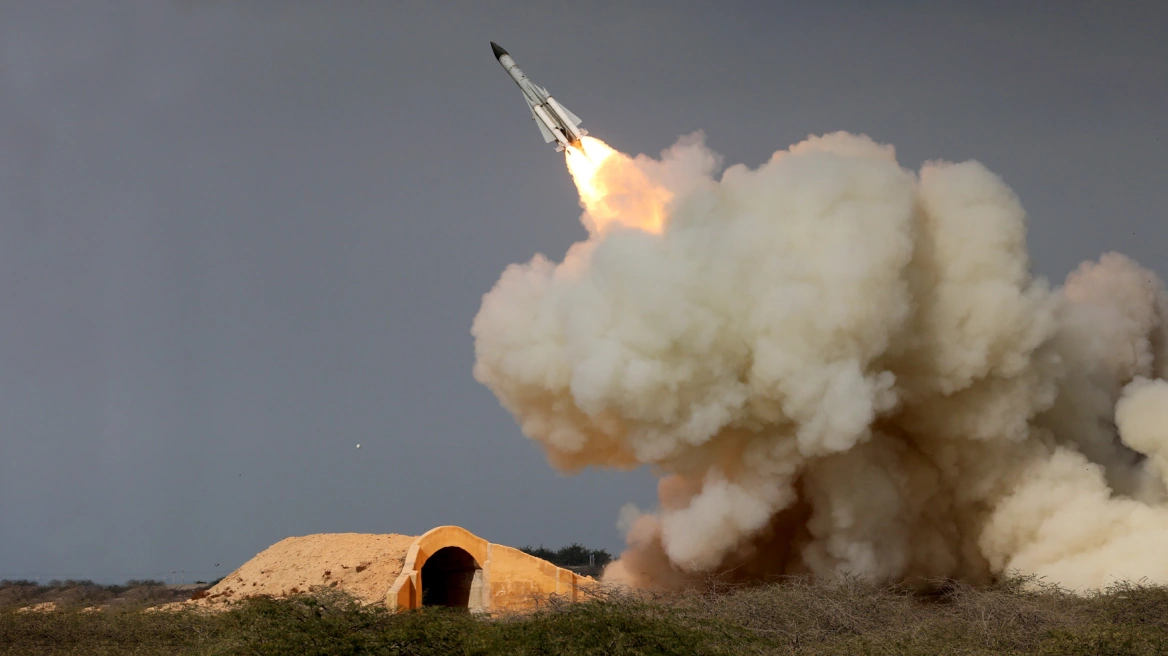
New tensions have emerged in relations between the United States and Iran, as Tehran responded to American strikes on a military installation near Bandar Abbas airport by attacking a U.S. air base in the region.
The U.S. had earlier announced that it carried out “defensive strikes,” claiming the target posed a threat to American troops as well as to commercial shipping in the Strait of Hormuz, one of the world’s most critical maritime routes for oil transport.
Tehran condemned the operation as “pre-dawn aggression,” while Iran’s armed forces announced that they launched an attack against an American base in retaliation. According to the Tasnim news agency, the Revolutionary Guards did not specify which base was targeted, but warned that there would be an “even more decisive” response if the attacks continue.
“The enemy knows that aggression will not go unanswered,” they said in a statement, placing responsibility for the consequences on the “aggressor.”
The exchange of fire increases uncertainty over whether the fragile ceasefire between the two sides can be maintained. Earlier this week, Washington announced that it had launched “self-defense strikes” against vessels which, according to U.S. authorities, were laying mines in the area.
The Iranian side argued that those strikes constituted a violation of the ceasefire agreement.
Confusion surrounding the de-escalation agreement
At the same time, confusion prevails regarding reports of a possible de-escalation agreement. On Wednesday, Iranian state television reported that “an initial informal framework memorandum of understanding” had been drafted between Tehran and Washington.
According to those reports, the draft provided for the withdrawal of American military forces from areas near Iran and the lifting of the naval blockade on Iranian ports.
However, the American side categorically denied the reports, describing claims of a draft agreement as “completely fabricated.”
Iran remains committed to its “red lines”
The head of the Iranian parliament’s national security committee, Ebrahim Azizi, stressed late Wednesday night into Thursday that Tehran remains unwavering in its demands during negotiations with the United States aimed at reaching an agreement to bring a lasting end to the war in the Middle East.
Mr. Azizi, who is not believed to be directly involved in the bilateral talks, said via X that Iran would never retreat from what it considers “its red lines,” specifically “the right to uranium enrichment, possession of enriched uranium, control of the Strait of Hormuz, and the lifting of sanctions.”
“It is obvious that President Trump, seeking a way out of his strategic deadlock, swings like a pendulum from issuing threats to calling for an agreement,” he added.
Trump: We are not satisfied yet
The fate of the roughly 400 kilograms of highly enriched uranium possessed by the Islamic Republic remains one of the thorny issues dividing the two sides.
During Wednesday’s cabinet meeting, Donald Trump claimed that the Iranian leadership “very much wants to make a deal,” but “has not yet gotten” to where he expects: “we are not satisfied” with its proposal, he said — adding that “we will be” in the end.
“Either that will happen, or we will go finish the job,” the U.S. president threatened, according to video footage of part of the cabinet meeting (from the ninth minute onward) released by the White House.
The American attacks
U.S. armed forces destroyed four Iranian unmanned aerial vehicles and bombed a base in southern Iran, an American official said Wednesday (early Thursday morning Greece time), confirming the second U.S. military operation against the Islamic Republic this week.
“These actions were measured, exclusively defensive, and conducted with the aim of maintaining the ceasefire in effect since early April,” the official said on condition of anonymity.
The four attack drones that were shot down “posed a threat in the Strait of Hormuz area,” according to the same source. U.S. forces also struck “a ground control station in Bandar Abbas” before a fifth drone could take off, he added — information previously reported by CNN and The New York Times, citing their own sources.
Earlier, around 1:30 a.m. Greece time, the Iranian news agency FARS reported that three explosions were heard east of Bandar Abbas.
New U.S. sanctions against Iran’s Strait of Hormuz authority
The U.S. Treasury Department announced Wednesday that it is imposing sanctions on the newly established Iranian Gulf Strait Authority, the body created by Tehran to collect transit fees from the strategically important Strait of Hormuz.
“The Iranian military’s latest attempt to extort global commercial shipping proves that Operation ‘Economic Fury’ has left the regime in desperate need of cash,” Treasury Secretary Scott Bessent said, according to the department’s statement, referring to the economic aspect of the campaign against the Islamic Republic — dubbed “Operation Epic Fury” — launched on February 28.
The Treasury statement also threatens sanctions against anyone paying transit fees, as they would be considered to be “providing support to the Revolutionary Guards” and “benefiting from their services.”
Ask me anything
Explore related questions




