





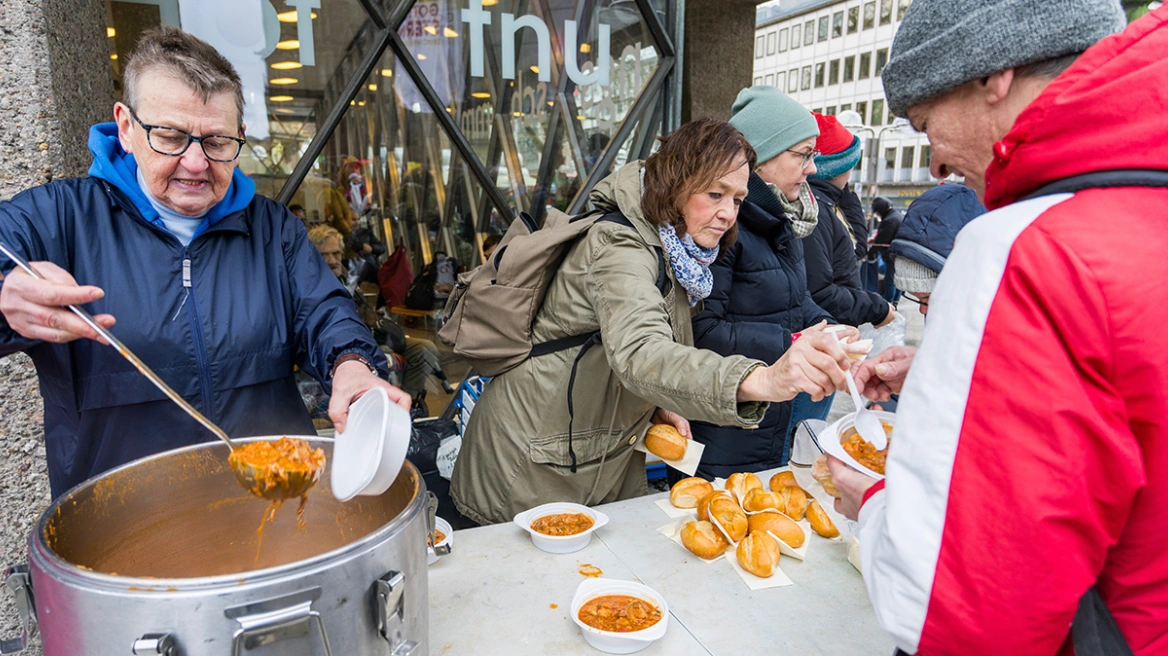
The share of people living in poverty conditions in Germany has reached a new historic high, according to a new report by the Paritätische Wohlfahrtsverband (Association for Equal Welfare). Single-parent families, people living alone, and the elderly are the groups most affected, while significant regional inequalities are also recorded.
According to Deutsche Welle, from 2024 to 2025 this percentage increased by 0.6 percentage points to 16.1% of the population, as the report highlights. “13.3 million people live in poverty conditions in this country, if we take income criteria into account,” the organization stresses.
The Federal Statistical Office had already published similar data in February. The CEO, Joachim Rock, spoke of a “state of crisis” and warned the federal government about cuts to social benefits. In an interview with the radio station Deutschlandfunk, he stated that additional savings would worsen the crisis, adding that it is particularly worrying that the poverty rate is rising significantly for the second consecutive year.
First time so many people affected by poverty
The Association for Equal Welfare emphasizes that a “sad record” has been reached. Never before in previous years have so many people been affected by poverty. Who is at risk of poverty in Germany, according to the European Union definition? People with less than 60% of the average income are considered at risk of poverty, according to statisticians. For single individuals, this threshold is €1,446 net per month, and for households with two adults and two children under 14, it is €3,036.
Regional differences are enormous
After a decrease in the rate of people at risk between 2020 and 2023, there has been “a negative reversal of the trend,” the organization notes. Differences between regions are also significant and show that there is no uniform picture across the country.
Bavaria and Baden-Württemberg, with their strong economic structures, have the lowest poverty rates at 12.6% and 13.2% respectively. The highest rates are found in Bremen (27.5%), Saxony-Anhalt (21.3%), and the city-states of Hamburg (18.9%) and Berlin (18.7%). Some cities in western Germany, such as Trier (21.4%), Weser-Ems (20.8%), and Arnsberg (19.6%), are particularly affected, while in eastern Germany Chemnitz (18.2%) and Leipzig (17.4%) are examples.
Is old age a poverty trap?
“Old age is threatening to become a poverty trap,” the Association for Equal Welfare notes. The situation for the elderly is described as extremely “tense.” According to the data, almost one in five people aged 65 and over is affected by poverty or at risk of it. Other groups also disproportionately at risk include people living alone (30.3%), single-parent families (28.9%), and people with low educational attainment (29.1%).
“Overall, current developments show that poverty is increasing, especially where structural disadvantages exist, such as low levels of education or limited access to the labor market,” the report’s authors explain. Four out of five of those affected are not working.
Finally, 70% of those affected have German citizenship, while 30% do not. Many households face serious financial difficulties. As highlighted in the report, 6.9% of the population did not have enough money last year to cover basic living expenses. Often, they could not afford rising electricity and heating costs or purchase a new refrigerator or stove.
Ask me anything
Explore related questions




