





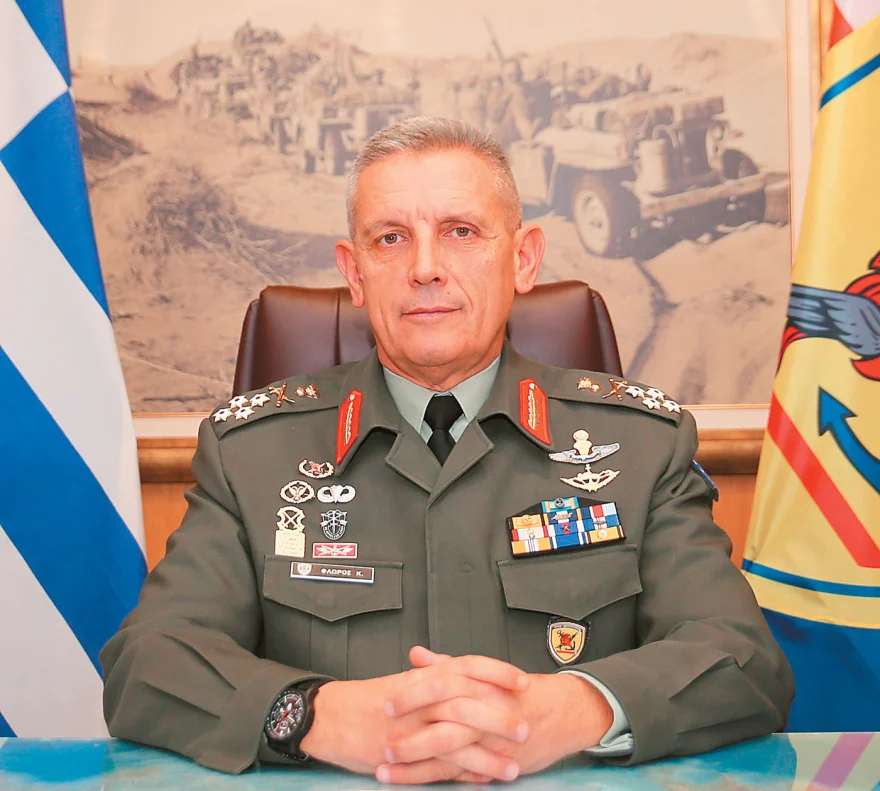
In a wide-ranging interview on Greece’s ongoing defense procurement program and the F-35 fighter jets, former Chief of the Hellenic National Defence General Staff, Konstantinos Floros, speaks candidly to Proto Thema.
He discusses Turkish provocations and President Recep Tayyip Erdogan’s revisionist strategy, while recalling critical details from the successive crises Greece faced in recent years, as well as key aspects of his cooperation with Prime Minister Kyriakos Mitsotakis on a series of crucial decisions.
The full interview with Konstantinos Floros:
GEORGE EVGENIDIS: During your tenure as Chief of the Hellenic National Defence General Staff, the first and most substantial steps were taken toward ordering the F-35s, which Greece is due to receive in 2029. Does this new weapon system take us to an entirely new level?
KONSTANTINOS FLOROS: Greece’s entry into this landmark program was based on the comprehensive 15-year defense procurement plan for 2021–2034, which was drafted in 2020–2021 during my tenure, approved by the government, and is still being implemented today, albeit under different names and labels.
That procurement program has so far delivered the capabilities that the overwhelming majority of Greeks take pride in: the Rafale fighter jets, the new FDI frigates, the Romeo helicopters for the Hellenic Navy, the M1117 armored vehicles, the rapid upgrade of the F-16 fleet to the Viper configuration, Spike NLOS missiles, Rampage missiles, Spice precision-guided munitions, heavyweight torpedoes for the Type 214 submarines, Marder infantry fighting vehicles, the Apache helicopter upgrade program, Island-class patrol vessels, the M-346 training aircraft at the new International Flight Training Center in Kalamata, along with many smaller programs and sub-programs. And, of course, nearly 60 Follow-On Support (FOS) agreements covering dozens of major weapons systems, which continue to keep the Armed Forces operational today.
The Hellenic Air Force, by joining the F-35 program in 2023, entered the highly exclusive club of operators of this unique aircraft, whose exceptional capabilities allow it to dominate the battlefield. The 2023 letter sent to the United States concerned the acquisition of 20 aircraft, plus an option for another 20, and I hope this will be fully implemented in the near future.
So the Hellenic Air Force is not merely moving to the next level—it has entered the future. Naturally, the appropriate weapons package must also be ordered without delay.
G.E.: Since the NATO Summit, there has been considerable concern that Turkey may ultimately acquire the F-35. Do you consider that a realistic prospect?
K.F.: Turkey was originally part of the F-35 program, even as a co-producer, but it was expelled in 2019 by decision of the White House under President Trump.
For the time being, we are hearing many promises and expressions of “goodwill” from President Trump, much as we did last year during President Erdoğan’s visit to the United States. However, the U.S. State Department recently stated that absolutely nothing has changed regarding the restrictions imposed on Turkey.
There are numerous—and extremely serious—obstacles that Turkey would have to overcome before the United States could seriously consider readmitting it to the program, and these extend beyond the S-400 missile system.
Turkey’s dependence on China for telecommunications infrastructure—5G networks and nationwide network-centric systems and operations—is perhaps an even greater issue, one that has not received sufficient attention or been appreciated in its true dimensions.
In any event, Greece’s responsibility is to continue strengthening its own defense capabilities, ensuring that its deterrence against Turkey remains decisive and that any attempt to do the unthinkable would come at an extraordinarily high and prohibitive cost. And that is precisely what Greece is doing.
G.E.: The government has been criticized—mainly from the political right—for placing too much faith in the policy of “calm waters” with Turkey. You personally experienced the period of… turbulent waters. Do you believe there is any naïveté within the political system regarding Turkey?
K.F.: The period during which I served as Chief of the Hellenic National Defence General Staff was perhaps the most intense and prolonged period of serious Turkish provocations. It lasted almost three years—from March 2020 until February 2023—when Erdoğan changed course following the devastating earthquakes in Turkey.
Fundamentally, however, Turkey has not retreated by even an inch from its claims and demands: the casus belli, the demilitarization of the islands, disputes over sovereignty, and so forth.
“Calm waters” are certainly a good thing for peaceful coexistence between the two countries, provided they do not come at the expense of one side’s fundamental sovereign rights.
The government, through the Prime Minister himself, has repeatedly emphasized this. The issue of the casus belli was raised unequivocally—even inside Turkey—during the NATO Summit. More broadly, Turkey’s reactions to Greece’s defense and diplomatic initiatives demonstrate that our country is proceeding cautiously but steadily in pursuing its vital national interests, in accordance with its international obligations and with the absolute defense of the national interest as its guiding principle.
Therefore, no, there is no naïveté on the part of the government, and certainly no “naïve risk-taking” of the kind that was openly acknowledged in the past.
G.E.: Erdoğan once repeatedly said, “We may come one night.” In recent years, however, that rhetoric has subsided. Could those threats and heightened tensions return?
K.F.: Turkey always has the initiative when it comes to escalation. It is the party that precipitates crises, and we end up in one form of confrontation or another because of its irrational claims, which are repeated incessantly.
From time to time, these are accompanied by slogans and statements from Erdoğan concerning both Evros and the Aegean. “We will come one night.” “We will bomb Athens.” Greece hears these statements regularly.
But when tensions escalate, we know how to restore the balance, as we did in 2020, when we emerged victorious on the ground while also winning the battle of perceptions.
Operationally, the Armed Forces are fully capable of responding to Turkey’s challenges within the political guidance provided by the government of the day.
We are not naïve. If we are provoked again on that scale, we know exactly what we will do. It is ultimately a matter of political will. Governments decide to wage wars; the Armed Forces conduct them and bring them to a victorious conclusion.
G.E.: One of your most widely discussed remarks was: “Anyone who sets foot on Greek soil will first be burned, and only then will we ask who they are.” Does that still stand as doctrine?
K.F.: I believe it does, because it is the only appropriate response to threats such as “We will come one night” or “We will set foot on your islands.”
That must indeed remain the doctrine, because it is deterrence in its purest form—the very essence of deterrence.
As everyone saw, including Greek society as a whole, that scenario never materialized. Deterrence worked. No one set foot on Greek territory.
But we should not stop there. I also said something else that ought to be doctrine.
For Greece, there is no such thing as a localized crisis, despite what we heard for many years.
If we are challenged at a single point—and naturally it will be our weakest point, because the Turks are not naïve either—we should not choose to fight solely at that weakest point.
Turkey must be certain that if it acts in such a manner, military operations will expand across the entire front of confrontation, from Ormenio in Evros all the way to Kastellorizo. Everyone would then have to bear the consequences of their decisions.
G.E.: You worked closely with Prime Minister Kyriakos Mitsotakis for several years. He is not generally seen as someone with an overtly forceful or confrontational style. What was your experience of working with him during critical national crises?
K.F.: Indeed, I worked very closely with the Prime Minister under extremely difficult circumstances throughout the four years I served as Chief of the Hellenic National Defence General Staff.
He may not have—or project—the profile of the kind of person you describe, but I can assure you, from firsthand experience, that he is exactly the kind of leader you want to have in times of crisis.
He grasps the situation immediately, listens carefully to the recommendations of those responsible, and makes decisions quickly and without hesitation, applying political judgment that those lacking experience—or even highly rigorous technocrats—may sometimes fail to appreciate.
He studies the issues thoroughly and wants to know details that one might think unnecessary for a prime minister to master. Yet, in the end, he listens to the specialists, once he has satisfied himself that both their recommendations and the people making them are sound and credible.
That level of trust is, of course, built over time.
In our case, however, events accelerated everything. The Evros crisis erupted just over a month after I assumed my duties. Successfully managing that crisis proved decisive for our subsequent cooperation through the many crises that followed—not only those of a purely military nature.
G.E.: After Evros came the “Oruc Reis” crisis and the incident in which the frigate Limnos made contact with the frigate Kemal Reis. Were there rules of engagement approved by the government? How close did we come to war?
K.F.: The 2020 crisis was perhaps the most serious crisis we have experienced with Turkey since 1974, and the longest in duration. This is significant when assessing how close one comes to war, because the prolonged presence of opposing forces in the field, under conditions of extremely high tension, increases the likelihood of an “accident” or of an intentional incident that could lead to war—even if that was not the intention of either side.
Secondly, and more importantly, the 2020 crisis and what followed during the next two years was a crisis after which the Greek Armed Forces withdrew from the area of confrontation—and only after the Turks had withdrawn first—not with the bitter feelings that accompanied other crises in the recent past, but with a strong sense of superiority on the battlefield.
The victory at Evros, where we imposed our will, was a defeat for Turkey, and that is how they perceived it as well. That is why, in the following months, there was a crescendo of violations, infringements, overflights, and provocations of every kind.
Morale and confidence reached unprecedented levels in 2020, not only within the Armed Forces but also throughout Greek society.
After Evros and the unsuccessful outcome for Turkey, I expected the situation to deteriorate. Therefore, detailed planning was carried out under the responsibility of the Hellenic National Defence General Staff and the military branches, and everyone knew what they would do, how they would act, and when they would act.
These plans were presented during closed briefings to the Prime Minister, he approved them, and we were ready.
Naturally, there were approved and released rules of engagement—by those who have the authority to approve them—should matters escalate, and they were used when and where necessary, with tangible results. I believe we should not elaborate further on that.
The facts are known: both regarding the contact incident, the pursuit of opposing submarines, and the extremely close visual encounters following years of identification operations involving hostile and unlawful aircraft inside the Greek Flight Information Region (FIR).
Therefore, we successfully did what we did in 2020. We know how and what we must do, and Greek society should be absolutely reassured that the Greek Armed Forces, within the framework of the government’s instructions and orders, can guarantee through their strength the freedom, independence, and territorial integrity of the homeland.
And that is what they will do if necessary.
No one should have the slightest doubt about this.
We know the way. We do not need other models to follow. We are models for others.
The personnel of the Armed Forces are the driving force behind the country’s military power and deserve unlimited respect and recognition from the state, just as they already receive from society, according to long-standing public opinion surveys, where they consistently rank first among the country’s institutions.
That should say something to everyone who deals—even temporarily—with defense matters.
G.E.: What do you believe Greece’s priorities should be, given that the nature of warfare is changing, beyond simply acquiring critical weapons systems?
K.F.: What I know with certainty is that, ultimately, it is large-scale, modern—as much as possible in qualitative terms—and resilient Armed Forces that dominate on the battlefield.
This is what the conflicts in Ukraine and the Middle East demonstrate, according to my analysis.
Major weapons systems—aircraft, ships, tanks, artillery, and so on—will never be replaced. They will always exist, and their presence will remain decisive on the battlefield.
The more than decade-long crisis cost us significantly, but it is now behind us.
We must build our military strength step by step, rationally and carefully, and we must not be drawn into “cure-all” solutions such as the claim that “drones of all kinds will replace major weapons systems.”
Drones are supporting assets and must be treated as such. They should not be overestimated. They assist operations, but they cannot achieve victory on their own.
I understand that for most people they are impressive; their capabilities and the results they produce are surprising. But Ukraine is desperately seeking tanks, artillery, air-defense systems, and aircraft—and if it had an extensive open sea environment, you can be certain it would also be seeking naval vessels.
Drones help Ukraine remain “on the field” by inflicting damage on Russia, but they will not liberate Donetsk, Luhansk, or Crimea.
That will be achieved, if it is ultimately achieved, by tanks, artillery, and the king of the battlefield: the infantry.
The history of warfare has shown that whenever a new capability appears on the battlefield, the corresponding countermeasure emerges very soon afterward.
I believe the same will happen with drones. There will be a response—and I believe that response will be the laser.
We shall see…
The recent decisions of KYSEA regarding the strengthening of Greek air defense represent the implementation of the 2022 Air Defense Study, which was prepared by the Hellenic National Defence General Staff and the military branches of that period, and they fortunately move in the direction I described above.
What remains is for these decisions to be rapidly transformed into contracts and for those contracts to be signed, so that the necessary systems can arrive as quickly as possible.
Finally, and to conclude, we must at last—even if it is at the eleventh hour—rebuild and restore our national defense industry, both in the public and private sectors.
In the private sector, we have made significant progress, but there is still considerable potential ahead.
In the public sector, steps have been taken in recent years, but bold decisions are required and they must be taken immediately.
Those responsible know the situation. They know what is required. What remains is to break some eggs and move forward quickly.
SAFE—I hope with better performance if there is a SAFE 2—and RearmEU are opportunities that Greece must not miss.
On the contrary, they represent an opportunity for Greece to awaken its national defense industry in cooperation with private defense-sector entities.
Ask me anything
Explore related questions




