





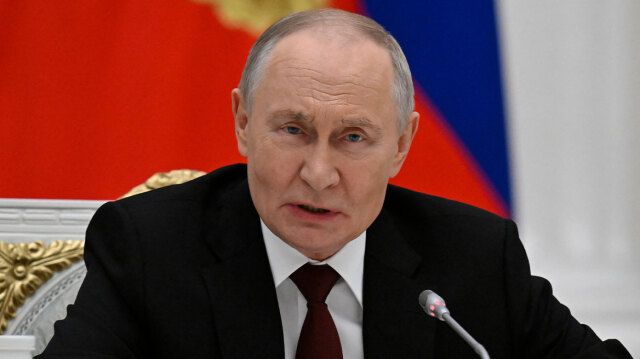
Russian President Vladimir Putin is reportedly demanding a weakening of the nuclear protection provided by Britain and France to their European allies as part of Moscow’s conditions for ending the war in Ukraine. According to a document dated 10 November, obtained by the New York Times, Russia is demanding that the two European nuclear powers commit to not using their nuclear weapons to defend other European countries.
According to the report, the demand forms part of a broader package of Russian proposals that includes NATO withdrawing from Eastern Europe and a drastic reduction in Western military support for Ukraine.
The revelation comes as the United States attempts to advance negotiations to end the war, with Russia seeking to link a peace agreement to a comprehensive restructuring of Europe’s security architecture. Moscow’s proposals have not been accepted by the West, and it remains uncertain whether they could provide the basis for an agreement.
Russia’s demand concerning the British and French nuclear umbrella
According to the information disclosed, Moscow is demanding that Britain and France rule out the possibility of using their nuclear arsenals to protect other European countries.
The demand goes far beyond the issue of Ukraine, as it touches on one of the central pillars of NATO’s deterrence strategy. Britain and France, together with the United States, are the Alliance’s three nuclear powers, with their arsenals contributing to the deterrence of a potential attack against their allies.
Britain’s nuclear deterrent is based on Trident ballistic missiles carried aboard nuclear-powered submarines. The British government has repeatedly stated that the country’s nuclear arsenal is intended to protect both the United Kingdom and its allies.
Moscow is seeking to restrict that capability so that European countries without nuclear weapons of their own can no longer rely on protection from London and Paris as part of nuclear deterrence arrangements.
The move represents an extension of Russia’s demands from 2021, when Moscow called for an end to NATO’s nuclear-sharing arrangements, under which American nuclear weapons are stationed on European territory.
NATO withdrawal from Eastern Europe and an end to weapons deliveries to Ukraine
According to the reports, the Russian document revives a series of demands that the Kremlin first put forward in December 2021, just months before Russia’s invasion of Ukraine.
These include a demand for NATO military forces to withdraw from the Alliance’s eastern flank, including Poland and the Baltic states, with the aim of restoring NATO’s military presence to its 1997 levels.
Russia is also demanding an end to deliveries of Western weapons, military equipment and other defence materiel to Ukraine, as well as guarantees that Kyiv will not join NATO.
The proposals also envisage restrictions on the deployment of foreign troops in Ukraine and the preservation of Russian control over large areas of Ukrainian territory occupied during the war.
According to the same reports, Russia could accept Ukraine’s accession to the European Union, provided that the country did not participate in the EU’s common defence arrangements.
These conditions demonstrate that Moscow is not limiting its demands to a settlement of territorial disputes with Kyiv, but is seeking changes that would have much broader implications for the West’s military presence and defence capabilities across Europe.
London’s response on nuclear deterrence
The British government has made clear that it has no intention of abandoning its commitments to its NATO allies. In an official briefing on the United Kingdom’s nuclear strategy, it emphasised that the threats facing Britain and its allies are increasing in scale, complexity and diversity, making nuclear deterrence more important than ever.
As the British government stated, “The United Kingdom must demonstrate that it can and will defend itself and its allies under any circumstances, even the most extreme.”
London has also warned that Russia is modernising its nuclear arsenal and developing weapons systems capable of carrying both conventional and nuclear warheads.
On 13 November, a day before the latest information about Russia’s demands became public, Britain and Ukraine reaffirmed in a joint statement the need for strong, legally binding security guarantees for Kyiv, rejecting Russian conditions that would amount to Ukraine’s surrender.
Europe’s response and talks with the United States
The new Russian demands have emerged at a time when Washington is seeking to broaden peace negotiations to include Europe’s future security architecture.
During talks in Abu Dhabi on 10 and 11 November, American negotiators Steve Witkoff and Jared Kushner discussed European security issues with the Russian side alongside efforts to end the war in Ukraine.
On Friday, 13 November, European leaders agreed that Europe would be represented in future peace negotiations by Britain, France, Germany, Italy and Poland, together with representatives of European institutions, while NATO is also expected to participate.
European Council President António Costa said Europe must speak with one voice in all discussions concerning Ukraine’s future and the continent’s security.
German Chancellor Friedrich Merz, for his part, rejected Moscow’s attempt to link a resolution of the Ukrainian conflict to a comprehensive revision of Europe’s defence structures.
“There will be no discussions about Ukraine without Ukraine, and there will be no discussions about Europe without Europe,” Merz said, adding that Europe already has its own security architecture.
Zelensky warns of dangers in reopening debate over European security
Against the same backdrop, Ukrainian President Volodymyr Zelensky warned that discussions about a new European security system could serve Moscow’s objectives by allowing Russia to reopen questions concerning NATO’s military presence and the balance of power in Europe.
Zelensky argued that the Kremlin was seeking to revive demands it had already put forward in 2021, before the start of Russia’s full-scale invasion of Ukraine.
He also stressed that discussions about Europe’s future security should not take precedence over ending hostilities.
According to the Ukrainian president, the correct sequence is first a ceasefire, followed by an end to the war and then the provision of security guarantees to Ukraine.
The development highlights the fundamental disagreement between Moscow and European governments: Russia is demanding broader negotiations on the rules governing European security, while European leaders insist that ending the war must remain the priority and that any decisions concerning the continent’s defence must involve the European countries themselves.
Ask me anything
Explore related questions




