





American airspace has reopened and flights are gradually resuming after a nationwide shutdown that brought air travel across the United States to a standstill for more than four hours on Friday, November 13. However, the end of the emergency has not brought an immediate end to the disruption, with thousands of flights cancelled or delayed, passengers stranded at major airports and airlines warning that restoring normal schedules could take several days.
The Federal Aviation Administration (FAA) lifted its nationwide ground stop at 8.15pm Eastern Time on Friday (3.15am Saturday in Greece), after technicians restored communications systems affected by a major network failure. More than 5,000 flights were cancelled on Friday, with hundreds of additional cancellations already recorded for Saturday, while delays exceeded 10,000. The number of affected flights continues to change as airlines adjust their schedules.
The Trump administration has blamed overloaded network routers and switches within the country’s ageing air traffic control infrastructure, ruling out any indication of a cyberattack and saying the incident was unrelated to the separate Microsoft service outage. Transportation Secretary Sean Duffy has called for $50 billion in funding to modernise the system, acknowledging that similar failures could occur again.
United States Secretary of Transportation‘s blames Congress for lack of funding
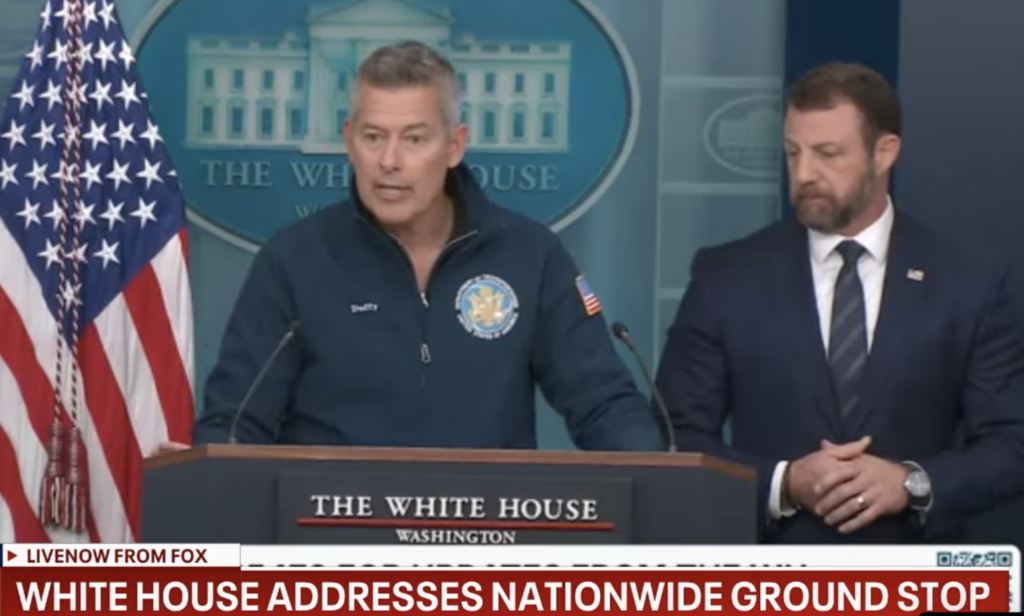
US Transportation Secretary Sean Duffy said at a White House press conference late on Friday, November 13, that the nationwide grounding of flights was caused by overloaded routers and outdated communications infrastructure, rather than an apparent cyberattack. Although the Federal Aviation Administration (FAA) has lifted its nationwide ground stop and reopened US airspace, Duffy warned that restoring normal flight operations would take time.
What Duffy said
– Cause of the outage: Duffy said the FAA experienced instability in radar and communications systems at 3:36 p.m. Eastern Time. Ageing switches and routers became overloaded with data, producing inconsistent information and prompting the agency to halt departures nationwide as a precaution.
– Outdated technology: He described the American air traffic control network as an exceptionally old system, still dependent on analogue telecommunications equipment and copper lines dating back to the 1980s. He emphasised that newly installed equipment had not failed, suggesting that the breakdown originated in the legacy network.
– Flights resuming, but disruption continuing: Duffy confirmed that US airspace had reopened and aircraft were beginning to depart. However, he warned that the recovery would be slow, with airlines needing time to reposition aircraft and restore schedules following thousands of cancellations and delays. He expressed hope that operations would improve significantly on Saturday.
– Thanksgiving travel: Duffy said he expected the system to be operational ahead of the Thanksgiving holiday travel period, although he did not provide a precise timetable for clearing the immediate backlog.
– $50 billion emergency funding request: Calling the situation an emergency, Duffy urged Congress to approve $50 billion to modernise the country’s air traffic control infrastructure. He argued that the investment should be a bipartisan priority and that the existing system required a comprehensive overhaul.
– Cyberattack concerns: Homeland Security Secretary Markwayne Mullin, who appeared alongside Duffy, said investigators had found no evidence of a cyberattack. However, he acknowledged that the investigation was continuing and that officials could not completely rule out malicious activity.
– Passenger safety: Mullin maintained that passengers and aircraft had not been placed in danger, presenting the nationwide suspension as a precautionary measure taken to protect aviation safety.
Duffy also said the Trump administration had remained closely involved throughout the emergency, with the president, whom he repeatedly praised for his exemplary leadership, receiving repeated briefings.
The central message from the press conference was that the nationwide grounding has ended, but the aviation disruption is not yet over. Duffy attributed the shutdown to the failure of ageing infrastructure, warned that normal schedules would not be restored immediately and used the incident to demand substantial new federal funding for the FAA.
Flights resume, but airlines face days of cancellations and delays
The immediate emergency ended on Friday evening when the FAA confirmed that its air traffic control communications system was operational again and authorised aircraft to resume departures.
Nevertheless, the reopening of airspace has left airlines facing a complicated recovery operation. Thousands of aircraft and flight crews are no longer in their scheduled locations, airports are struggling with congestion, and large numbers of passengers need to be rebooked onto alternative services.
The disruption affected major airlines including American Airlines, Delta Air Lines, United Airlines, Southwest Airlines and JetBlue, which cancelled large numbers of services as the ground stop continued into Friday evening.
United Airlines announced that it would cancel most of its remaining departures on Friday, except for selected international flights. JetBlue also suspended its remaining domestic departures while allowing certain Europe-bound services from New York and Boston to proceed.
Delta confirmed that it was resuming operations after the restrictions were lifted but warned that restoring its network would require repositioning aircraft and crews across the country.
The scale of the disruption means that flights scheduled for Saturday and potentially Sunday could remain affected even though the technical problem that triggered the shutdown has been resolved.
Aviation industry estimates indicated that approximately 11,000 flights carrying more than 1.5 million passengers had been scheduled to depart from American airports after 4pm Eastern Time on Friday, placing an enormous number of travellers at risk of disruption.
Authorities have urged passengers to check directly with their airlines before travelling to airports, as the lifting of the ground stop does not mean that previously cancelled flights have been reinstated.
How the aviation shutdown unfolded: The timeline
The first signs of trouble emerged on Friday afternoon when communications problems affected air traffic control operations in Chicago. Restrictions were initially imposed at Chicago O’Hare and Midway airports before the situation escalated into a nationwide emergency.
At 3.36pm Eastern Time on Friday (10.36pm in Greece), the FAA began experiencing instability involving communications and radar information at regional air traffic control centres.
As the problems spread, controllers encountered inconsistent information transmitted through the network, prompting concerns about the reliability of essential air traffic control systems.
Shortly afterwards, the FAA issued a nationwide ground stop, ordering departing aircraft to remain on the ground for safety reasons. More than 3,500 aircraft were already airborne when the restrictions began, and controllers continued managing flights already in progress.
The decision caused a sharp reduction in the number of aircraft flying across the United States, with airports unable to accommodate normal departure schedules and congestion developing as arriving flights continued to land.
During the suspension, hundreds of aircraft were diverted or returned to their departure airports. By 7.05pm Eastern Time, at least 827 flights had been diverted, including 670 that returned to their original airports and 157 redirected to alternative destinations.
At 8.15pm Eastern Time, after more than four hours of disruption, the FAA lifted the nationwide restrictions and authorised the gradual resumption of departures.
Shortly afterwards, Duffy and Homeland Security Secretary Markwayne Mullin appeared at a White House briefing to explain the technical failure and outline the government’s response.
The two ministers confirmed that the immediate problem had been addressed, although they acknowledged that the recovery of airline operations would be gradual.
Duffy expressed hope that a significant improvement would become apparent on Saturday but warned that the system’s underlying vulnerabilities remained unresolved.
America’s skies are reopening after a 4 hour, 22 minute nationwide ground stop, the longest since 9/11 as far as we can find. Our estimate: about 633,000 travelers were grounded. At the low point, just 336 planes were in the air over the lower 48, down from 4,266 when it started. What happened: CBS News reports a failed update to the FAA’s telecom network, run by contractor L3Harris, crashed the system that connects air traffic control facilities. Controllers lost radios at multiple centers. The FBI and Homeland Security say there’s no sign it was an attack. If you’re flying tonight or Saturday, check your airline app before you leave. Southwest and JetBlue canceled the rest of tonight, and JetBlue is already canceling some Saturday flights. The first clue was out at 3:44 PM: a National Weather Service notice saying Boston Center had "teleco issues," 80 minutes before officials called it a telecom outage.
— Ryan Hall, Y’all (@ryanhallyall) November 14, 2026
What caused the nationwide failure?
The preliminary explanation provided by federal officials centres on overloaded routers and switches used to transmit communications and radar information between air traffic control facilities.
According to Duffy, the network relies on a complicated combination of ageing analogue infrastructure and modern digital technology. Recent technological upgrades appear to have placed additional demands on older equipment, resulting in intermittent communications problems and inconsistencies in the data received by controllers.
The minister explained that the routers became overloaded with data, preventing the system from delivering consistently reliable information.
Faced with uncertainty about the integrity of communications, authorities decided to suspend departures nationwide rather than allow additional aircraft to enter the air traffic network.
Officials stressed that the failure did not mean that all radar systems stopped operating simultaneously or that every aircraft lost contact with controllers.
Instead, interruptions and inconsistencies affected critical communications used to coordinate aircraft movements across the country.
The FAA informed airlines that problems involving network routers were responsible for the widespread disruption.
One scenario under examination suggests that the malfunction may have originated around Chicago Midway International Airport before spreading through interconnected systems elsewhere in the country.
However, the precise sequence of technical failures has not been conclusively established.
Investigators are also examining whether the installation or integration of newer technology contributed to the overload of older infrastructure, although no specific software update has been definitively identified as the cause.
At the lowest point at 01:29 UTC, just 336 flights worldwide were in the air bound for US airports. Normal volume for that time is more than 3,600 flights. Our full coverage of tonight’s nationwide ground stop: https://t.co/Gvi82hCQx4 https://t.co/wpeZ5H31Lh
— Flightradar24 (@flightradar24) November 14, 2026
No evidence of cyberattack or connection to Microsoft
The timing of the shutdown initially raised concerns about a possible cyberattack, particularly because it coincided with a separate major disruption affecting Microsoft services.
Homeland Security Secretary Markwayne Mullin said investigators had found no evidence of malicious activity and that the incident appeared to have been caused by a technical failure.
He emphasised that the authorities had no reason to believe the United States had been targeted by an attack, although the investigation into the precise cause was continuing.
President Donald Trump also indicated in an interview with Fox News that the disruption was not believed to involve either a cyberattack or a malfunction involving artificial intelligence.
Microsoft separately stated that there was no indication its service problems were connected to the FAA incident.
Questions were also raised about the introduction of new artificial intelligence technology designed to help air traffic controllers anticipate problems and manage flight movements.
The SMART system had begun operating across 22 regional air traffic control centres on November 10, following a pilot programme in the Washington area in September.
However, Duffy said the new AI-powered system was not connected to the equipment that failed during Friday’s shutdown.
He stressed that the malfunction involved older technology rather than newly installed equipment, while officials continued examining the circumstances in which the network became overloaded.
Thousands of passengers stranded at airports
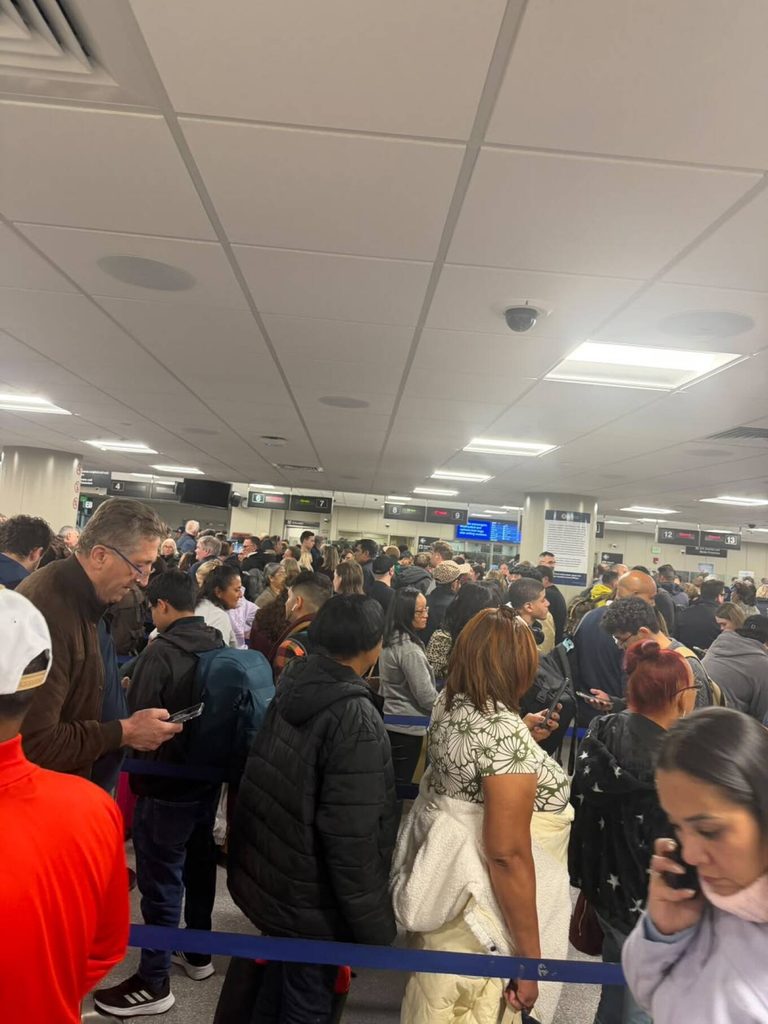
The consequences of the shutdown were visible at airports across the United States, where departure boards filled with cancellations and passengers faced long queues, uncertain departure times and difficulties finding alternative transport.
Severe disruption was reported at major hubs including Chicago O’Hare, Dallas-Fort Worth, Atlanta, Los Angeles, Boston Logan, New York’s John F. Kennedy and LaGuardia airports, and Washington Reagan National Airport.
Many passengers were unable to leave airports after their flights were cancelled, while others remained aboard aircraft waiting for permission to depart.
Some arriving aircraft were also unable to reach their gates because aircraft scheduled to leave earlier were still occupying them.
At Los Angeles International Airport, passengers reported remaining on board for several hours after landing while waiting for an available gate.
The problem extended beyond domestic travel, as passengers with connecting flights missed onward departures and international travellers faced additional complications.
Airlines have begun rebooking affected passengers, but the process is being hampered by the scale of the cancellations and the need to restore aircraft and crew schedules.
A further complication involves mandatory rest periods for pilots and cabin crews, which limit how quickly airlines can restart services after prolonged delays.
The result is that the operational disruption is expected to continue long after the technical emergency itself has ended.
Nationwide ground stop halts all US flights with more than 14,000 delayed or canceled Follow our live coverage ➡️ https://t.co/GENhb8MIps https://t.co/YrgAIEkqf9
— Daily Mail (@DailyMail) November 14, 2026
European flights affected despite no technical problems in Europe
The disruption also affected international aviation, with European authorities temporarily suspending departures bound for the United States at the request of the FAA.
The restrictions were introduced to prevent further congestion at American airports and to avoid sending additional aircraft into an already severely disrupted air traffic network.
European air traffic control systems were not affected by the technical failure, and flights operating within Europe continued normally.
Nevertheless, the restrictions on transatlantic departures disrupted passengers travelling from European airports to destinations across the United States.
🇪🇺 🇺🇸 Eurocontrol has suspended all flights from Europe to the United States at the FAA’s. All flights were grounded in the U.S. earlier as part of a response to nationwide "technical issues." https://t.co/zrvQqjX8qJ
— Europa.com (@europa) November 13, 2026
Air Canada also cancelled its remaining flights between Canada and the United States on Friday evening, although domestic Canadian services were not subject to a comparable nationwide suspension.
Departures from Mexico towards American destinations were also affected by the emergency restrictions.
Some international flights were permitted to operate on a case-by-case basis, while selected services from American airports continued despite the broader suspension.
With US airspace now reopened, international services are gradually returning, although airlines are continuing to adjust schedules because of the knock-on effects of Friday’s cancellations.
‘Nobody was in danger,’ officials insist
Despite the scale of the disruption, federal officials have stressed that the decision to halt departures was a preventive safety measure and that no aircraft or passengers were placed in danger.
Mullin told reporters that the travelling public had not been at risk and that more than 3,000 aircraft had been brought safely to the ground during the emergency.
The FAA did not order every aircraft already airborne to land immediately. Instead, controllers continued coordinating existing flights while preventing additional departures until the reliability of communications could be restored.
This distinction separates Friday’s incident from the nationwide shutdown ordered after the September 11 terrorist attacks in 2001.
The most recent comparable nationwide suspension occurred in January 2023, when a malfunction involving the FAA’s Notice to Air Missions system, which distributes safety information to pilots, resulted in a temporary halt to domestic departures.
Friday’s incident was particularly serious because problems affected communications across regional control centres rather than a single airport or limited geographical area.
Officials said the decision to halt departures allowed controllers to manage existing aircraft safely while engineers investigated the malfunction.
Duffy demands $50 billion to modernise ageing infrastructure
The failure has intensified the debate over the deteriorating condition of America’s air traffic control infrastructure, with Duffy calling on Congress to approve $50 billion for a comprehensive modernisation programme.
The Transportation Secretary described the existing network as an increasingly fragile combination of outdated technologies, including analogue telecommunications equipment, ageing routers and switches, and decades-old copper connections.
He argued that the government had been warning for months that the system required substantial investment and that Friday’s failure demonstrated the consequences of delaying upgrades.
Congress approved approximately $12.5 billion in funding for aviation infrastructure improvements in 2025, while the administration has been seeking around $30 billion more to complete its modernisation plans.
Duffy’s latest demand for $50 billion exceeds that earlier funding request and reflects his argument that a much broader overhaul is required.
He also criticised the poor condition of some air traffic control facilities, pointing to ageing towers, deteriorating buildings and equipment that has remained in service long beyond its intended lifespan.
The FAA has already begun replacing older copper telecommunications lines with fibre-optic connections and upgrading radio systems, but substantial parts of the infrastructure remain dependent on obsolete technology.
Government reviews have repeatedly identified weaknesses in the sustainability of air traffic control equipment, warning that older systems are increasingly difficult to maintain and vulnerable to technical failures.
Duffy acknowledged that technicians had been able to identify the immediate malfunction and restart the system, but warned that the broader infrastructure problems remained.
He said additional outages could occur if the United States failed to accelerate its modernisation programme.
Previous failures had already exposed weaknesses
Friday’s shutdown follows a series of technical problems involving American air traffic control facilities.
In January 2023, a malfunction in the FAA’s Notice to Air Missions system prompted a nationwide suspension of departures lasting approximately 90 minutes and disrupted thousands of flights.
More recently, communications and radar equipment failures have affected regional air traffic control operations in the northeastern United States, including facilities serving Newark Airport.
A separate communications incident in September disrupted hundreds of flights after damage to a fibre-optic connection affected air traffic control operations.
Such incidents have highlighted the difficulty of maintaining a network that combines older technology with modern systems across numerous facilities.
The latest emergency was especially significant because the failure affected the national network and forced authorities to suspend departures across the country.
The incident has therefore renewed questions about whether existing modernisation programmes are sufficiently coordinated and whether the FAA has the funding and technical capacity required to replace vulnerable systems without introducing new operational risks.
Sports teams and cargo flights also disrupted
The shutdown affected activities beyond ordinary passenger travel, with professional and university sporting teams among those stranded by the restrictions.
Teams competing in American football, basketball and ice hockey faced difficulties reaching destinations for weekend fixtures, with some forced to consider alternative travel arrangements.
Duffy encouraged university American football teams to contact the FAA to coordinate their travel plans and ensure they could reach scheduled matches.
Cargo operations were also affected, with freight airlines forced to delay departures and reorganise deliveries.
FedEx indicated that it was prepared to activate contingency arrangements to minimise the disruption to its network.
The interruption illustrated the wider economic significance of air transport in the United States, where commercial airlines and freight operators depend on complex schedules connecting hundreds of domestic and international destinations.
Will flights return to normal before Thanksgiving?
The immediate priority for the aviation industry is restoring normal flight schedules before the Thanksgiving holiday on November 26, one of the busiest travel periods in the United States.
Duffy expressed confidence that airline operations would return to normal before the peak holiday travel period, although he acknowledged that the recovery from Friday’s shutdown would take time.
The FAA has confirmed that the technical problem responsible for the emergency has been addressed and that departures are permitted to operate again.
However, the scale of the cancellations means that passengers could continue experiencing delays over the weekend as airlines reposition aircraft, arrange replacement crews and clear the backlog.
For passengers, the key advice remains to check their flight status directly with their airline before travelling to the airport, even when their departure is scheduled from an airport that has resumed normal operations.
The nationwide ground stop is over, and the immediate safety emergency has ended. What remains is the challenge of restoring an aviation network disrupted on an exceptional scale, while authorities investigate the precise cause of the failure and confront longstanding questions about the reliability of the infrastructure on which American air travel depends.
Ask me anything
Explore related questions




