





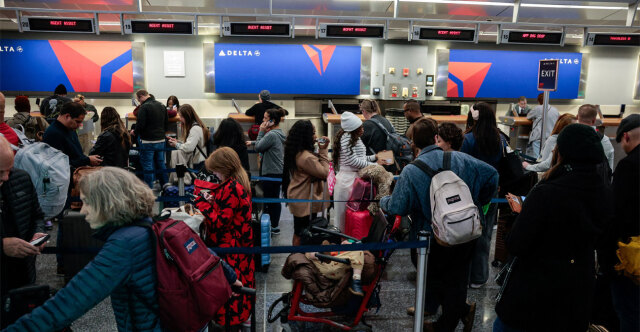
The nationwide suspension of take-offs imposed by the US Federal Aviation Administration (FAA) on Friday, 13 November 2026, has brought renewed attention to one of the most serious problems facing American aviation: the dependence of the world’s largest civil aviation network on critical technological infrastructure, much of which has been in operation for decades.
The current crisis is particularly serious because the problem does not appear to be confined to take-off procedures or the notification of flight crews. Instead, it is affecting regional air traffic control centres, which are responsible for managing aircraft once they are already airborne.
According to information available so far, the fault has affected all 22 regional control centres in the United States, while controllers are attempting to transfer responsibility for managing flights to facilities that remain operational. At the same time, US authorities are examining the possibility that the crisis is linked to a software upgrade and the rollout of a new air traffic management system incorporating artificial intelligence applications.
It has not yet been established that this technology is responsible for the fault. However, the timing has raised questions about the process of integrating new applications into an already overstretched network.
To understand the significance of the current crisis, it is worth looking back at the major incidents that have brought US aviation to a complete or partial standstill.
11 September 2001: the first nationwide flight ban
The most significant and dramatic decision to suspend flights in the history of the United States was taken on the morning of 11 September 2001, when the terrorist attacks in New York and Washington prompted the US authorities to introduce an unprecedented measure.
At 9.25am, the FAA ordered all civil aircraft departures to be halted. Twenty minutes later, at 9.45am, it instructed all civil aircraft in US airspace to land as soon as possible.
At that moment, more than 4,500 flights were in the air. By 12.15pm, the airspace over the 48 contiguous states had effectively been cleared of civil flights.
The suspension was not caused by a technical failure, but by the need to rule out the possibility of further hijackings. It nevertheless marked the first time US authorities had been forced to manage thousands of grounded aircraft simultaneously while completely reorganising the country’s airspace.
3 August 1981: the major air traffic controllers’ strike
Twenty years before the 11 September attacks, US aviation had faced one of the biggest operational crises in its history.
On 3 August 1981, around 12,300 air traffic controllers went on strike, demanding better working conditions, higher pay and shorter working hours.
The industrial action caused enormous disruption, affecting around 35 per cent of daily commercial flights.
Then-President Ronald Reagan gave the strikers 48 hours to return to their posts. When the majority failed to comply, the government dismissed approximately 11,400 controllers.
The FAA was forced to rely on supervisors, military controllers and staff who had not joined the strike to keep the US aviation system operational.
Although there was no nationwide flight ban, the incident highlighted the aviation industry’s dependence on a relatively small number of highly specialised professionals.
11 January 2023: the NOTAM system blackout
The closest historical comparison with the current crisis came in January 2023. On 11 January, a serious failure in the Notice to Air Missions (NOTAM) system forced the FAA to temporarily suspend all domestic flight departures in the United States.
NOTAM is a key mechanism for informing pilots about hazards, restrictions, closed runways, technical works and other information affecting flight safety.
The outage meant that airlines and flight crews could no longer rely on the normal system for distributing this information. The FAA imposed a departure suspension lasting approximately 90 minutes, while the disruption continued for many hours after the system was restored. More than 10,000 flights were delayed and over 1,300 cancelled, causing widespread disruption at airports and airlines.
The subsequent investigation found that the failure was linked to human error during maintenance work. External contractors had accidentally deleted critical files while attempting to synchronise the main database with the backup system.
The most significant finding was that a mistake during a technical maintenance procedure had proved sufficient to disrupt the entire US aviation network. This is also the key similarity with the current incident, should the theory that a software upgrade triggered the latest collapse be confirmed.
19 July 2024: the global CrowdStrike crisis
A different but equally revealing incident occurred on 19 July 2024.
A faulty security software update from CrowdStrike caused serious problems for millions of computers running Microsoft Windows.
The consequences quickly spread to the aviation sector, with Delta Air Lines, United Airlines and American Airlines experiencing widespread disruptions to their information technology systems. By early afternoon, more than 2,200 flights had been cancelled in the United States, while nearly 7,000 had been delayed.
The crisis was not caused by a failure in the FAA’s air traffic control centres, but by the collapse of systems used by airlines to manage schedules, crews and passengers. It nevertheless highlighted a critical vulnerability: the ability of a single faulty software update to affect thousands of independent organisations simultaneously.
April-May 2025: repeated failures at Newark
In the spring of 2025, Newark Airport in New Jersey became the focus of a new crisis. A series of problems with the telecommunications infrastructure at the Philadelphia approach control facility caused temporary losses of radar coverage and radio communication with aircraft.
In one of the most notable incidents, on 9 May, the outage lasted approximately 90 seconds. That may seem like a short period, but in an environment where aircraft travel at high speeds and controllers must constantly maintain the required separation between them, even a brief loss of communication presents a serious operational problem.
The failures caused delays, cancellations and restrictions on air traffic. The incident exposed weaknesses in ageing telecommunications lines, as well as the consequences of inadequate staffing in air traffic control services.
September 2025: another telecommunications failure in Dallas
A few months later, a new telecommunications problem affected the operation of the air traffic control system in the Dallas area.
The failure affected radar functions, radio frequencies and automated systems, forcing controllers to use alternative procedures.
More than 1,800 flights were affected by delays and cancellations. Once again, the problem was not related to the aircraft themselves, but to the ground-based technological infrastructure required to guide them safely.
September 2026: warning blackout in the north-eastern United States
On 21 September 2026, another failure in communication lines at a control centre in Philadelphia caused significant disruption at Newark, Philadelphia and Teterboro airports.
US authorities imposed temporary restrictions on arrivals, while hundreds of flights were affected. At Newark, delays averaged 112 minutes.
The incident remained geographically limited, but added to a series of failures that had already exposed the vulnerability of the FAA’s telecommunications network.
The warning from the US Government Accountability Office
These recurring crises are not isolated incidents in an otherwise modern and fully upgraded system. The Government Accountability Office (GAO), the independent auditing body of the US Congress, has repeatedly warned about the age of critical FAA technological infrastructure.
In a report published in September 2026, the GAO revisited the findings of an earlier assessment of 138 air traffic control systems. Of these, 51 had been classified as unsustainable and a further 54 as potentially unsustainable.
In total, 105 of the 138 systems faced problems relating to technological obsolescence, maintenance capabilities or long-term reliability. Of the systems identified as problematic, 58 had been classified as particularly critical to the safety and efficiency of air traffic management.
The problems include difficulties sourcing spare parts, the use of outdated equipment, delays in modernisation and the gradual loss of specialised personnel familiar with older technologies.
The November 2026 crisis and the artificial intelligence factor
The incident on 13 November is particularly significant because of the reported scale of the technical failure and the timing of its occurrence. On 10 November, the FAA had announced the expansion of its new SMART system, which uses artificial intelligence and data analysis applications to support air traffic management. The expansion covered all 22 regional control centres in the United States.
Three days later, the FAA announced a nationwide suspension of take-offs because of widespread communication problems.
Asked whether the technical crisis could be connected to the rollout of the new system, Homeland Security Secretary Markwayne Mullin replied: “We are looking into it.”
The statement does not confirm that artificial intelligence was responsible for the failure. It does, however, indicate that the possibility is being examined as part of the investigation. The FAA has not so far presented technical evidence proving that SMART is connected to the communications outage.
There is, moreover, a fundamental difference between a system that supports decision-making in air traffic management and the telecommunications infrastructure that allows controllers to communicate with aircraft.
The key question is whether the expansion of the new system was accompanied by changes to existing networks, whether parallel software upgrades were carried out, and whether any of them affected critical functions.
US aviation has experienced the consequences of human error during software maintenance in the past, as happened in 2023, as well as those of a faulty update that triggered a widespread technological crisis, as in 2024.
The difference this time is that the problem appears to involve the communications infrastructure of the control centres themselves, at a time when the authorities are trying to integrate new technologies into a network with documented weaknesses.
The history of major aviation crises in the United States shows that an external threat is not necessarily required to ground thousands of aircraft. Human error, a faulty software update or a failure in critical telecommunications infrastructure can have consequences across the entire country.
Whether the latest crisis will be recorded as another case of technological failure or as a serious problem in the modernisation of US air traffic management will depend on the findings of the ongoing investigation.
Ask me anything
Explore related questions




