





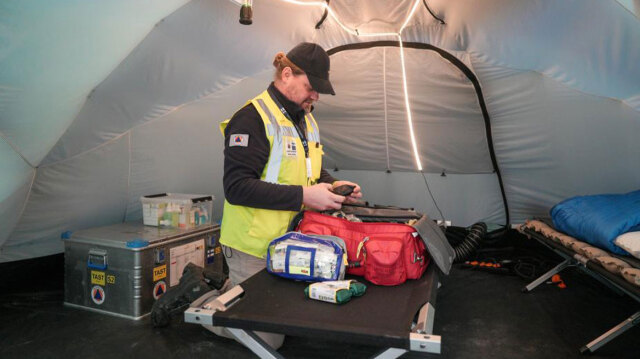
Amid growing public debate over the new guidelines for preparing Europeans for emergencies, European Commission sources responded to questions from the Athens-Macedonian News Agency (ANA-MPA), explaining the thinking behind the new recommendations and why particular emphasis is being placed on citizens being self-sufficient for 72 hours.
The fundamental change, they pointed out, is “the transition from strategic planning to everyday implementation, with the aim of creating a shared culture of preparedness throughout European society”.
The new guidelines, presented on 3 November 2026 by the European Commissioner for Equality, Preparedness and Crisis Management, Hadja Lahbib, at the European Civil Protection Forum, had already been announced as proposed actions under the EU Preparedness Union Strategy of March 2025, the relevant sources explained. The Commission is now fulfilling that commitment and taking, as the same sources added, “the next step in the same effort, specifying the actions required to systematically strengthen citizens’ preparedness across all member states”.
For his part, Efthymios Lekkas, president of the Earthquake Planning and Protection Organisation (OASP) and emeritus professor of Dynamic Tectonics, Applied Geology and Natural Disaster Management at the National and Kapodistrian University of Athens, also stressed the importance of improving preparedness for all types of crises, whether caused by natural phenomena or human activities. He welcomed the EU recommendations, emphasising, however, that “this in no way involves an attempt to instil fear”.
As announced by the Commission, Europe is facing increasingly frequent and complex crises, prompting the European Commission to step up its efforts to strengthen preparedness throughout the EU. Against this backdrop, Commissioner for Equality, Preparedness and Crisis Management Hadja Lahbib presented new guidelines on 3 November 2026 aimed at preparing individuals and communities for emergencies.
The guidelines focus on four main areas:
- Ensuring citizens can remain self-sufficient for 72 hours.
- Introducing preparedness education from an early age.
- Ensuring the inclusion of people with disabilities.
- Improving communication about risks and threats.
“The Commission is not simply repeating the proposed actions of 2025. Under the Preparedness Union Strategy presented in 2025, it had already committed to developing guidelines on citizens’ self-sufficiency for at least 72 hours. With these guidelines, the Commission is fulfilling that commitment and taking the next step in the same effort, specifying the actions required to systematically strengthen citizens’ preparedness across all member states. Modern crises can cause simultaneous disruptions to essential services such as electricity, water supplies, communications and supply chains. During the first hours of an emergency, the relevant authorities may need time to organise their response and reach affected areas,” European Commission sources told ANA-MPA.
Regarding the first priority, namely citizens’ ability to remain self-sufficient for 72 hours, the objective is to help people meet their basic needs during the first three days of an emergency while public assistance is being mobilised. This includes keeping essential emergency supplies and preparing emergency backpacks containing, for example, water, food, medicines and alternative means of heating, cooling and lighting.
“In practice, citizens will be encouraged to maintain basic supplies of water, food and medicines, while also acquiring skills such as first aid and emergency management,” European Commission sources said.
At the same time, they noted that preparedness would be incorporated into school curricula so that children learn to recognise risks, assess information and understand how to seek help.
Particular emphasis is being placed on making warnings and evacuation procedures accessible to people with disabilities, as well as protecting citizens from disinformation and deepfakes.
“The new guidelines, published on 3 November 2026, were announced as proposed actions under the EU Preparedness Union Strategy of March 2025 and translate them into concrete measures,” the same sources said. They added that “before drafting the guidelines, the Commission organised, among other initiatives, a series of technical consultations with experts from all EU member states, as well as three two-day meetings (March, April and May 2026) involving a group of 150 randomly selected citizens from across the EU, whose recommendations are publicly available”.
Furthermore, to make preparedness a shared priority across Europe, the Commission is proposing the establishment of an annual EU Preparedness Day, to be held on 23 October each year, beginning in 2027.
Asked by ANA-MPA why 72 hours had been chosen as the timeframe, European Commission sources clarified that the three-day period represents a minimum benchmark designed to allow households to meet their essential needs during the initial phase of a crisis. “This reduces immediate dependence on emergency services, allowing them to focus on those who urgently need assistance. The specific timeframe does not mean that a crisis will necessarily have ended within three days or that assistance will be delayed for the same period. It means that citizens can be adequately prepared by having essential supplies, a family emergency plan and the necessary knowledge to manage the first difficult hours,” the same sources explained.
Along the same lines, Lekkas pointed out that estimates suggest a failure in an energy or water supply network could last approximately that long.
“Measures are moving in a positive direction, helping to reduce vulnerability and improve resilience”
According to Lekkas, the new emergency preparedness guidelines are a step in the right direction because, as he told ANA-MPA, “they reduce the vulnerability of systems and improve resilience”.
As he explained, citizens have become accustomed to a particular way of life in which insufficient consideration is often given to risks that may arise either from natural phenomena or human activities. “All these phenomena disrupt our routines and can become harmful, as we have essentially grown accustomed to a way of life that does not place particular emphasis on prevention,” he noted.
A characteristic example of the need for better preparedness, he said, is the possibility of water or electricity supplies being interrupted in Athens for three days because of an earthquake, wildfire or any other hazard. “Why shouldn’t each of us keep a supply of water at home so that we can get through difficult situations? I am not talking about a complete lack of water over a prolonged period, but a three-day interruption to the water supply could happen at any moment, as could a power cut,” he stressed.
He noted that this approach should become part of citizens’ everyday lives, enabling them to manage difficult situations more effectively and improve their safety.
At the same time, he clarified that preparedness should not be interpreted as an attempt to generate fear or as an indication of some invisible threat, but rather as a practical approach to prevention and protection.
“The new guidelines are not binding”
European Commission sources pointed out that the new guidelines, developed with contributions from experts across member states, national civil protection authorities, stakeholders and citizens, “are not binding and do not provide for penalties in the event of non-compliance, nor do they impose a single national preparedness plan”.
“Member states remain responsible for developing their own measures, taking into account their specific national circumstances, risks and needs. The European Commission supports member states through guidelines, cross-border risk assessments, exchanges of best practices, educational activities and joint exercises. At the same time, it strengthens cooperation through the EU Civil Protection Knowledge Network and the EU Civil Protection Mechanism, through which assistance can be mobilised when a crisis exceeds national response capabilities.
“In addition, Article 110 of the European Electronic Communications Code provides for public warnings to citizens through mobile communications networks. Consequently, the EU’s objective is to encourage and support all member states in strengthening their preparedness, without replacing national authorities,” European Commission sources emphasised.
Regarding Greece, competent Civil Protection sources said that no equivalent framework currently exists in the country. They clarified, however, that general protection guidelines for risks arising from natural phenomena, as well as other threats such as industrial accidents or chemical, biological, radiological and nuclear (CBRN) incidents, are available on the ministry’s official website. They also pointed out that responsibility for crisis management differs between northern and southern EU countries, noting that in southern European countries these responsibilities are mainly divided between Civil Protection and Defence, depending on the nature of the crisis.
Ask me anything
Explore related questions




