





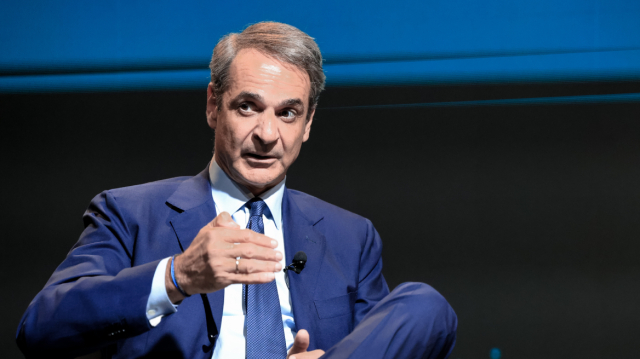
In their joint statements, they emphasized the strategic role of the region in Europe’s evolving geopolitical and economic landscape, placing particular focus on strengthening connectivity and addressing security challenges together.
Mitsotakis stressed the importance of a north-south infrastructure corridor linking Greece and Bulgaria, with the potential to extend to Romania.
“We highlighted the importance of a vertical infrastructure corridor connecting Greece, Bulgaria, and potentially extending to Romania,” the Prime Minister said, also underscoring the significance of energy interconnections and the development of a north-south natural gas transport corridor.
He noted that Greece had already demonstrated its commitment to such projects by completing the Greece-Bulgaria Interconnector (IGB) in record time.
Cross-Border Water Management
Particular attention was also given to the management of shared water resources. Mitsotakis stressed the need for a long-term agreement regarding rivers such as the Evros River and the Nestos River, enabling both countries to plan critical investments related to agriculture and climate resilience.
“It is time to take a long-term view so that we can plan the important investments needed not only for agriculture but also for protection against the climate crisis,” he said.
New Financing Instruments for European Defense
Referring to discussions on the future European budget, Mitsotakis reiterated Greece’s support for a more ambitious approach to financing European defense. He argued that defense should be regarded as a European public good and could be funded through a new EU borrowing instrument.
“Greece insists on a more ambitious budgetary approach for defense. European defense is a collective public good and could be financed through a new European borrowing instrument,” he said.
The Prime Minister emphasized that such resources should be distributed fairly among member states and address the defense needs of the entire continent.
He also noted that the security challenges facing the European Union are not confined to its eastern flank.
“Our region faces 360-degree challenges. European defense policy must take into account the concerns of countries such as Greece and Bulgaria, which are located on the EU’s external borders,” he said, adding that Athens would continue supporting efforts to strengthen Europe’s common defense capabilities.
Radev: Joint Defense of National Interests
For his part, Rumen Radev stressed that Athens and Sofia support EU efforts to strengthen Europe’s strategic autonomy. He said the two countries had agreed to jointly defend their interests during negotiations on a new Competitiveness Fund, aiming to ensure a balanced allocation of resources among member states.
“We support Europe’s effort to strengthen its strategic autonomy. We agreed to defend the interests of our states so that every country has the opportunity to develop its competitiveness and expand its industrial base,” Radev said.
The Bulgarian president also highlighted significant opportunities for cooperation in digital infrastructure and data centers.
“Bulgaria and Greece have great potential for the development of data and information centers. In an uncertain world and at a time of escalating tensions, our two countries share responsibility for the security of our region during a critical period for Europe,” he noted.
Finally, Radev publicly thanked the Greek government for its contribution to strengthening Bulgaria’s air defense capabilities.
“I would like to thank the Prime Minister of Greece for enhancing Bulgaria’s air defense at a critical moment for the region,” he said, referring to the growing security challenges facing Southeastern Europe.
Ask me anything
Explore related questions




