





The concept of the circular economy is playing an increasingly central role in discussions about the future of Greek agriculture, as it is directly linked to reducing waste, improving soil quality, lowering production costs, and increasing the resilience of farms to the pressures of climate change.
At a time when the agricultural sector is being called upon to produce more efficiently, with fewer inputs and better protection of natural resources, the utilization of crop residues, pruning waste, green waste, livestock waste, and organic bio-waste is emerging as a key area for both policy and practical implementation.
“Modern agriculture can no longer be viewed separately from soil, water, biodiversity, climate, and the quality of the food that reaches consumers,” Protopsaltis told the Athens-Macedonian News Agency. He added:
“The major challenge today is not only to produce more. It is to produce better—with less waste, fewer inputs, greater protection of natural resources, and more value for the producer.”
Turning Waste into a Resource
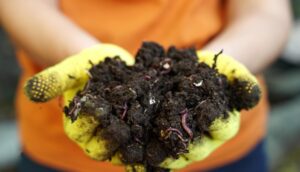
At the heart of this transition is a change in how production residues are perceived. Materials that were often regarded as a burden or a management cost can, when properly collected and processed, be returned to the land as organic matter, compost, or soil-enhancing material.
“The essence of the circular economy in agriculture is moving from the concept of waste to the concept of a resource,” Protopsaltis explained. “Crop residues, pruning waste, green waste, livestock waste, and bio-waste can return to the soil as organic matter, compost, or soil conditioners.”
According to him, compost offers direct practical benefits to agricultural production. It can:
- Improve the soil’s ability to retain water and nutrients.
- Enhance soil aeration.
- Contribute to the gradual release of nutrients.
- Reduce the need for chemical fertilizers.
Link to Organic Farming
A particularly important aspect is the connection between the circular economy and organic agriculture. Organic farming depends on healthy, fertile, living soil and on farming practices that reduce reliance on chemical inputs while making greater use of the natural functions of agricultural ecosystems.
In Greece, organic production has expanded significantly in recent years. The number of organic producers increased from 34,000 in 2020 to 119,000 in 2024, while €1.265 billion was allocated between 2017 and 2024 through programs supporting organic farming methods.
However, Protopsaltis emphasized that growth alone is not enough:
“Organic production cannot rely solely on increasing the number of producers or cultivated areas. It must be built on credibility. An organic product without trust, real inspections, traceability, and clear rules loses its value. And first and foremost, it is unfair to the producers who are doing things properly.”
The Ministry of Rural Development and Food aims to further expand organic production, but with a strong emphasis on reliability, transparency, inspections, digital tools, and protection for both responsible producers and consumers.
Support Through Agricultural Policy
Important support for this transition is available through the Strategic Plan of the Common Agricultural Policy (CAP). A program promoting circular economy practices in agriculture is already being implemented, encouraging the return of biomass removed from fields back to the soil in the form of compost or through other sustainable management practices.
Additional support is planned for:
- Circular economy investments on farms.
- Energy-related agricultural investments.
- Waste management systems.
- Utilization of by-products and residues.
- Composting equipment.
- Biogas facilities.
- Other infrastructure that reduces environmental impact while improving farm competitiveness.
“The tools already exist and should be used in ways that deliver real benefits to production,” said Protopsaltis. “The circular economy can reduce waste, protect soil, lower input requirements, and support farmers’ incomes.”
The Role of Local Communities and Municipalities
The LEADER rural development program can also provide opportunities through local projects that connect energy and water conservation, the bioeconomy, and circular economy practices to the specific needs of each region.
Municipalities have a particularly important role because circular economy initiatives are implemented not only through national policies but also through practical local action—where farmers, livestock breeders, cooperatives, green waste streams, pruning residues, and local infrastructure already exist.
Municipalities can contribute by:
- Organizing waste collection at the source.
- Managing green waste.
- Connecting producers and cooperatives with composting or biogas facilities.
- Informing and educating local communities.
Biogas and Anaerobic Digestion
Protopsaltis also highlighted anaerobic digestion and biogas production as examples of a model that can generate multiple benefits.
In this system:
- Farmers and livestock breeders dispose of residues and waste.
- Energy is generated.
- The processed residue can be returned to the fields as a soil improver.
“Anaerobic digestion and biogas demonstrate how a truly beneficial model can work for everyone. Farmers and livestock breeders are relieved of waste, energy is produced, and the remaining material returns to the soil as a soil-enhancing product.”
A New Agricultural Model
The new approach envisions cooperation among:
- The Ministry of Rural Development and Food,
- Municipal authorities,
- Farmers and livestock breeders,
- Cooperatives,
- Businesses,
- Local communities.
The goal is for the circular economy to move beyond isolated initiatives and become a routine tool within Greek agriculture.
As Protopsaltis concluded:
“Organic farming and the circular economy are not two separate policies. They are two sides of the same transition—a transition toward an agriculture that creates value, respects the environment, supports producers, and responds to the needs of our time.”
Ask me anything
Explore related questions




