





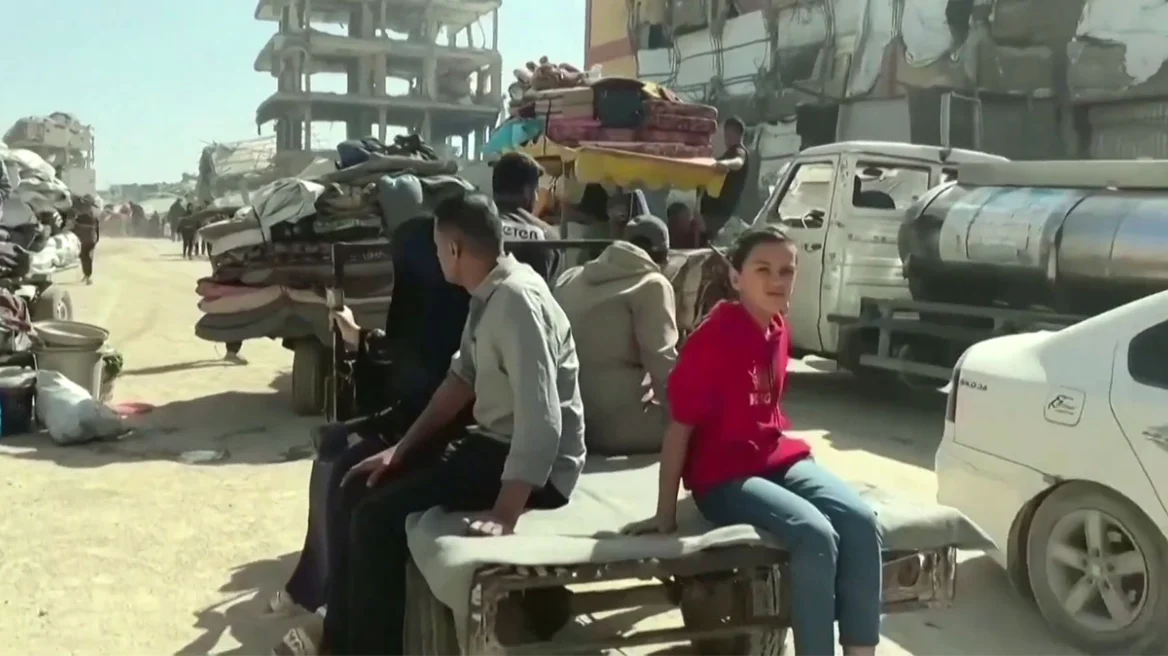
More than two and a half years after the day Gaza once again became ground zero in the Middle East, what remains of the Palestinian enclave is not merely rubble.
It is lives cut in half. Families who never had the chance to say goodbye. Children born into war and forced to grow up before they even learned what childhood means.
This episode of Medusa is not a story about the statistics of war. It is a story about what lies behind them. About the infants who were urgently evacuated from Gaza’s hospitals in 2023 amid bombardment, siege and the collapse of essential infrastructure. About the children who survived because they were moved away from death, but whose survival came at the cost of separation from their parents — including parents who did not survive the war.
In November 2023, images from Al Shifa Hospital traveled around the world. Premature babies, disconnected from their incubators, wrapped in blankets and laid side by side, while doctors and nurses struggled to keep alive whatever could still be saved.
There, war was not depicted through maps, operational analyses or military statements. It was visible on bodies weighing only a few grams. On children whose lives depended on a generator, an oxygen cylinder, or a doctor forced to decide which baby would leave first.
Twenty infants were transferred from Gaza to Egypt at the time in order to survive. They left without suitcases, without farewells, without the embrace every child deserves in moments of fear. Some parents did not know for days whether their child was alive. Others held on only to a name, a photograph, a fragment of information arriving slowly and sporadically through the fog of war.
Some of those children survived. They grew up far from Gaza, far from their parents, far from their first homeland. And now they are returning. One such case is the story of the family reunited with their child after two years, featured in the program Medusa.
Not to the Gaza they left behind, because that Gaza no longer exists. They are returning to a place where life continues, yet often feels unliveable. To a region where survival is a daily negotiation and a constant battle. A battle against hunger, the lack of clean water, shortages of medicine, destroyed hospitals, disease and the exhaustion of those still trying to care for others.
Gaza today is not only a place of military conflict. It is a landscape of humanitarian deterioration unfolding in real time. Children are growing up without normality, without school, without a permanent home, without the certainty that tomorrow morning will resemble the day before. Some were born during the war. Others lost parents, siblings and relatives. Some no longer want to eat or drink. They do not ask for toys. They ask for their siblings back. Their home. Their homeland restored in a form capable of sustaining human life once again.
And yet, as the crisis deepens, the world’s attention is drifting away. Not because the tragedy has ended, but because it has become repetitive. Because images of suffering, when they return every day, cease to shock. Because international public opinion grows weary, political centers calculate and societies become accustomed. Because Gaza, once at the center of global attention, risks becoming a place where horror is regarded as almost routine.
This is perhaps the most difficult question raised by the episode. Not only what happened to Gaza’s children, but why we have allowed ourselves to stop wanting to see what is happening to them.
Medusa returns to Gaza not to show shocking images, but to confront a reality that must not remain unseen. Because behind every number there is a child. Behind every evacuation there is a separation. And behind every rescue that appears miraculous, there is still a war that continues to demand that children pay the heaviest price.
Ask me anything
Explore related questions




