





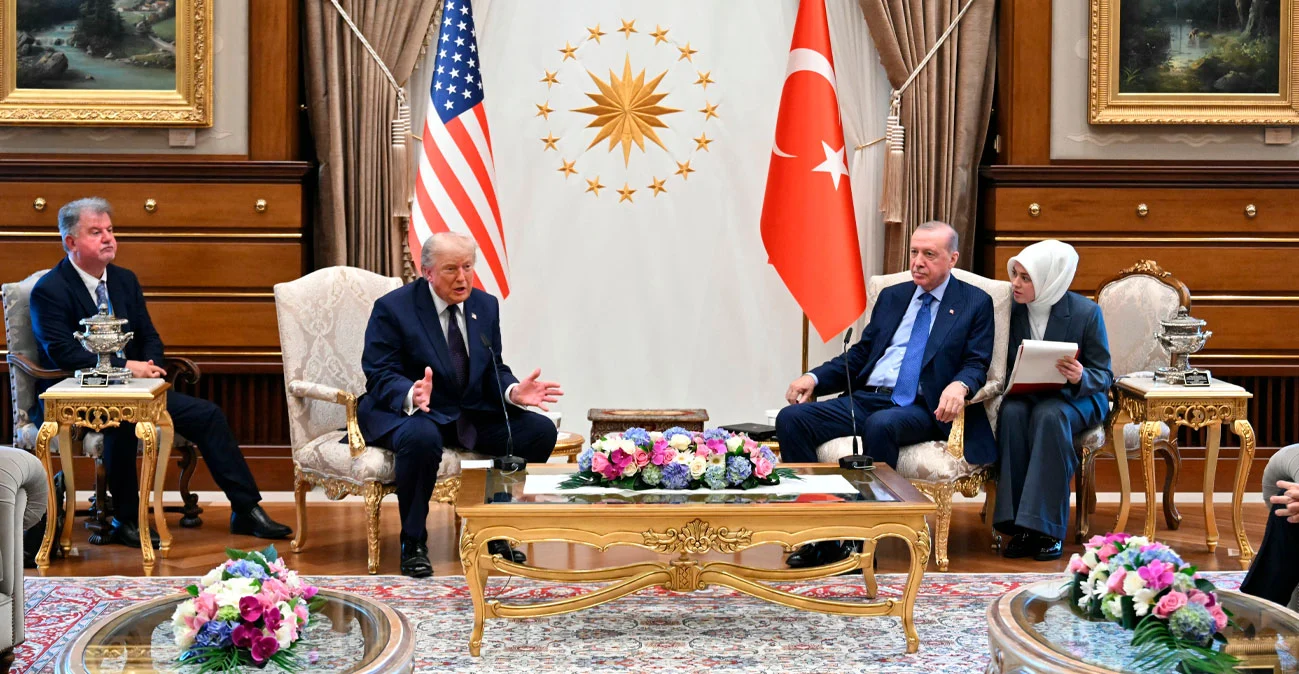
UPDATE: The 36th NATO Summit opened in Ankara in a notably cordial atmosphere, marked by an elaborate welcome ceremony and intense international focus on the long-awaited arrival of US President Donald Trump.
Turkish President Recep Tayyip Erdoğan personally welcomed his US counterpart at Etimesgut Air Base, linking arms with him in a gesture widely seen as a sign of the notably close personal rapport between the two leaders.
Positive signals on CAATSA sanctions and the F-35s
The fifth-generation fighter jet programme was at the centre of the first public remarks, as Donald Trump left open the possibility of Turkey returning to the F-35 programme. “We’ll look at that,” Trump said when asked about the aircraft, while Erdoğan pointedly added: “The United States has promised them to us.” The US president also said Washington was prepared to move towards lifting CAATSA sanctions, a step Ankara regards as essential to reopening the legal path to the F-35s.
Frustration with allies
During their joint remarks, Trump once again made clear his frustration with the position taken by several NATO allies. The US president sharply criticised member states that, in his view, had failed to actively support Washington during the war with Iran. Referring to Giorgia Meloni, he described the Italian prime minister as “a good person” who had made one mistake: not helping Washington against Tehran.
By contrast, Trump praised Turkey as a “loyal ally” that had, he said, risen to the occasion and met its alliance obligations, underscoring Ankara’s upgraded role in the region.
The central issue at the NATO Summit of the 32 leaders will be the implementation of the commitment to raise total defence-related spending to 5% of GDP by 2035, with 3.5% allocated to strictly military expenditure and the remainder to investments strengthening defence and resilience.
According to diplomatic sources, the Alliance wants the Summit to send a message of unity and progress, as several allies have already significantly increased defence spending. Greece is among the countries already meeting the new target, alongside Poland, the Nordic and Baltic states, while other allies have yet to present a credible adjustment plan.
The spending discussion is linked to NATO’s wider transformation and the gradual transfer of greater responsibility for Europe’s conventional defence to European allies and Canada, without calling into question the US commitment to Article 5.
Support for Ukraine will also be high on the agenda. According to the draft declaration already approved by the ambassadors of the 32 member states in Brussels, leaders are expected to pledge €70 billion in military aid for Ukraine in 2026 and to maintain support at at least similar levels in 2027.
The Summit is also expected to focus on strengthening NATO’s defence industrial base, accelerating innovation and ensuring that increased spending is translated more quickly into operational capability. Diplomatic sources say the final Ankara declaration is expected to be brief, reaffirming the allies’ commitment to collective defence under Article 5 and stressing stronger military capabilities, fairer burden-sharing and transatlantic unity.
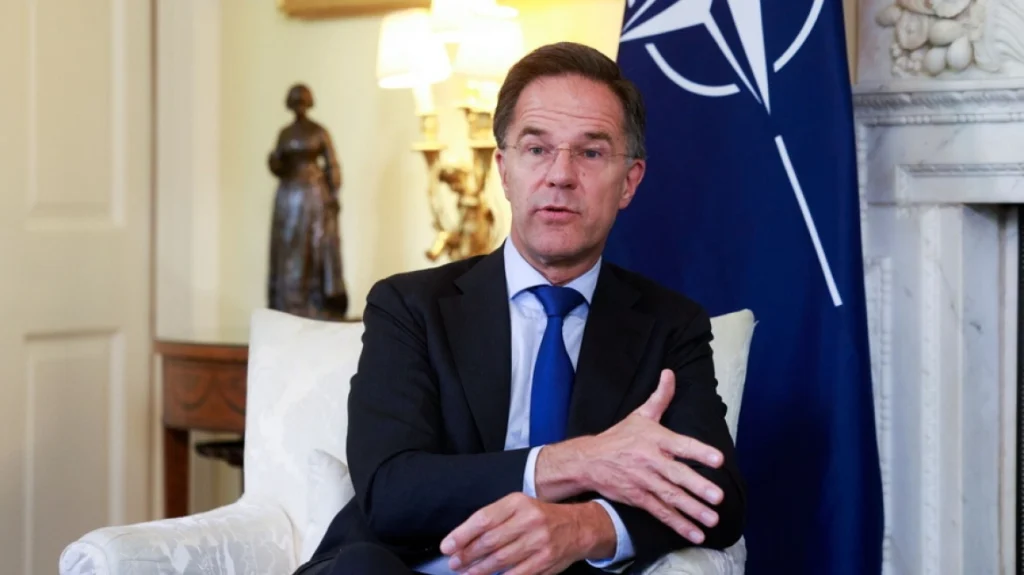
UPDATE: NATO Secretary General Mark Rutte praises Trump over NATO defence spending: “I like this man”
Mark Rutte has praised Donald Trump’s pressure campaign on defence spending, saying the US president had been right to demand that European allies modernise their armed forces and shoulder more of the burden for the Alliance’s security.
Speaking on Politico’s podcast on the sidelines of the NATO Summit in Ankara, Rutte said Trump had succeeded where previous American presidents had struggled for decades.
“I like this man. I believe what he’s doing for NATO is very good news,” Rutte said.
According to the NATO chief, Trump has effectively delivered a long-standing American demand: a more balanced division of defence spending between the United States and Europe.
“President Trump is essentially achieving what US presidents have been trying to achieve since the time of Eisenhower: to balance defence spending between the US and Europe,” Rutte said.
His comments come despite repeated tensions inside the Alliance over Trump’s approach to NATO, from his remarks on Article 5 — the principle of collective defence — to his criticism of European leaders and his administration’s review of the US military presence on the continent.
Rutte said this year’s summit would be “transformative” for NATO, leading to major new investments in defence and military production. Over the past two years, the 31 NATO allies other than the United States have committed to hundreds of billions of dollars in new defence spending and procurement, with further announcements expected in Ankara.
Rutte said European countries and Canada were moving rapidly to increase their military capabilities and take on a larger share of responsibility for the defence of Europe.
“We must build a NATO that is sustainable and not overly dependent on the US — a stronger Europe within a stronger NATO, where Europeans and Canadians truly take on more responsibilities,” he said.
The NATO chief stressed that the rise in defence spending was not only the result of pressure from Trump, but also a response to Russia’s war in Ukraine and the broader security threat facing the Alliance.
“We have to do this because of the threat from Russia, and we see what the Russians are doing in Ukraine,” he said.
Rutte added that NATO’s objective was to protect the one billion citizens of Allied countries not only from Russia, but also from China’s military expansion and from the growing cooperation between Russia, China, North Korea and Iran.
One of the most sensitive issues hanging over the summit is the rift between Washington and some European allies over US military action against Iran.
Trump has expressed frustration that several European governments did not give stronger public backing to the operation. Speaking during a meeting with Rutte at the White House, the US president said: “They let us down. We didn’t need help — we literally destroyed them in the first week — but it would have been nice if they had said, ‘We want to help.’”
Rutte, however, argued that European allies had played an important role, even if not all of that support was visible publicly.
He said the United States “most likely could not have carried out” its operation against Iran without using Europe as a major platform for projecting power. He cited Romania as an example, saying the country had closed its largest commercial airport in order to accommodate US aircraft.
According to Rutte, thousands of aircraft took off from European bases during the operation.
Despite the disagreements, the NATO secretary general insisted that the broader picture was one of unity between the United States and its European allies.
“The president is right that there are isolated cases in which he is justifiably disappointed,” Rutte said. “However, if we look at the big picture of what the Europeans are doing, it is enormous.”
UPDATE: Trump arrives in Ankara for NATO summit as Erdoğan greets him at airport
#Canlı: Cumhurbaşkanı Erdoğan, NATO Ankara Zirvesi öncesi Türkiye'ye resmi ziyaret gerçekleştiren ABD Başkanı Trump'ı, Cumhurbaşkanlığı Külliyesi'nde resmi törenle karşılıyor https://t.co/ADJvJ1xrZc
— AA Canlı (@AACanli) July 7, 2026
The US president was welcomed by his Turkish counterpart before heading into a summit expected to focus on defence spending, Ukraine and NATO’s shifting balance under Trump.
Donald Trump arrived in Ankara on Tuesday for the NATO summit, landing at the Turkish capital’s airport aboard Air Force One, where he was welcomed by Turkish President Recep Tayyip Erdoğan.
The two leaders shook hands on the tarmac, with Trump placing a hand on Erdoğan’s shoulder as they posed for photographs under the strong sun. Erdoğan, wearing sunglasses, was then seen lightly taking Trump by the hands before the two men walked together along the ceremonial carpet and inspected Turkish troops.
At moments, Erdoğan appeared to guide Trump discreetly by the arm as they made their way through the formal welcome. According to the Associated Press, neither leader made remarks to reporters during the arrival ceremony.
Cumhurbaşkanı Erdoğan ile ABD Başkanı Trump görüşmesinden kareler.#NATOsummit https://t.co/4CxpGguegS pic.twitter.com/Mr2xiEjQiH
— TRT HABER (@trthaber) July 7, 2026
Trump, however, could be heard speaking briefly to Erdoğan about the aircraft he had used for the journey, a Qatar-gifted plane now being used as Air Force One.
“This is the first flight of this plane,” Trump appeared to say, adding: “For the first time.”
“Yes, yes, I know. I heard,” Erdoğan replied.
“It is brand new now,” Trump said.
A translator then explained to Erdoğan that the aircraft was “being used as the first plane, because it was given as a gift.”
“It came from Qatar,” the Turkish president said.
The translator relayed to Trump: “From Qatar, as a gift.”
“Yes, yes,” Trump replied. He then appeared to mention “$800 million” and added: “Brand new.”
During the ceremony, Trump also greeted members of Turkey’s presidential ceremonial guard in Turkish, saying: “Merhaba asker” — “Hello, soldiers.”
UPDATE: The ‘16 Turkish empires’ guard welcomes Trump at Erdoğan’s presidential palace
A highly symbolic welcome also awaited Trump at the Presidential Palace in Ankara, where members of the honour guard appeared in ceremonial costumes representing what Turkey refers to as the “16 Turkish empires” of history.
The uniforms, now a regular feature of official Turkish presidential ceremonies, are intended by Ankara to symbolise the continuity of Turkish statehood, from ancient Turkic entities through the Ottoman Empire and into the modern Turkish Republic.
UPDATE: Trump to meet Erdoğan, Zelenskyy and al-Sharaa on summit sidelines
Trump’s first bilateral meeting in Ankara was expected to be with Erdoğan, the host of the summit.
During his stay in Turkey, the US president is also expected to meet Ukrainian President Volodymyr Zelenskyy and Syrian President Ahmad al-Sharaa on the sidelines of the NATO gathering.
A senior US official, briefing reporters on condition of anonymity, said Trump would meet Zelenskyy on Wednesday to discuss “how we can end the war.”
“The battlefield has clearly been frozen over the last couple of months, and neither side is making significant progress,” the official said. “The president feels a real sense of urgency to try to bring this to an end.”
Trump is also expected to press NATO allies to increase their defence spending. “He will deliver that message in person,” the official added.
UPDATE: Rutte says Europe is a stronger partner for the US than five years ago
NATO Secretary General Mark Rutte said Europe is a stronger partner for the United States than it was five years ago, pointing to what he described as progress by the Alliance in reducing its defence dependence on Washington.
“We cannot continue, as we have until now, to depend too heavily on the United States,” Rutte said during talks between NATO and the EU with European Commission President Ursula von der Leyen in Turkey. “We need a much stronger Europe and a stronger NATO.”
Rutte said NATO’s priority is to expand its defence industrial base across Europe, Canada and the United States, adding that Europe has already increased production lines in recently opened factories.
“What we are seeing right now is a transformation unprecedented since the end of the Cold War, with Europe taking on much greater responsibility for NATO,” he said.
Rutte described it as a transformed NATO, in which the United States has a much stronger partner in Europe than five years ago, making the Alliance as a whole stronger.
UPDATE: Turkey accuses ‘Netanyahu and his accomplices’ of disinformation over F-35s
Turkey rejected as “disinformation” Israel’s claim that a possible US sale of F-35 fighter jets and related components to Ankara would upset the balance of power in the region.
“The baseless accusations recently circulated by Israeli officials in a coordinated manner and with calculated timing are part of a disinformation campaign,” the Turkish Foreign Ministry said.
“Netanyahu and his accomplices deliberately distort every criticism directed at them and seek to distract attention through a systematic propaganda effort,” the ministry added.
UPDATE: Fidan says restrictions on SAFE cooperation undermine NATO collective defence
Turkish Foreign Minister Hakan Fidan raised Ankara’s objections to the barriers Turkey says Greece is placing on its participation in the SAFE programme, ahead of the NATO Summit and Donald Trump’s arrival in Ankara.
Fidan said restrictions on cooperation undermine the effectiveness of NATO’s collective defence, underlining Turkey’s concerns over its exclusion from aspects of the programme.
UPDATE: Macron stops in Damascus before Ankara and meets Syrian President Ahmad al-Sharaa
French President Emmanuel Macron visited Damascus before travelling to Ankara, meeting Syrian President Ahmad al-Sharaa and saying France is ready to help rebuild Syria’s economy and banking sector.
Speaking alongside al-Sharaa after talks at the presidential palace, Macron said France is a “reliable and stable partner” for Syria and has always supported the interests of the Syrian people. He said Paris wants to continue working on the reconstruction of the banking sector and is assisting Syria’s central bank.
Al-Sharaa said he wants France to become Syria’s “first partner” as the country seeks to regain its role as a crossroads for global routes following the closure of the Strait of Hormuz. Opening an economic forum with Macron in Damascus, he said the crisis had highlighted the importance of Syria’s geographic position.
View on X
President Ahmad al-Sharaa welcomes French President Emmanuel Macron at the People's Palace in Damascus.#Ahmad_AlSharaa#Emmanuel_Macron#Damascushttps://t.co/WnU3JBU1si pic.twitter.com/Yj9qyASXcA
— SANA English (@SANAEnOfficial) July 7, 2026
UPDATE: Zelensky says no other country can defend against drone attacks like Ukraine
Ukrainian President Volodymyr Zelensky told the NATO Summit that drones and remote warfare technology represent “a revolutionary change” in the technology of war.
Zelensky at NATO Summit in Ankara:
— Clash Report (@clashreport) July 7, 2026
Europe needs its own effective anti-ballistic systems and missiles, and this work is already underway.
I urge all of you and all our partners to give it the attention it deserves.
And this cannot wait until 2030 or beyond. Europe needs… pic.twitter.com/gR6tkXxoAH
He said almost 28,000 Russian soldiers were killed by Ukraine in June, with the “overwhelming majority” hit by drones, adding: “Frankly, we are not proud of this.”
Zelensky also said Ukraine has raised its interception rate of Russian drones to more than 90%. “With all due respect, no other country has the ability to defend against attack drones on this scale,” he said, adding that Ukraine now defends itself against hundreds of drone attacks every day and every night.
Italy-US relations UPDATE
Italian Foreign Minister Antonio Tajani said Rome will no longer respond to Donald Trump’s online provocations, after the US president posted on Truth Social over a photo of Italian Prime Minister Giorgia Meloni that “restrictive measures are needed.” Speaking to La Stampa, Tajani said Trump “loves challenges, especially online,” but stressed that Italy will not fuel disputes between allies. He added that transatlantic relations, Western unity and cooperation with Washington remain more important than any single post, noting that his dialogue with US Secretary of State Marco Rubio has “never stopped.”
Trump-Erdoğan NATO Summit UPDATE
Ahead of Donald Trump’s arrival in Ankara for the NATO Summit and his meeting with Turkish President Recep Tayyip Erdoğan, Hürriyet framed the visit as a test of whether Turkey-US relations could move towards a new security understanding. The paper noted that Trump’s promised “gift” to Erdoğan has fuelled speculation over possible movement on Turkey’s return to the F-35 programme, F-16 modernisation or engine sales for Turkey’s KAAN fighter jet. It also stressed that the central obstacle remains the CAATSA sanctions triggered by Turkey’s purchase of Russian S-400 systems, with any lasting solution likely to require approval from the US Congress.
Turkey F-35 programme UPDATE
The New York Times reported that Trump is expected to tell Erdoğan he is willing to bring Turkey back into the F-35 programme, provided the dispute over Ankara’s Russian S-400 missile systems can be resolved. Citing senior US officials, the newspaper said talks have been under way for weeks, though it remains unclear how Trump could overcome legal and congressional barriers. Possible options reportedly include transferring the S-400s to a third country or rendering them inactive by removing key components. The report also noted that Congress may resist such a move, while Israeli Prime Minister Benjamin Netanyahu has long opposed the sale of F-35s to Turkey, citing Ankara’s stance towards Israel, Cyprus and Greece.
Turkey is “pulling out all the stops” UPDATE
Turkey is “pulling out all the stops” in an effort to capitalize on the current circumstances surrounding today’s and tomorrow’s NATO Summit in Ankara, attended by U.S. President Donald Trump, in order to secure the removal of obstacles to the full normalization of U.S.-Turkish relations and, at the same time, guarantee its unconditional participation in the major European defence initiative.
Recent reports in the past hours — both regarding Donald Trump’s intention to renew commitments for Turkey’s return to the F-35 programme and France’s reported willingness to unblock the sale of the French-Italian-made SAMP/T missile system to Turkey — have encouraged not only the Turkish media but also senior figures within the Turkish government.
The U.S. president arrives in Ankara, where he will meet with Recep Tayyip Erdogan at the Beştepe presidential complex, having already taken care to send positive signals before his arrival.
Trump stated shortly before his departure that the only reason he is attending the summit is because Recep Tayyip Erdogan is hosting it. Just days earlier, he also promoted the agreement for the sale of 80 F110 engines, which are necessary for advancing the most ambitious project of Turkey’s defence industry: the construction of the Turkish fifth-generation fighter jet KAAN.
Reports from several international media outlets regarding a possible French change of position on the SAMP/T system are nevertheless particularly significant. If the sale of the system to Turkey is confirmed, it could potentially eliminate the need for Turkey to retain the S-400s in its arsenal.
Such a move could pave the way for lifting U.S. sanctions and allowing Turkey’s return to the F-35 programme.
Of course, Donald Trump would have to overcome not only opposition from Greek and Armenian lobbying groups in the United States, but above all resistance from Israel, which — through a statement by Prime Minister Benjamin Netanyahu himself — warned that Turkey acquiring F-35s would constitute a security threat and could upset the balance of power across the region.
Speaking at a forum earlier in the morning, shortly before the start of the NATO Summit, Turkish Foreign Minister Hakan Fidan said, among other things:
“A stronger European contribution is necessary, but restrictions on defence industry cooperation undermine efficiency and delay responses. These restrictions have turned into strategic burdens. European defence initiatives must remain fully inclusive for all NATO allies.”
At a parallel forum, Turkey’s Defence Minister Yaşar Güler also stressed that:
“Excluding Turkey, a leading member of the international security architecture thanks to its military strength, defence industry and geographical position, does not make Europe safer.”
Turkey’s European Defence Ambition
For Turkey, the other major objective is to use the NATO Summit — where a parallel event showcasing the achievements of the Turkish defence industry is also taking place — as an opportunity to open the door for its institutional participation, without conditions or restrictions, in the European defence initiative and Europe’s rearmament efforts.
This is important not only because it would provide a significant source of funding for the Turkish defence industry, but also for political reasons, as Ankara hopes it could create the framework for a special relationship with the European Union.
Such a relationship would see Turkey, without fully aligning itself with the EU’s strategic objectives, operate as a provider of security and defence equipment. In return, Ankara hopes to obtain from Brussels what it has so far failed to achieve, due both to political disputes in its relations with the Union and to Turkey’s casus belli against Greece and the continued occupation of Cyprus.
Among Turkey’s objectives are:
- the modernization of the EU–Turkey Customs Union,
- the abolition of visa requirements for Turkish citizens, and
- Turkey’s inclusion in the European payments system SEPA (Single Euro Payments Area).
Ask me anything
Explore related questions




