





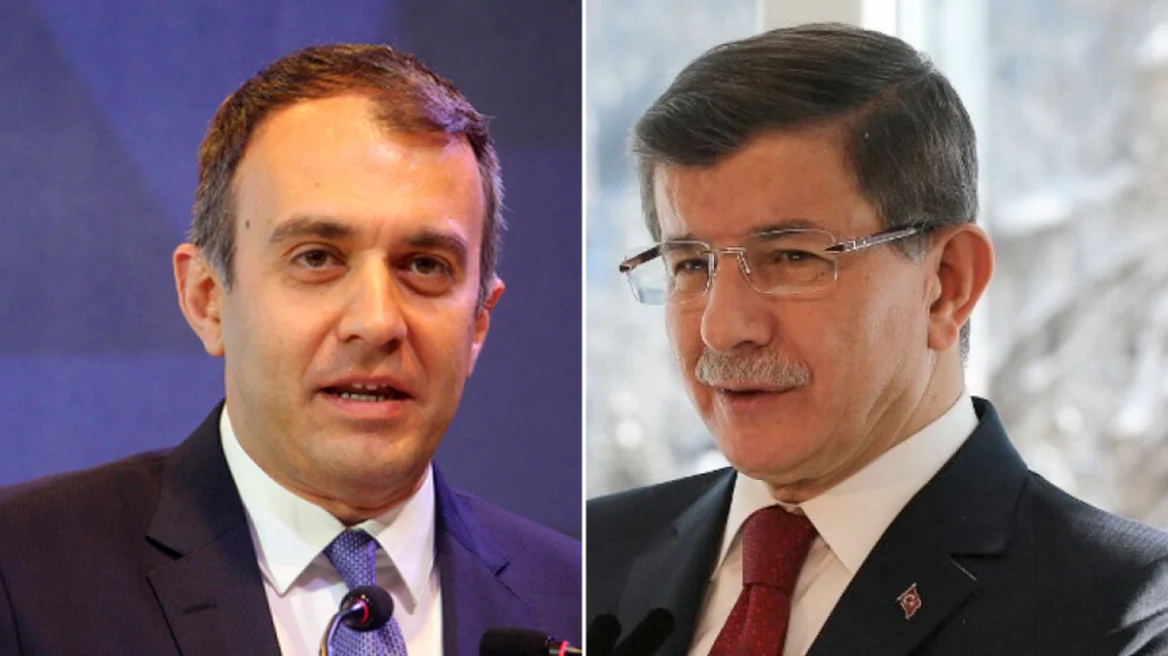
“There has been an invasion since 1974. You must accept reality,” Deputy Foreign Minister Tasos Hatzivassiliou told former Turkish Prime Minister Ahmet Davutoglu during the panel “Europe’s Next Vital Steps Between Geopolitics, EU Ambitions and EU Accession” at the 30th annual Economist Government Roundtable in Lagonisi.
The exchange occurred after Mr. Davutoglu argued that Turkey’s presence in Cyprus derives from international law. Mr. Hatzivassiliou politely interrupted him, pointing out that “this has been an invasion since 1974.”
During the discussion, Ahmet Davutoglu also sought to place responsibility for the Cyprus deadlock on the Greek Cypriot side, arguing that the Greek Cypriots’ rejection of the Annan Plan in 2004 was the root cause of the impasse. He also criticized Brussels, saying that the European Union should not have admitted Cyprus as a member while the issue remained unresolved.
Despite efforts by the moderator, Joan Hoey, Europe consultant at the Economist Intelligence Unit (EIU), to restore order to the discussion, Mr. Davutoglu intervened again, repeating that “Turkey’s presence in Cyprus is based on international law, unlike Russia’s.” The Greek Deputy Foreign Minister responded by clearly reiterating Greece’s position, emphasizing that Turkey carried out an illegal invasion of Cyprus and that this is the reality. His remarks were met with applause from the audience.
Earlier in the discussion, when asked about the issue, Mr. Hatzivassiliou had outlined Greece’s position, stressing, among other things, that one cannot ignore Turkey’s casus belli declaration, nor the invasion and the continuing occupation of the territory of a European Union member state.
He also defended the EU’s enlargement policy, recalling Foreign Minister Giorgos Gerapetritis’ statement that Greece’s goal during its Presidency of the Council of the European Union would be the accession of at least one new member state, provided the relevant criteria are met.
“Greece is here to help candidate countries on their European path,” he said, adding that Athens consistently wants a European-oriented Turkey, noting that Ankara renewed its interest in joining the European family in 2023.
@protothema.gr ‼️ Επεισόδιο Χατζηβασιλείου με Νταβούτογλου στο Λαγονήσι: Στην Κύπρο έγινε εισβολή το 1974, η Τουρκία να αποδεχθεί την πραγματικότητα! #protothema #news #greektiktok #tiktokgreece ♬ πρωτότυπος ήχος – protothema.gr
Diamantopoulou: European Principles Are Not Applied À la Carte
In her own intervention, Anna Diamantopoulou stated:
Europe is not merely a geopolitical power. Its true strength lies in its principles: democracy, human rights, the rule of law, and social cohesion.
She continued:
The Copenhagen criteria are not bureaucratic formalities. They are the political and value-based foundation of the European Union. Anyone who wishes to become a member is not simply expected to accept them—they are expected to genuinely believe in them. And these principles are not applied à la carte. Europe cannot rightly condemn the Russian occupation of the territory of a candidate country, Ukraine, while at the same time overlooking the fact that another candidate country, Turkey, occupies the territory of a member state of the European Union, Cyprus. This is not an issue that disappears simply because it is inconvenient. It is a matter of consistency, credibility, and the very identity of Europe.
Ask me anything
Explore related questions




