





Concern has been raised by a report from an Iranian media outlet that extensively lists major energy infrastructure projects serving Europe, with particular reference to Greece and Cyprus. The article suggests that, if tensions continue to escalate, some of these projects could find themselves in Tehran’s “target pool.”
The report claims that a recent attack by Ukrainian forces on an Iran-linked vessel in the Caspian Sea has altered the situation and, in its view, turned European energy interests into a “legitimate target” for Iran. At the same time, it portrays Ukraine as a “proxy force” of the European Union and NATO, implying that European support for Kyiv could provoke Iranian retaliation.
The Iranian outlet notes that following the U.S. attack on Iran, energy costs for the European Union rose significantly, while stressing that “all eyes are now focused” on the energy routes supplying Europe. In this context, it states that although detailed information is not available for all projects, “one possibility is that these lines are included in Iran’s target pool.”
Greece and Cyprus in the Spotlight
Particular reference is made to the energy infrastructure of Greece and Cyprus, which is presented as a critical component in Europe’s efforts to diversify its energy supply.
Among the projects named are:
- the EastMed pipeline, which is planned to connect Eastern Mediterranean gas reserves through Cyprus and Crete with mainland Greece and subsequently Italy;
- the Southern Gas Corridor, through which Azerbaijani natural gas is transported to Europe, passing through Greece;
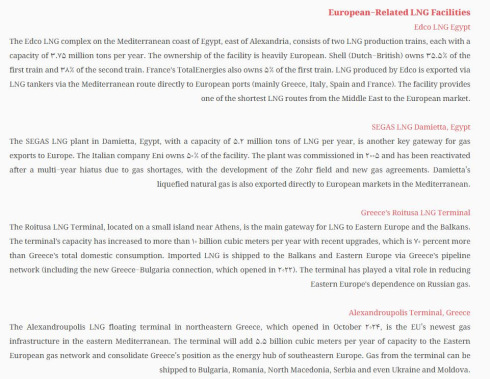
- the Revithoussa LNG terminal, described as a key entry point for liquefied natural gas serving the Balkans and Eastern Europe;
- the Alexandroupolis floating LNG terminal, which, according to the report, strengthens Greece’s role as an energy hub for Southeastern Europe;
- and the Cronos gas field in Cyprus’ Exclusive Economic Zone, being developed by TotalEnergies and Eni and expected to supply the European gas market through Egypt.
Investments Worth Tens of Billions of Euros
The report highlights that Europe has developed an extensive energy infrastructure network stretching from Turkmenistan to Italy and from Oman to Greece. This network includes 15 operational or under-construction pipelines, eight oil and gas fields, four LNG facilities and six major green hydrogen projects.
It also names major European energy companies such as BP, Shell, TotalEnergies, Eni, ENGIE, EDF, DEME, Snam, Fluxys, Enagas and MOL, noting that their investments—worth tens of billions of dollars—form a key pillar of the European Union’s energy security.
It should be stressed, however, that the report represents an analysis and assessment by an Iranian media outlet and does not contain any official statement or announcement by Iranian authorities declaring that these specific energy facilities are approved military targets.
Nevertheless, it contains clear implications that, as part of possible retaliation against Western support for Ukraine and the United States, European energy routes—including projects in Greece and Cyprus—could become a focus of Iranian strategy.
It is also noted that Farhikhtegan is a daily Iranian newspaper owned by Islamic Azad University, a major university network with close ties to Iran’s establishment.
Ask me anything
Explore related questions




