





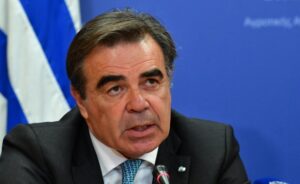
The minister announced that a new payment system for agricultural subsidies will be launched in July, based on pre-filled data, automated cross-checks and the use of public registries.
Agricultural Development and Food Minister Margaritis Schoinas delivered a dual message to Greek farmers and to those who have exploited long-standing weaknesses in the agricultural subsidy system during his appearance before the Parliamentary Cross-Party Committee.
On the one hand, he announced that Greece has secured more than €61 million to support farmers facing the rising cost of fertilisers, while on the other he issued his strongest warning yet against illegal subsidy claims and the cases currently under investigation.
“Tolerance is over. The opportunists are over. The crooks are over. And this was put into practice by this government, despite those who predicted that we would fail,” Schoinas said, referring to around 2,900 cases currently being investigated, involving estimated losses of approximately €69 million, as well as the 1,151 cases where prosecutions have already been initiated.
At the same time, the minister announced that Greece will be among the seven largest beneficiaries of European funding, securing around €21 million in EU funds, which will be supplemented by approximately €40 million from national resources.
“No one gives resources away in Brussels. You have to claim them, justify them and win them. And Greece is once again starting to do this successfully,” he said, linking the outcome to the country’s negotiating presence within the European Union.
A significant part of his speech focused on reforming the agricultural subsidy payment system. Schoinas argued that Greece is entering a new era, stating that “Greece has proven that it can pay more because it now pays correctly. That is the real political message.”
He explained that it is no longer enough for large sums of money to be distributed; they must reach genuine producers. “It is not enough to pay a lot. What matters is paying correctly, so that support reaches those who actually produce,” he said, noting that with roughly the same European resources, more genuine farmers received higher payments.
He also announced that the new OSDE (Integrated Administration and Control System) will open in July with a completely different approach, based on pre-completed information, automatic data verification and the use of public databases.
“Our goal is for an honest farmer not to have to prove every year that they are honest. The system itself should prove it,” he said, outlining the new model for agricultural support payments.
Schoinas also sought to broaden the discussion towards the future of Greek agriculture, linking current measures with negotiations for the new Common Agricultural Policy (CAP) for 2028–2034.
“We are not going to Brussels simply to safeguard what we already have. We are going there to shape the agricultural production we want to have,” he said, calling for a CAP with strong funding but also greater flexibility for member states.
Concluding his remarks, Margaritis Schoinas argued that Greece is experiencing a historic “alignment of circumstances” that could transform the primary sector.
“Greece now needs a new national contract with Greek production. A plan that looks towards 2035 and not towards the next elections,” he said, expressing the view that the current period could become a turning point for the restructuring of the Greek agricultural economy.
Ask me anything
Explore related questions




